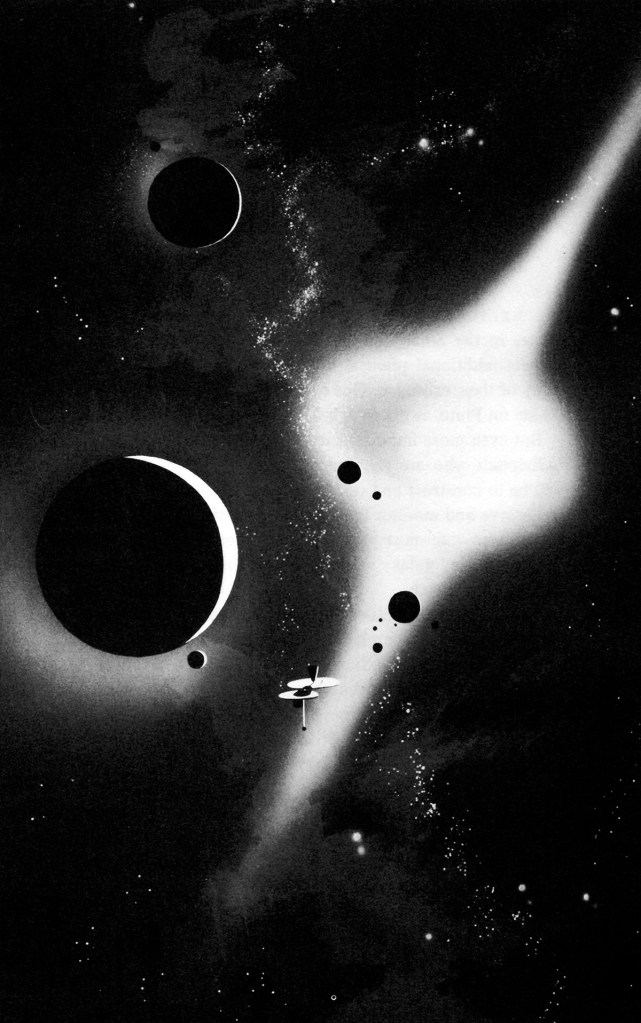
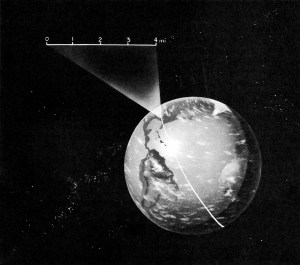
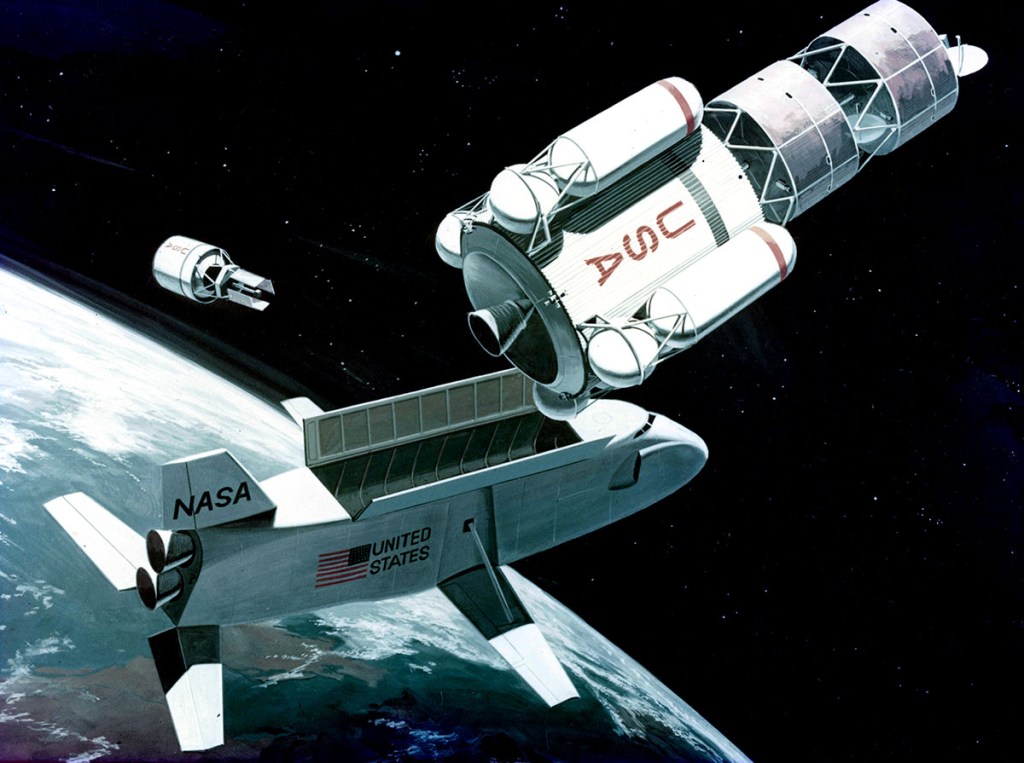
6,250 times as great as the distance from Earth to Pluto. To make such astronomical differences comprehensible we can say that the difference between these two distances is like the difference between the circumference of Earth (25,000 miles) and 4 miles.
Conquering the Sun’s Empire Frederick I. Ordway, III and Ronald C. Wakeford
The problem with septuagenarians, octogenarians, and nonagenarians is that they don’t really ‘do’ social media. I guess the reason is, at that point in one’s life, your brand is pretty much established and perhaps there are better things to do with one’s time.
Fair.
But that’s also the first hurdle I faced on the piece I wrote about Alvarez. I did some research, but it’s such a common name in Southern California that looking for a M. Alvarez in Downey California yielded hundreds of results on social media, and none of them were the right person. I hoped that maybe, just maybe, the article would fire up a synapse or two in a stranger. It worked out well for the Sentovic piece, right?
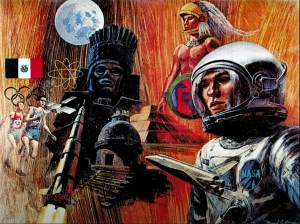
Anyway, a couple of days after I published the article, I got an email from Mike. The story had stirred a synapse, and he remembered an article he’d read written by Apollo engineer Anthony Vidana called “I Remember Bldg. 290.” In the article, the author recalls a career at North American Aviation, presenting a fascinating memoir that includes a story about him and others trying to push NASA towards hiring a Mexican American astronaut. As part of the campaign, he’d used some of his clout at Rockwell to get a company artist to create a painting.
Anthony recalls, “I envisioned an astronaut and an Aztec with similar head gear and an Aztec pyramid, observatory, moon and statue in the background. The artist, Alvarez, added the Space Shuttle and the Mexican Olympics as an added touch.”
Alvarez!
The article includes a thumbnail of the painting – subsequently gifted to the President of Mexico – and it’s gorgeous but low resolution, and the signature is pretty much cropped out, but it’s there and it’s by Alvarez for sure. I can make out an M and maybe an L. Mike emails me, “At the risk of stereotyping, could it be Miguel or Manuel?” It could, but perhaps we’re reaching? Look at it long enough and we’ll start to see what we want to see.
I reached out to Anthony Vidana, who has a social media presence. Sadly no success.
In the meantime Mike kept digging and found another clue, a Directory of Spanish Surnamed and Native Americans in Science and Engineering, published in 1978 by San Diego City Schools. One of the entries is a Manuel Alvarez working at North American Rockwell.
1. Jake I. Al4irjd (b. New Mexico) /North American Rockwell 2. Humberto F. Alcantar (b. California), North American Rockwell, NASA Space Division 3. Manuel E. Alvarez (b. California), North American Rockwell
And there’s more – and I’d completely missed this while trying to track down Mr. Vidana – Anthony has a YouTube channel, where he shared a delightful video in 2020. The clip retells the story of The Mexican Astronaut, and mentions the artist again, this time using his full name.
Manuel E. Alvarez.
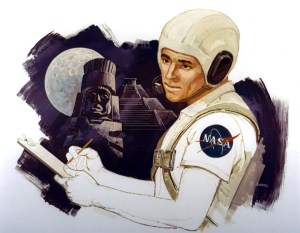
Above: A screengrab from Anthony’s video. Enlarged, the signature is pretty clear. Below: An early study for the painting, the astronaut is clearly modelled on a yet-to-be-born Ryan Reynolds.
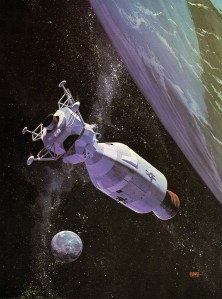
Below: Last but not least, and also grabbed from the video.
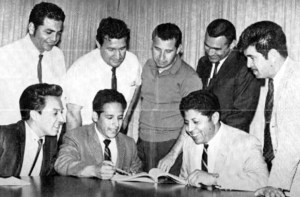
MOTIVATION OCCUPATION – Space Division and Autonetics employees comprise the board of directors for the Youth Incentive Through Motivation organization combating the school “drop out” problem. Planning activities are, seated, Fred Rodriguez, Robert Arabelo, Autonetics; Manny Alvarez, Space; standing, Hank Martinez, Phil Padilla, Jake Alarid, Joe Gomez, Ted Garcia, Space.
If by any chance you’re Manuel Alvarez and you’re reading this, or perhaps he’s your dad, or an uncle, or your grandpa; please reach out to me. I’d love to talk to you, and I know there are a lot of people who’d love to know more about you and your career.
If you have a minute, take a look at Anthony’s channel and y’know, ‘smash the like button’. Hopefully he’ll be encouraged to release more videos.
Mike, thanks again, you’re a legend!
Image credit: North American Rockwell Image source: Anthony Vidana
I recently sat down with concept artist Robert Watts, for coffee and a chat about his career and by that, I mean Robert graciously agreed to be interviewed by email and took time out of his schedule to answer my questions. It’s entirely possible one of us was drinking coffee whilst typing.
Robert was Lead Illustrator at Ryan Aeronautical during a very interesting time in the company’s history. His former clients include NASA, American Airlines, General Dynamics and the United States Navy. Robert was a Navy Combat Artist during Vietnam, has served as President of the Society of Illustrators of San Diego, and to this day is a highly sought-after architectural illustrator. He is a signature member of the Laguna Plein Air Painters Association and teaches at the school founded by son Jeffery.
He is also an utterly charming man.
Did art run in the family?
My mother and paternal grandfather did some art, but I really did little serious drawing or painting before college. I started out in graphic design at Pratt Institute and later decided to pursue illustration at The Art Center School in L.A.
Two very prodigious schools. Was concept art always the goal or were you leaning towards a fine art career?
I had always been obsessed with aviation, but I didn’t realize there were aerospace opportunities till Joe Henniger (Art Center – Illustration Head) asked if I would be interested in a job at Ryan Aeronautical (later Teledyne Ryan) in San Diego… I said yes!
Wow, so straight to Ryan from college?
First big job, though I did some freelance work in L.A. before starting.
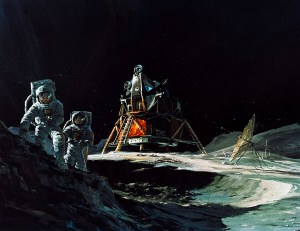
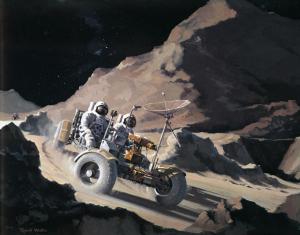
Your Apollo artwork is extremely detailed. Did you have access to the flight hardware?
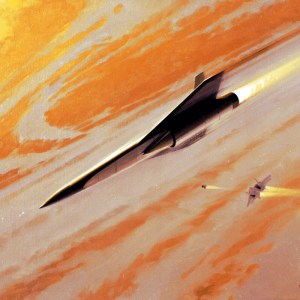
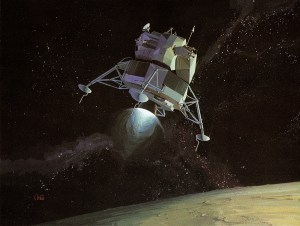
They were obviously all done while at Ryan, and they of course had models and engineering drawings of everything. Ryan Electronics built the Doppler radar landing unit, which was the final vital piece in any landing. My job was to simply attempt a believable depiction of these events. We did work on Skylab during the same period.
How much autonomy were you given?
I had tremendous control over all my work at Ryan. They would simply explain what their intent was and what we should emphasize After leaving Ryan I worked in advertising and had some art direction there. I also did about 3000 architectural renderings after that and my ability to read plans was very useful. I have always been able to conceive an image in my mind before starting… and that was crucial. I’ve been all over the map in illustration!
Did any of your Apollo era artwork make it home with you?
No… but they were decent pieces so I’m confident someone has them. Piers [Bizony] was kind enough to send me some hi-rez copies! *
Comic book artists love to namecheck Frank Frazetta as an influence. Who inspired you?
I was one of the first to see Franks’ work and continue to be spellbound by anything he did. In aerospace: Robert McCall, Jack Leynnwood. John Steel, R.G. Smith and Chesley Bonestell. In general illustration: Rockwell, Mead Schaeffer, Bernie Fuchs, Dean Cornwell, Bob Peak, John Harris (scifi) David Grove and Drew Struzan… many others too numerous to mention!
You jump effortlessly between media, if you had to paint or draw in one medium for the rest of your career what would it be?
Gouache… it was a medium of emphasis at Art Center and aerospace. I teach it and use it a lot… often on a heavily gesso’d surface for a more textured and painterly feel. I often do the underpainting with casein as well.
Do you still love to paint, or is it just a job now?
It is my life passion… never tire! I teach all manner of illustration topics at my son Jeff’s school: Watts Atelier of the Arts in Encinitas California. I also still do all conceptual work for the world-wide San Diego Zoo Wildlife Alliance. I also sell all types of paintings at my gallery website.
Would you ever consider a commemorative work relating to the Apollo Program, or has that ship sailed for you?
I always consider everything, it is a subject that is iconic for America, so who knows?
Your signature is present on nearly all of the work from your time at Ryan. Was this contractually stipulated or Ryan’s policy?
The subject never arose.
I love that you’re involved with the atelier. Is there anything you’d like people to know about it?
There are streaming classes of mine and others at the school available at very reasonable fees.