The Round-The-Moon Ship

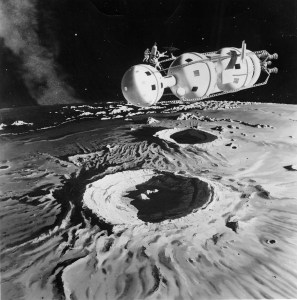
The first trip to our moon will be without landing, in a ship designed to travel in space only, taking off near the Space Station and returning to it. Here the round-the-moon ship is some 240,000 miles from earth, 50 miles above the lunar surface. The large crater is Aristillus (diameter 35 miles); the other crater is Autolycus; the distant mountains are the lunar Apennines.

Man will Conquer Space Soon
Collier’s, March 22, 1953

Image credit: Collier’s
Image source: Mike Acs

Emergency!

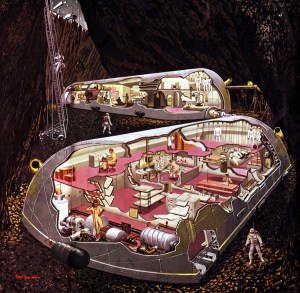
  1. Inbound from space, a fast moving rocket ship noses down toward the earth, its crew alert – as always – for signs of danger. Disaster wont’ occur often on space, but rocketeers will be prepared: most of the paraphernalia shown in the cutaway sections of artist Fred Freeman’s picture is emergency equipment. To see how it is used, turn to Emergency!
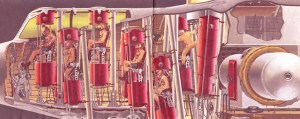
  2. In emergency (as when broken porthole lets cabin pressure escape, as pictured), crew and passengers press buttons on chair arms; contour seats straighten automatically, capsules clap shut, seal. Capsules are connected to cabin pressure system, also have own pressure for bail-out. To abandon ship, men push another button. Capsules, guided by rails, are ejected by powder charge, drop safely into ocean with men inside. When possible, men will remain in ship, operating controls from within capsules, until they are close enough to earth to land normally.
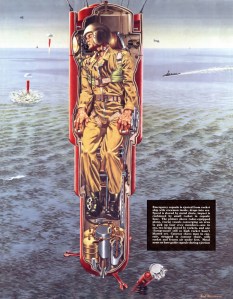
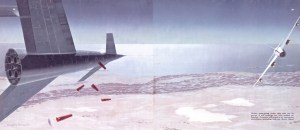
  3. Emergency capsule is ejected from rocket ship with crewman inside, drops into sea. Speed is slowed by metal chute, impact is cushioned by small rocket in capsule base. The picture shows radar-equipped plane, rescue vessels converging on area to pick up crew members, two being slowed by rockets, and one (foreground) still so high rocket hasn’t blasted yet. Cutaway shows man in capsule, strapped to contour chair, with rocket and frozen under feet. Metal arms on base guide capsule during ejection.

How Man will Meet Emergency in Space Travel
Collier’s, March 14, 1953

Image credit: Collier’s
Image source: AIAA Houston

Emergency in Space Travel

Before space-going rocket tries out its power, it will undergo tow tests behind jet bomber. Crew will board it, try emergency procedures–including bail-out, shown above.

How Man will Meet Emergency in Space Travel
Collier’s, March 14, 1953

Image credit: Collier’s
Image source: AIAA Houston

Dewy Bay and Home

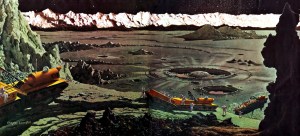
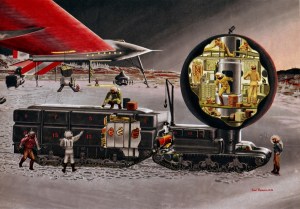
  1. At end of two-week-long lunar day, convoy of tractors, each pulling two of its three trailers moves cautiously across rough terrain near plain of Sinus Roria (Dewy Bay). Glare of mountain range to north is caused by setting sun. Remainder of scene is illuminated by greenish earth light.
  2. Seen from abandoned cargo ship with “full earth” shining i sky, passenger ships take off for return trip from moon to space station’s orbit.

More about Man on the Moon
Collier’s, October 25, 1952

Image credit: Collier’s
Image source: AIAA Houston
Can We Get to MARS?

  1. Cutaway of plane in the foreground shows personnel, tractors in ship.
  2. Advance party, after landing on Martian snow in ski-equipped plane, prepares for trip to equator. Men live in inflatable, pressurized spheres mounted on tractors, enter and leave through air locks in the central column. Sphere on tractor is just being blown up. Cutaway of tractor, foreground, shows closed-circuit engine, run by hydrogen peroxide, oil. Trailer cutaway shows fuel supply, cargo.

Is there Life on Mars?
Collier’s, April 30, 1954

Image credit: Collier’s
Image source: AIAA Houston
620 Miles Above Mars

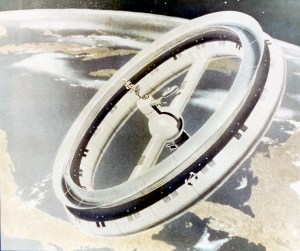
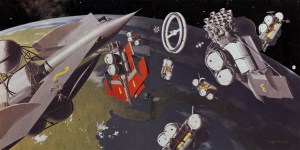
  1. Near wheel-shaped space station 1,000 miles from the earth, built especially for assembly of the Mars expedition, weightless workers put together 10 rocket ships required for the flight. Three of the huge space craft have torpedo noses which convert to planes for landing on the planet.
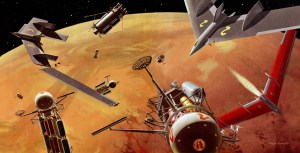
  2. The first landing party takes off for Mars. Two other landing planes will wait until runway is prepared for them, and then the remaining seven ships will stay in 600-mile orbit. Arms on cargo ships hold screenlike dish antennas (for communication), trough-shaped solar mirrors (for power).

Is there Life on Mars?
Collier’s, April 30, 1954

Image credit: Collier’s
Image source: AIAA Houston
Return Flight

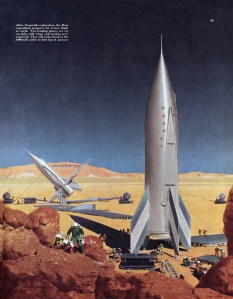
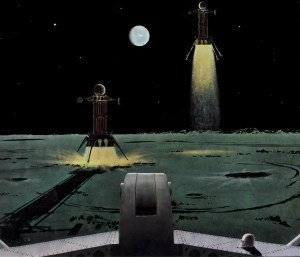
After 15 month exploration, the Mars expedition prepares for return flight to earth. Two landing planes are set on tails, with wings and landing gear removed. They will rocket back to the 600-mile orbit on first leg of journey.

Is there Life on Mars?
Collier’s, April 30, 1954

Image credit: Collier’s
Image source: AIAA Houston
Unloading on the Moon

The unloading on the moon. Twenty-four hours after landing, supplies have been stowed in caterpillar tractors. Hold of cargo ship (r.) is being lowered to ground in sections, to be used as prefabricated headquarters, Earth is at center; halo effect is caused by sun, hidden behind sphere of rocket ship at left. Diagonal streak in sky, the zodiacal light, is caused by sun’s ray reflecting from cosmic dust. The red star at left is Mars.

More about Man on the Moon
Collier’s, October 25, 1952

Image credit: Collier’s
Image source: AIAA Houston

The Exploration

Causing moonquakes. Rockets with explosive war heads are fired off and scientists check the vibrations waves caused by distant blast, to determine interior composition of the moon. Seismograph in foreground is push-button controlled and surveying instrument to it’s left has cupped headpiece, to accommodate hooks and helmets of expedition members.

More about Man on the Moon
Collier’s, October 25, 1952

Image credit: Collier’s
Image source: AIAA Houston
The Journey

Landing on the moon. Ten minutes before touchdown, rocket motors are switched on to slow down ships’ high-speed fall caused by the moon’s gravity. Vehicles are maneuvering 550 miles above landing area known as Sinus Roris (Dewy Bay), dark plain above cargo ship in lower left.

Man on the Moon
Collier’s, October 18,1952

Image credit: Colliers
Image source: AIAA Houston