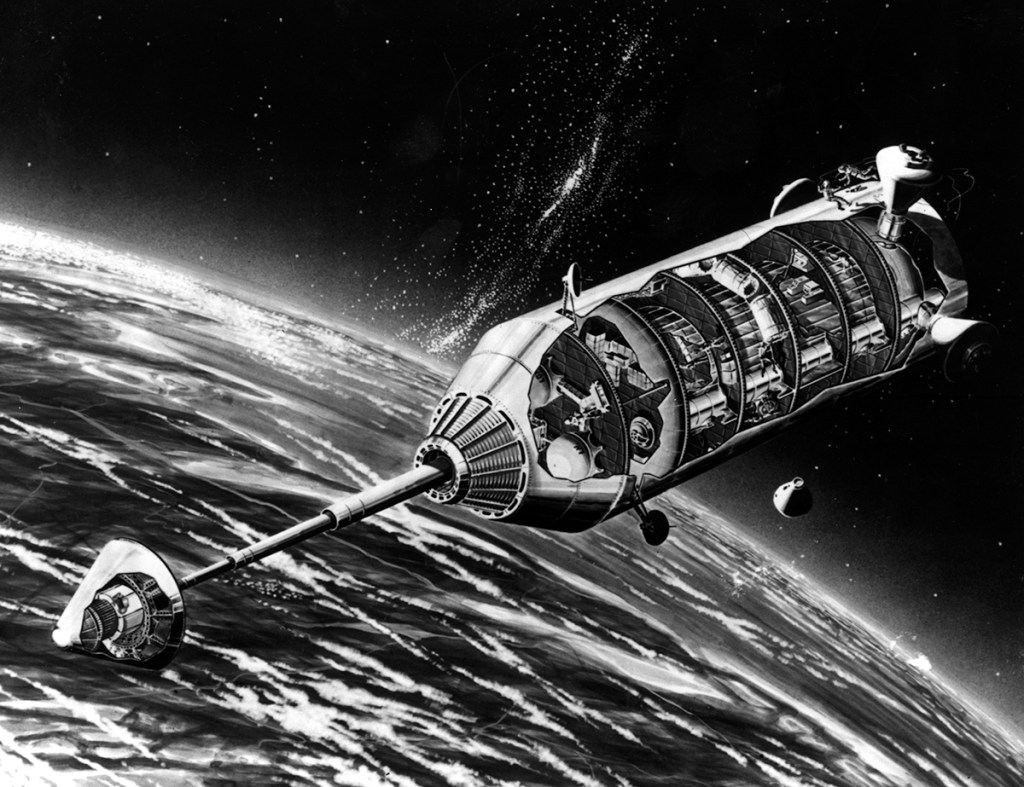
Image credit: NASA Marshall
Image source: NASA on The Commons
Image credit: NASA Marshall
Image source: NASA on The Commons
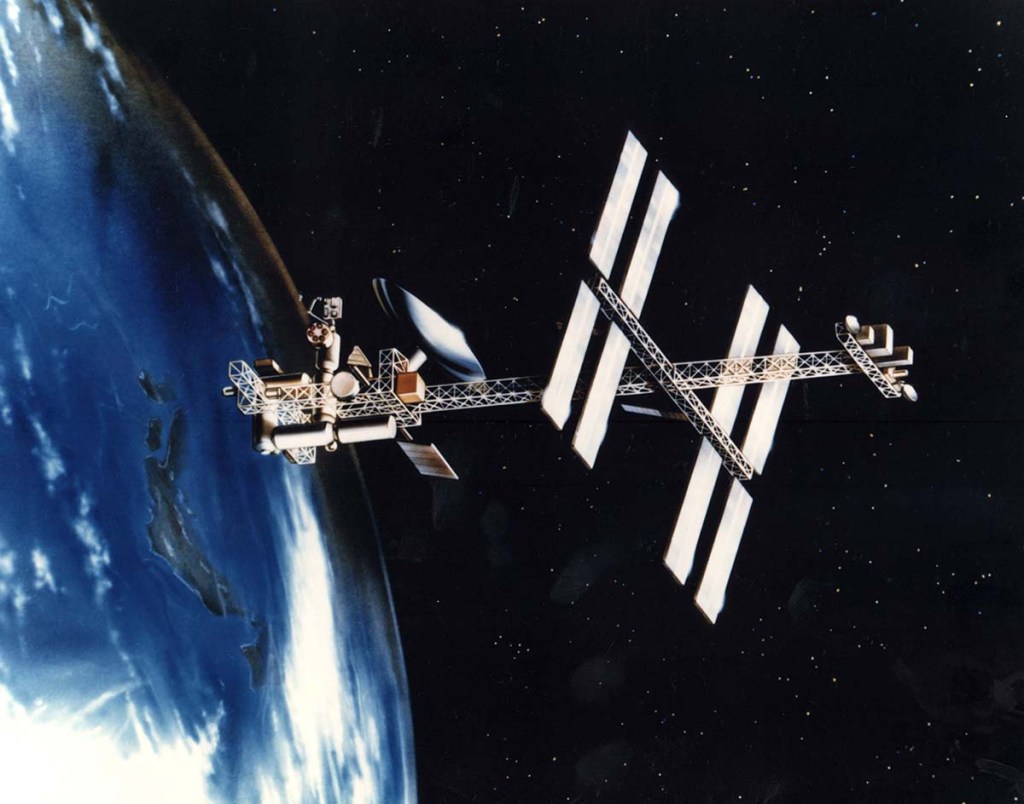
This is an artist’s conception of the proposed “Power Tower” space station configuration, shown with the Japanese Experiment Module attached. This model and several others were examined before deciding on the Space Station Freedom structure that was later abandoned in favor of the International Space Station.
Image credit: NASA
Image source: NASA on The Commons
This is what an artist envisioned the Solar Power Satellite would look like. Shown is the assembly of a microwave transmission antenna. The solar power satellite was to be located in a geosynchronous orbit, 36,000 miles above the Earth’s surface.
Image credit: NASA
Image source: NASA on The Commons
A 1960 concept image of the United States Air Force’s proposed Manned Orbiting Laboratory (MOL) that was intended to test the military usefulness of having humans in orbit. The station’s baseline configuration was that of a two-person Gemini B spacecraft that could be attached to a laboratory vehicle. The structure was planned to launch onboard a Titan IIIC rocket. The station would be used for a month and then the astronauts could return to the Gemini capsule for transport back to Earth. The first launch of the MOL was scheduled for December 15, 1969, but was then pushed back to the fall of 1971. The program was cancelled by Defense Secretary Melvin R. Laird in 1969 after the estimated cost of the program had risen in excess of $3 billion, and had already spent $1.3 billion. Some of the military astronauts selected for the program then transferred to NASA and became some of the first people to fly the Space Shuttle, including Richard Truly, who later became the NASA Administrator.
Image # : 2B24070-Fig3
Date: Circa 1960
Image credit: McDonnell
Image source: NASA on The Commons
