Image credit: Boeing Aircraft Company
Image source: Mike Acs
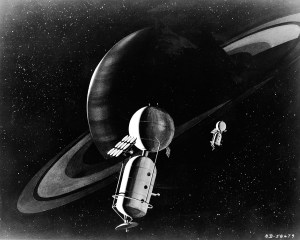
Image credit: Martin Marietta
Image source: Ed Dempsey
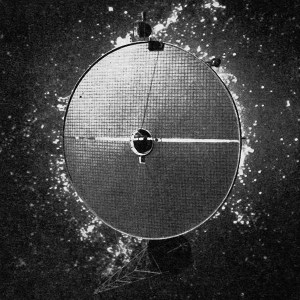
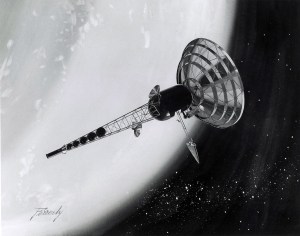
A Boeing design study for a Mars exploration probe, 40 ft. in diameter and weighing 600 lb. Assembled and launched at a space-station, the unmanned probe would draw its power from the Sun. Propelled by an ion rocket, it would take three years to orbit Mars and return.
Eagle Book of Rockets and Space
Longacre Press, 1961
Right:
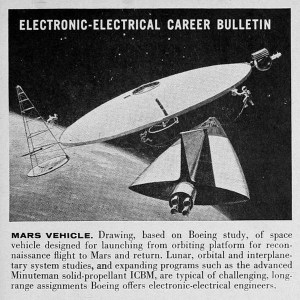
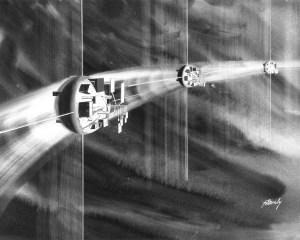
MARS VEHICLE. Drawing, based on Boeing study, of space vehicle designed for launching from orbiting platform for reconnaissance flight to Mars and return. Lunar, orbital and interplanetary system studies, and expanding programs such as the advanced Minuteman solid-propellant ICBM, are typical of challenging assignments Boeing offers electronic-electrical engineers.
Missiles and Rockets
December 7, 1959
Image credit: Boeing Aircraft Company
Image source(s): Numbers Station, Internet Archive
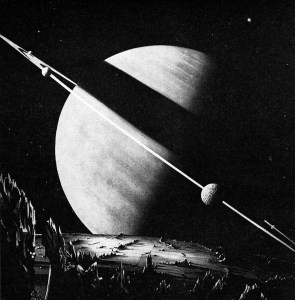
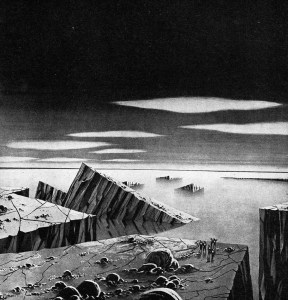
Eagle Book of Rockets and Space
by John W.R. Taylor and Maurice Allward
Longacre Press, 1961
Image credit: The Eagle
Image source: Numbers Station
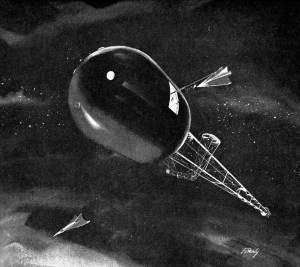
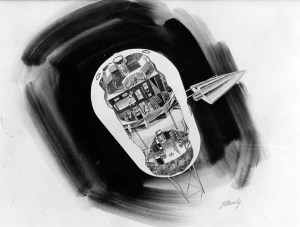
A Boeing design for a manned orbital or interplanetary reconnaissance vehicle. The vehicle would be built in orbit around the earth around the Earth, inside a plastic bubble having controlled atmosphere and pressure, permitting technicians to work without space suits. Propelled by a nuclear-powered plasma jet, it could travel to planets within our solar-system , carrying shuttle vehicles to make the actual observations of planet surfaces. Nylon nets, rather than flooring, would divide the vehicle into seven levels.
Eagle Book of Rockets and Space
by John W.R. Taylor and Maurice Allward
Longacre Press, 1961
Image credit: Boeing Aircraft Company
Image source: Numbers Station
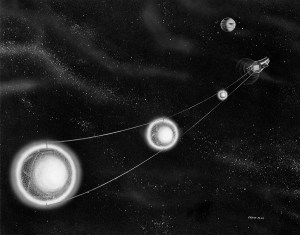
see also:
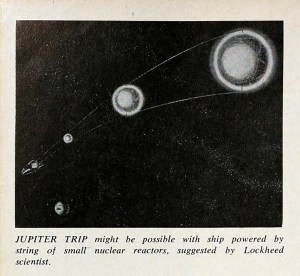
Missiles and Rockets, August 22, 1960
Image credit: Lockheed
Images: Numbers Station, Internet Archive
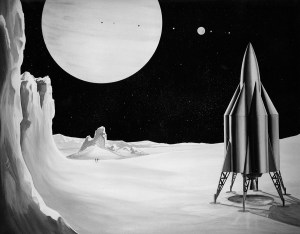
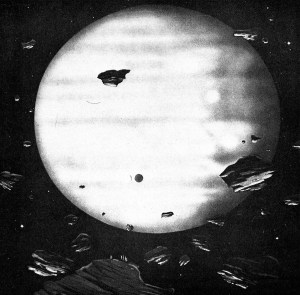
Jupiter Lunar Landing
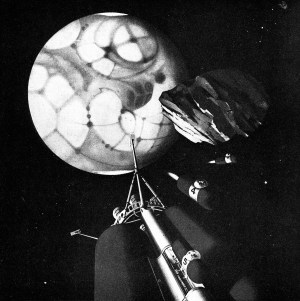
From one of Jupiter’s 12 moons, earth astronauts gaze on this impressive, but bleak, view of the 86,900 mile-diameter planet. More than 316 times the mass of the Earth, Jupiter is seven times further from the sun than Earth; would require voyage of one to two months to reach at velocity of one million feet per second. Max Hunter, Douglas Aircraft Company engineer predicts economically feasible trips to Jupiter will be made through development of nuclear thrust spaceship engines.
Douglas Aircraft Company, Inc. General Offices, Santa Monica, Calif.
Image credit: Douglas Aircraft Company
Image source: Numbers Station
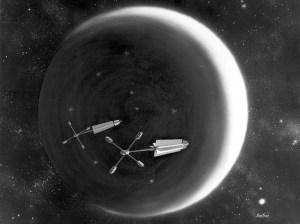
Image credit: Convair
Image source: SDASM Archives
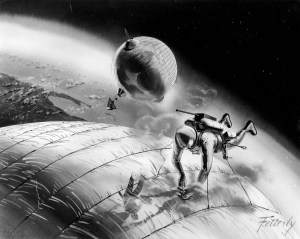
Image credit: Boeing Aircraft Company
Image source: Numbers Station