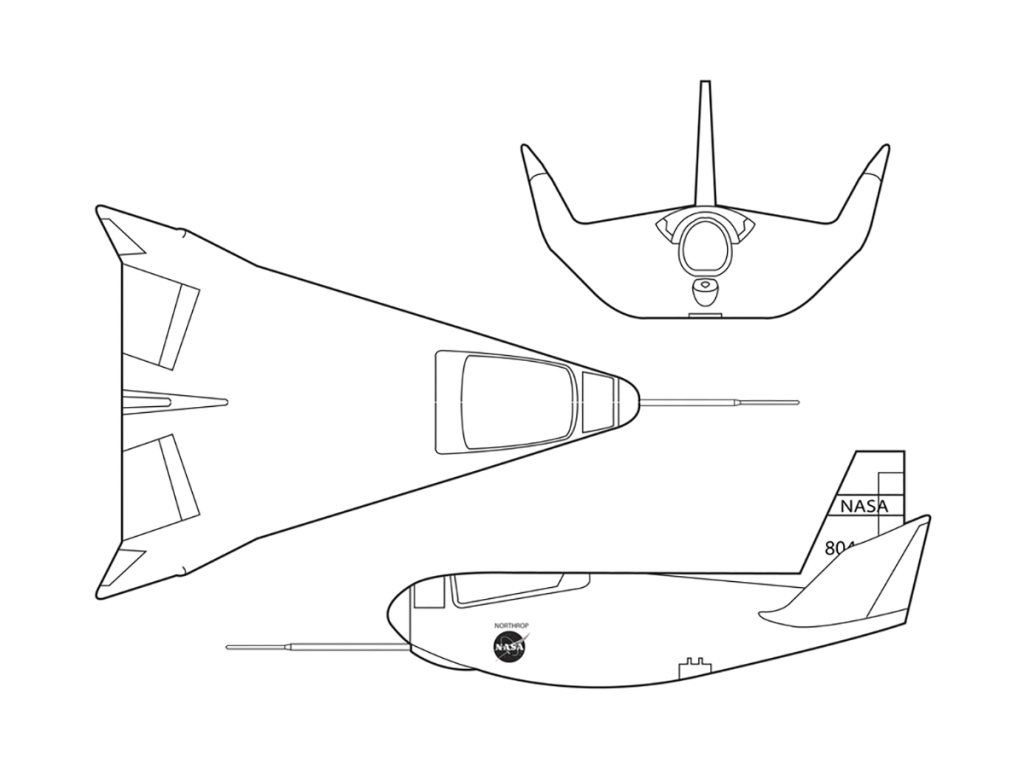
The HL-10 was one of five aircraft built in the Lifting Body Research Program. It was a NASA design and was built to evaluate an inverted airfoil lifting body with a delta planform. The HL-10 was flown 37 times during the program and logged the highest altitude and fastest speed.
EG-0053-01
The HL-10 was one of five aircraft built in the Lifting Body Research Program. It was a NASA design and was built to evaluate an inverted airfoil lifting body with a delta planform. The HL-10 was flown 37 times during the program and logged the highest altitude and fastest speed.
The other lifting body designs were the M2-F2, M2-F3 (rebuilt M2-F2 following a landing accident), X-24A and X-24B (the rebuilt X-24A with a different aerodynamic shape).
The HL-10 was flown 37 times during the lifting body research program and logged the highest altitude and fastest speed in the Lifting Body program. On Feb. 18, 1970, Air Force test pilot Peter Hoag piloted the HL-10 to Mach 1.86 (1,228 mph). Nine days later, NASA pilot Bill Dana flew the vehicle to 90,030 feet, the highest altitude reached in the program.
Some new and different lessons were learned through the successful flight testing of the HL-10. These lessons, when combined with information from it’s sister ship, the M2-F2/F3, provided one option for designers of future atmospheric re-entry vehicles.
Specifications
- Dimensions: Length, 21 ft. 2 in.Width, 13 ft. 7 in.Weight, including pilot, 6,060 lbs.
- Controls: Elevons between vertical and center fins for pitch and roll control. Split rudder on center fin for yaw and speed control. All surfaces used in three-axis stabilizer-augmenter system.
- Power: One XLR11 four-chamber rocket engine fueled by ethyl alcohol and liquid oxygen, producing a rated thrust of of 6,000 lbs.; built by Reaction Motors, Inc.-
- Aux. Power: Silver zinc batteries provided electrical power for control system, flight instruments, radios, cockpit heat, and stability augmentation system. To assist in pre-landing flare, two throttleable hydrogen peroxide rockets provided up to 400 lbs of thrust.
- Landing Gear: Main gear was modified T-38 system retracted manually, and lowered by nitrogen pressure. Nose gear was modified T-39 nose gear, retracted manually and lowered with nitrogen pressure.
- Ejection System: Modified T-37 system.
Image credit: NASA FRC
Image source: NASA