Image credit: Boeing Aircraft Company
Image source: Mike Acs
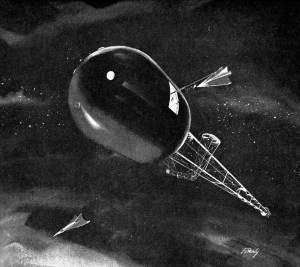
A Boeing design for a manned orbital or interplanetary reconnaissance vehicle. The vehicle would be built in orbit around the earth around the Earth, inside a plastic bubble having controlled atmosphere and pressure, permitting technicians to work without space suits. Propelled by a nuclear-powered plasma jet, it could travel to planets within our solar-system , carrying shuttle vehicles to make the actual observations of planet surfaces. Nylon nets, rather than flooring, would divide the vehicle into seven levels.
Eagle Book of Rockets and Space
by John W.R. Taylor and Maurice Allward
Longacre Press, 1961
Image credit: Boeing Aircraft Company
Image source: Numbers Station
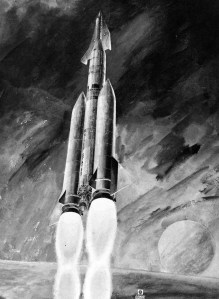
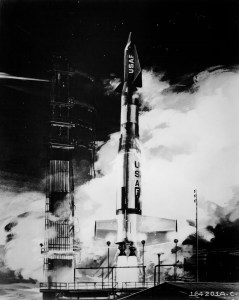
330-PSA-279-62 (USAF 167026): Artwork by George Mathis of how the Air Force Titan III Standard Launch Vehicle may look boosting the United States Air Force X-20 (Dyna-Soar) into orbit, August 1962.
Image credit: Boeing
Image source: National Museum of U.S. Navy
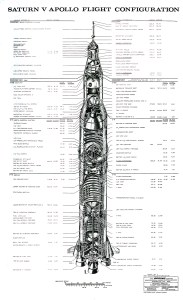
The Saturn V configuration is shown in inches and meters as illustrated by the Boeing Company. The Saturn V vehicle consisted of three stages: the S-IC (first) stage powered by five F-1 engines, the S-II (second) stage powered by five J-2 engines, the S-IVB (third) stage powered by one J-2 engine. A top for the first three stages was designed to contain the instrument unit, the guidance system, the Apollo spacecraft, and the escape system. The Apollo spacecraft consisted of the lunar module, the service module, and the command module. The Saturn V was designed perform lunar and planetary missions and it was capable of placing 280,000 pounds into Earth orbit.
Image credit: NASA MSFC
Image source: NASA Images

FOR RELEASE AT 9:00 A.M., PDT, SEPTEMBER 22, 1960
DYNA SOAR GLIDER RE-ENTERING EARTH’S ATMOSPHERE
This is a Boeing artist’s impression of how the Dyna Soar manned space glider will look when it re-enters the earth’s atmosphere after a flight into space. Leading edges of the craft will glow from the heat created by the friction of the vehicle passing into the atmosphere. Dyna Soar will be boosted into space by a modified Titan intercontinental ballistic missile. After being separated from its booster, the glider will be left in a piloted, near orbital flight. Its pilot later could glide to a conventional landing at an Air Force base. The Boeing Company, under supervision of the Air Force, is prime contractor for the system and the glider. The Martin Company is prime contractor for the Titan booster.
— Boeing Airplane Company Photo
FROM:
News Bureau
Boeing Airplane Company
Seattle 24, Washington
Image credit: Boeing
Image source: Numbers Station
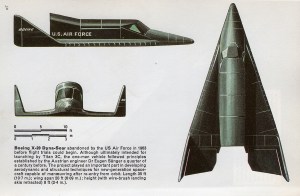
Boeing X-20 Dyna-Soar abandoned by the US Air Force in 1963 before flight trials could begin. Although ultimately intended for launching by Titan 3C, this one-man vehicle followed principles established by the Austrian engineer Dr Eugen Stänger a quarter of a century before. The project played an important part in developing aerodynamic and structural techniques for new-generation space-craft capable of maneuvering after re-entry from orbit. Length 35 ft (10.7m.) wingspan 20 ft (6.09m.); height (with wire-brush landing skis retracted) 8 ft (2.4m.).
Frontiers of Space
Philip Bono & Kenneth Gatland
Macmillan, 1969
Image credit: Macmillan
Image source: Numbers Station
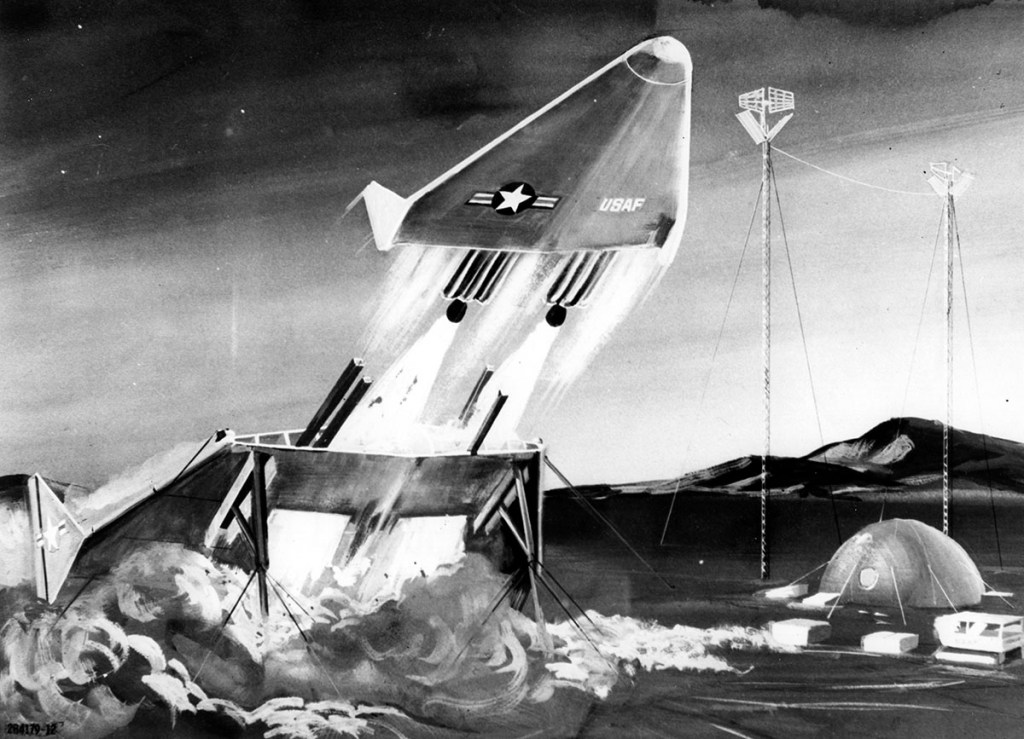
Image credit: Boeing / Chicago Daily News
Image source: Numbers Station
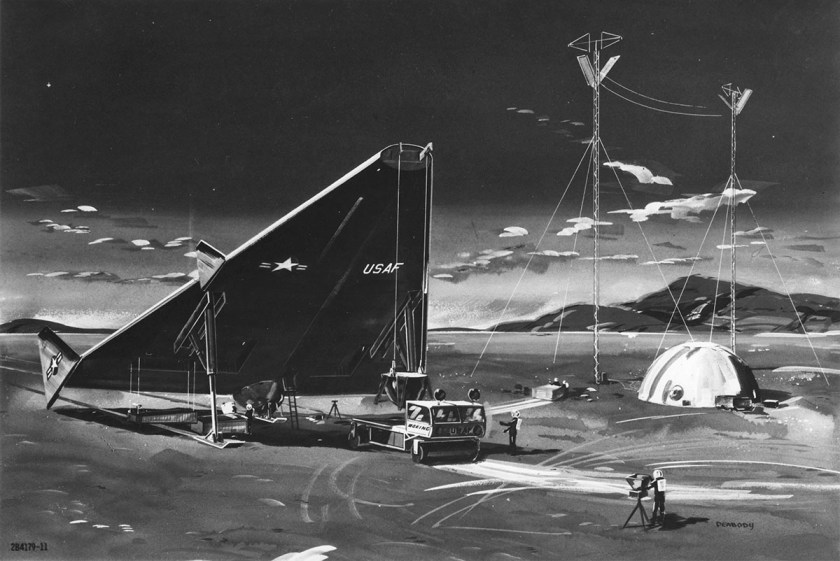
It’s January 1972.
Having safely glided to a stop on a Martian plateau, this illustration depicts the Operational Phase of the mission. The crew have already inflated their six meter habitat (it’s a tent), assembled the flat-pack steamroller and are shown removing the nuclear reactor so it can be dragged at least a kilometer from base camp so it won’t kill them.
With the reactor at a safe distance, the crew of eight have 479 days to explore the surface of Mars and maybe do a spot of gardening.
You can read more about this fascinating 1960 Boeing Study here.
Image credit: Boeing / Chicago Daily News
Image source: Numbers Station
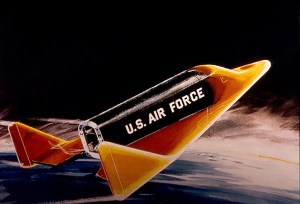
Image credit: United States Air Force
Image source: Wikipedia
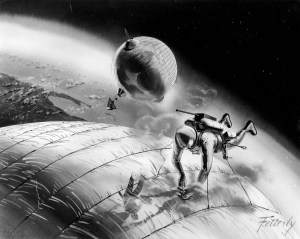
Image credit: Boeing Aircraft Company
Image source: Numbers Station