Sol Dember

Eagle Book of Rockets and Space
by John W.R. Taylor and Maurice Allward
Longacre Press, 1961

Image credit: NASA
Image source: Numbers Station
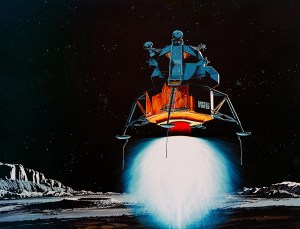
S69-39011

S69-39011 (July 1969) — TRW Incorporated’s artist concept depicting the Apollo 11 Lunar Module (LM) descending to the surface of the moon. Inside the LM will be astronauts Neil A. Armstrong, commander, and Edwin E. Aldrin Jr., lunar module pilot. Astronaut Michael Collins, command module pilot, will remain with the Command and Service Modules (CSM) in lunar orbit. TRW’s LM descent engine will brake Apollo 11’s descent to the lunar surface. The throttle-able rocket engine will be fired continuously the last 10 miles of the journey to the moon, slowing the LM to a speed of two miles per hour at touchdown. TRW Incorporated designed and built the unique engine at Redondo Beach, California under subcontract to the Grumman Aircraft Engineering Corporation, Bethpage, New York, the LM prime contractor.

Image credit: NASA JSC
Image source: NASA Images
A Grand Tour

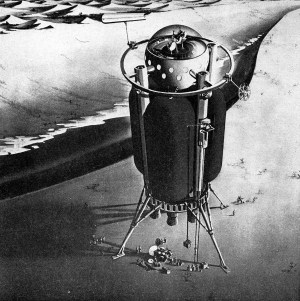
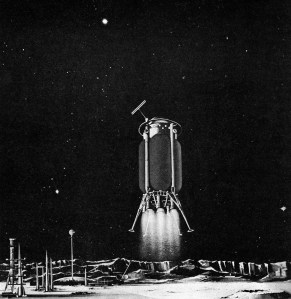
  1. A “deep-space” craft, which does not need to take off or re-enter through Earth’s atmosphere, needs no streamlining and can utilise a very light structure. Such a space-ship is shown here landing at a lunar base.
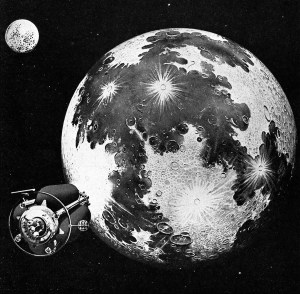
  2. Having refuelled at a lunar base, the space-ship is shown before leaving the Moon for a journey to one of the other planets of the solar system. The cabin for the crew is separated from the rocket engines by a cluster of huge propellant tanks.
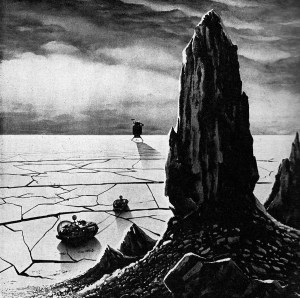
  3. After landing in the twilight one of Mercury, the explorers set out in small tracked vehicles across the parched, cracked, lifeless surface of this innermost planet of our solar system.
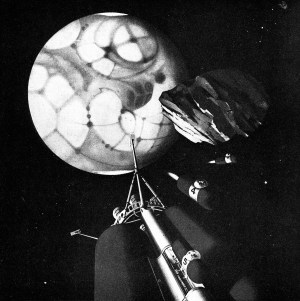
  4. After entering an orbit high above Mars, the space-shop releases a number of small landing vehicles which will carry explorers down to the “red planet”. Also in orbit, is a meteorite, representing one of the hazards of space flight.
  5. After a pre-liminary reconnaissance by the small craft, the main space-ship has landed on the surface of Mars, near one of the mysterious “canals” that have puzzled astronomers for years. Soon the riddle will be solved.
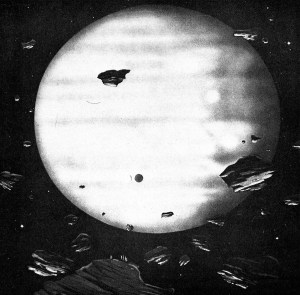
  6. Although they cannot land on Jupiter, with its dense atmosphere of poisonous gases, the explorers are able to observe it from a distant perch on an orbiting meteorite. One of the planet’s moons casts a shadow on the clouds as it passes.
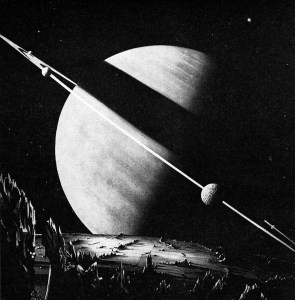
  7. Show piece of the whole solar system is Saturn, with its spectacular rings. Although this is another planet on which explorers from Earth may never land, it should be possible to observe Saturn from one if its moon, as depicted.
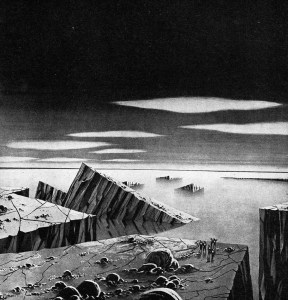
  8. Somewhere in space, explorers have discovered a dead world. Perhaps Uranus might look like this, or Pluto. Nobody knows at present,. But nobody doubts any longer than man will one day be able to learn the secrets of every corner of his own solar system.

Eagle Book of Rockets and Space
by John W.R. Taylor and Maurice Allward
Longacre Press, 1961

Image credit: The Eagle
Image source: Numbers Station