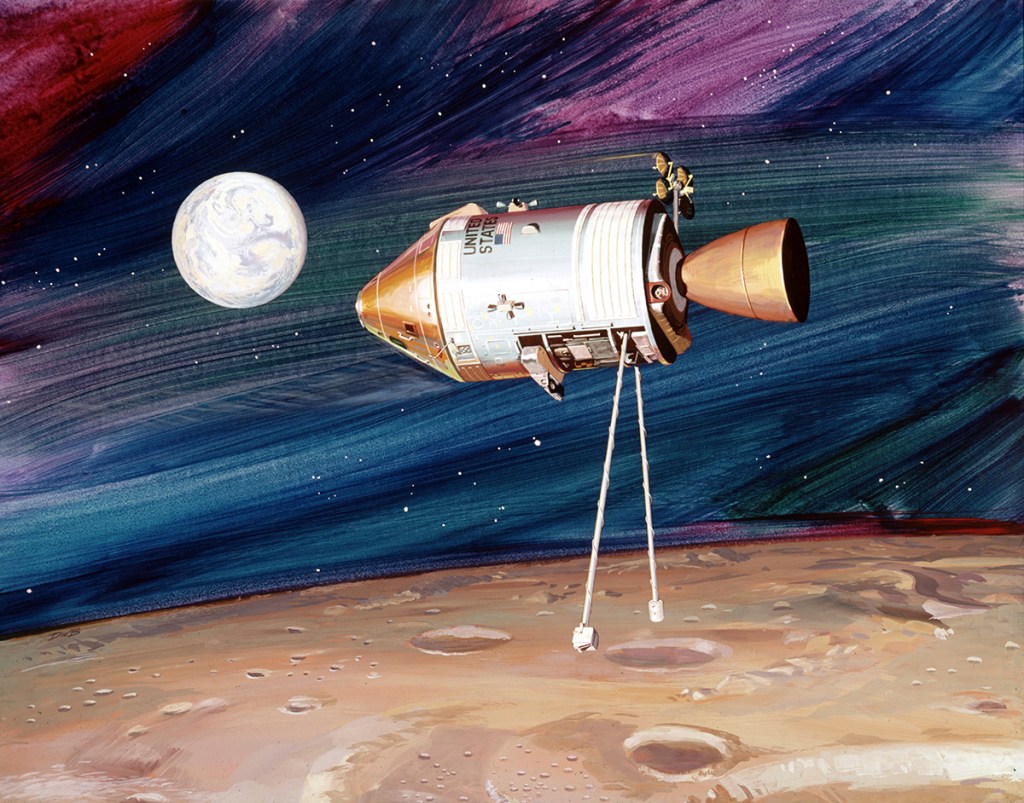
Image credit: NASA
Image source: Drew Granston
Image credit: NASA
Image source: Drew Granston
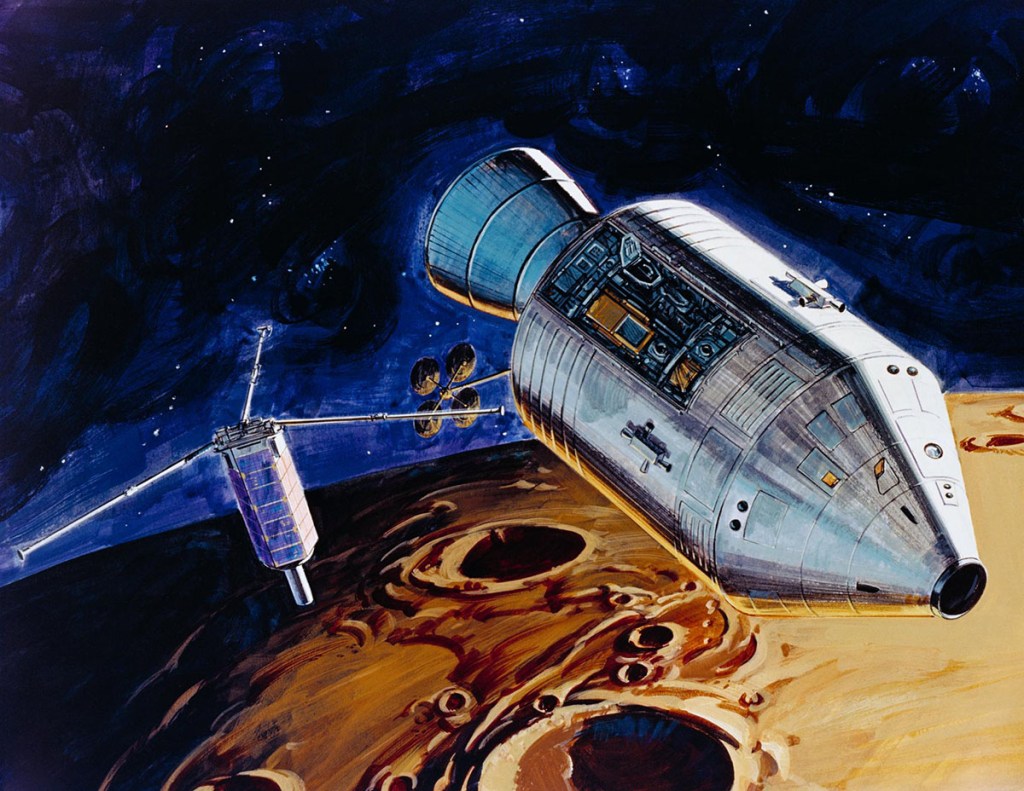
S71-39481 (July 1971) — An artist’s concept showing TRW’s small lunar subsatellite being ejected into lunar orbit from the SIM bay of the Apollo 15 Service Module. The 80-pound satellite will remain in orbit a year or more, carrying scientific experiments to study space in the vicinity of the moon. The satellite carries three experiments: S-Band Transponder; Particle Shadows/Boundary Layer Experiment; and Subsatellite Magnetometer Experiment. The subsatellite is housed in a container resembling a rural mailbox, and when deployed is spring-ejected out-of-plane at 4 fps with a spin rate of 140 rpm. After the satellite booms are deployed, the spin rate is stabilized at about 12 rpm. The subsatellite is 31 inches long and has a 14 inch hexagonal diameter. The exact weight is 78.5 pounds. The folded booms deploy to a length of five feet. Subsatellite electrical power is supplied by a solar cell array outputting 25 watts for dayside operation and a rechargeable silver-cadmium battery for nightside passes.
Image credit: NASA JSC
Image source: NASA Images
S69-39011 (July 1969) — TRW Incorporated’s artist concept depicting the Apollo 11 Lunar Module (LM) descending to the surface of the moon. Inside the LM will be astronauts Neil A. Armstrong, commander, and Edwin E. Aldrin Jr., lunar module pilot. Astronaut Michael Collins, command module pilot, will remain with the Command and Service Modules (CSM) in lunar orbit. TRW’s LM descent engine will brake Apollo 11’s descent to the lunar surface. The throttle-able rocket engine will be fired continuously the last 10 miles of the journey to the moon, slowing the LM to a speed of two miles per hour at touchdown. TRW Incorporated designed and built the unique engine at Redondo Beach, California under subcontract to the Grumman Aircraft Engineering Corporation, Bethpage, New York, the LM prime contractor.
Image credit: NASA JSC
Image source: NASA Images
S69-33765 (12 May 1969) — Artist’s concept depicting the firing of the Apollo 10 Lunar Module descent engine for 42 seconds to propel “Snoopy” back into a higher lunar orbit for rendezvous and docking with the Command and Service Modules. Earlier, the LM descent engine will be fired for 27 seconds to take astronauts Thomas P. Stafford, Apollo 10 commander; and Eugene A. Cernan, lunar module pilot, to within 10 miles of the moon’s surface. Astronauts John W. Young, command module pilot, will remain in the Command Module, “Charlie Brown,” in lunar orbit. Developed by TRW’s Systems Group at Redondo Beach, California, under Grumman subcontract, the throttleable descent engine will be used to soft land the LM on the lunar surface during Apollo 11 and subsequent Apollo missions.
Image credit: NASA JSC
Image source: NASA Images
