Can We Get to MARS?

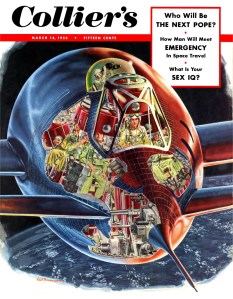
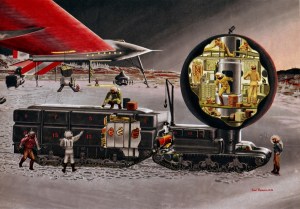
  1. Cutaway of plane in the foreground shows personnel, tractors in ship.
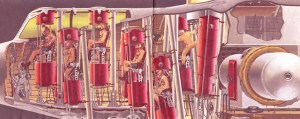
  2. Advance party, after landing on Martian snow in ski-equipped plane, prepares for trip to equator. Men live in inflatable, pressurized spheres mounted on tractors, enter and leave through air locks in the central column. Sphere on tractor is just being blown up. Cutaway of tractor, foreground, shows closed-circuit engine, run by hydrogen peroxide, oil. Trailer cutaway shows fuel supply, cargo.

Is there Life on Mars?
Collier’s, April 30, 1954

Image credit: Collier’s
Image source: AIAA Houston
620 Miles Above Mars

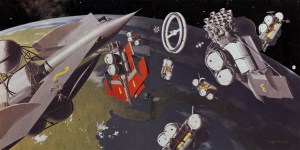
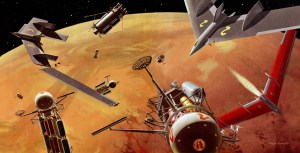
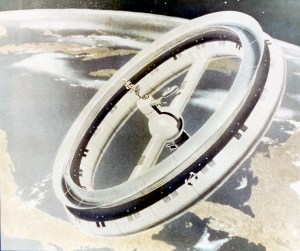
  1. Near wheel-shaped space station 1,000 miles from the earth, built especially for assembly of the Mars expedition, weightless workers put together 10 rocket ships required for the flight. Three of the huge space craft have torpedo noses which convert to planes for landing on the planet.
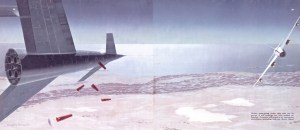
  2. The first landing party takes off for Mars. Two other landing planes will wait until runway is prepared for them, and then the remaining seven ships will stay in 600-mile orbit. Arms on cargo ships hold screenlike dish antennas (for communication), trough-shaped solar mirrors (for power).

Is there Life on Mars?
Collier’s, April 30, 1954

Image credit: Collier’s
Image source: AIAA Houston
Return Flight

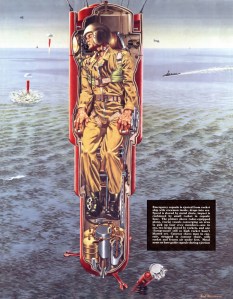
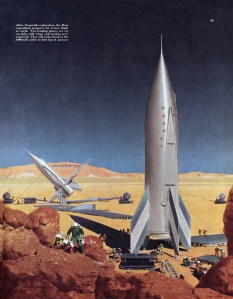
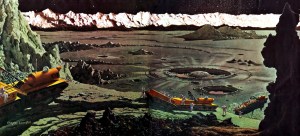
After 15 month exploration, the Mars expedition prepares for return flight to earth. Two landing planes are set on tails, with wings and landing gear removed. They will rocket back to the 600-mile orbit on first leg of journey.

Is there Life on Mars?
Collier’s, April 30, 1954

Image credit: Collier’s
Image source: AIAA Houston
Unloading on the Moon

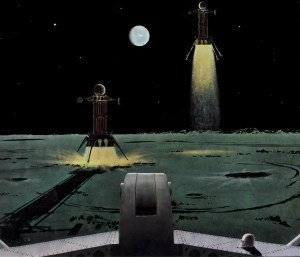
The unloading on the moon. Twenty-four hours after landing, supplies have been stowed in caterpillar tractors. Hold of cargo ship (r.) is being lowered to ground in sections, to be used as prefabricated headquarters, Earth is at center; halo effect is caused by sun, hidden behind sphere of rocket ship at left. Diagonal streak in sky, the zodiacal light, is caused by sun’s ray reflecting from cosmic dust. The red star at left is Mars.

More about Man on the Moon
Collier’s, October 25, 1952

Image credit: Collier’s
Image source: AIAA Houston

The Exploration

Causing moonquakes. Rockets with explosive war heads are fired off and scientists check the vibrations waves caused by distant blast, to determine interior composition of the moon. Seismograph in foreground is push-button controlled and surveying instrument to it’s left has cupped headpiece, to accommodate hooks and helmets of expedition members.

More about Man on the Moon
Collier’s, October 25, 1952

Image credit: Collier’s
Image source: AIAA Houston
The Journey

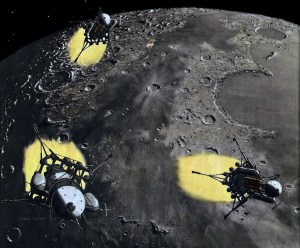
Landing on the moon. Ten minutes before touchdown, rocket motors are switched on to slow down ships’ high-speed fall caused by the moon’s gravity. Vehicles are maneuvering 550 miles above landing area known as Sinus Roris (Dewy Bay), dark plain above cargo ship in lower left.

Man on the Moon
Collier’s, October 18,1952

Image credit: Colliers
Image source: AIAA Houston
Stowed Vent Array

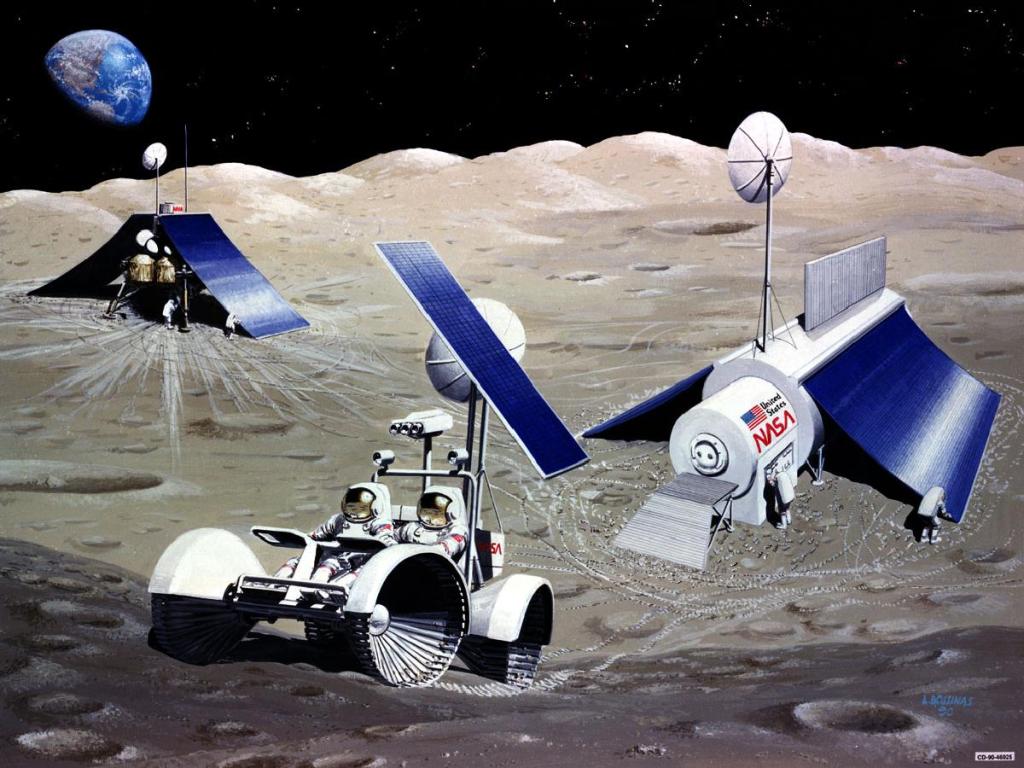
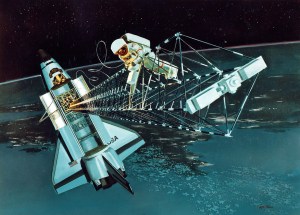
In this series by Lewis Research Center artist Les Bossinas, an astronaut demonstrates multi-purpose solar arrays. As it harnesses the power of the sun, the first can be configured as a wind-tunnel for protecting strawberries or used as a tent for children’s garden parties. The second model can be used as a balance beam for gymnastics, a ping pong table, or folded up to create a porch screen. Just the thing for an evening cocktail while watching the sunset.

Image credit: NASA LRC
Image source: DVIDS

Moving The Playhouse

Or, “Articulated Lunar Rover Lunar Excavator.”

Image credit: NASA LRC
Image source: DVIDS

Lunar Commuter Shuttle

S99-04186 (1996) — Routine 24-hour flights to the Moon could employ detachable crew modules atop nuclear thermal transfer vehicles. By transferring the module from one propulsion element to the next, the passengers could complete their trip to the lunar surface without ever leaving the module. This image produced for NASA by Pat Rawlings and Bill Gleason, (SAIC). Technical concepts for NASA’s Exploration Office, Johnson Space Center (JSC).

Image credit: NASA LRC
Image source: Internet Archive

S-83-28321

S83-28321 (14 March 1983) — In this artist’s concept of future lunar operations, a lunar ferry is about to burn out of lunar orbit for the trip back to facilities in low Earth orbit. The ferry vehicle carries tank modules filled with liquid oxygen, which has been produced from mining operations on the surface of the Moon. One possibility for such operations would be to have manned facilities in low lunar orbit, such as illustrated here. At the upper right side of the photo is a small orbiting manned station. At the lower right side of the photo is a liquid oxygen propellant dump, to which a lunar landing vehicle carrying liquid oxygen is about to dock. The lunar ferry vehicle itself is representative of one type of aerobraking system. The balloon-like torus around the center of the ferry-craft would inflate to several times its illustrated size and, once the vehicle has swooped down close to the Earth’s outer atmosphere on the return journey, would use atmospheric drag to slow the craft and place itself in low Earth orbit. The liquid oxygen would then be used in operations there for fueling various vehicles, including an orbital transfer vehicle for trips to geosynchronous Earth orbit. This concept is part of a study done for the Johnson Space Center by Eagle Engineering of Houston. The artist was Pat Rawlings.

Image credit: Eagle Engineering
Image source: Internet Archive