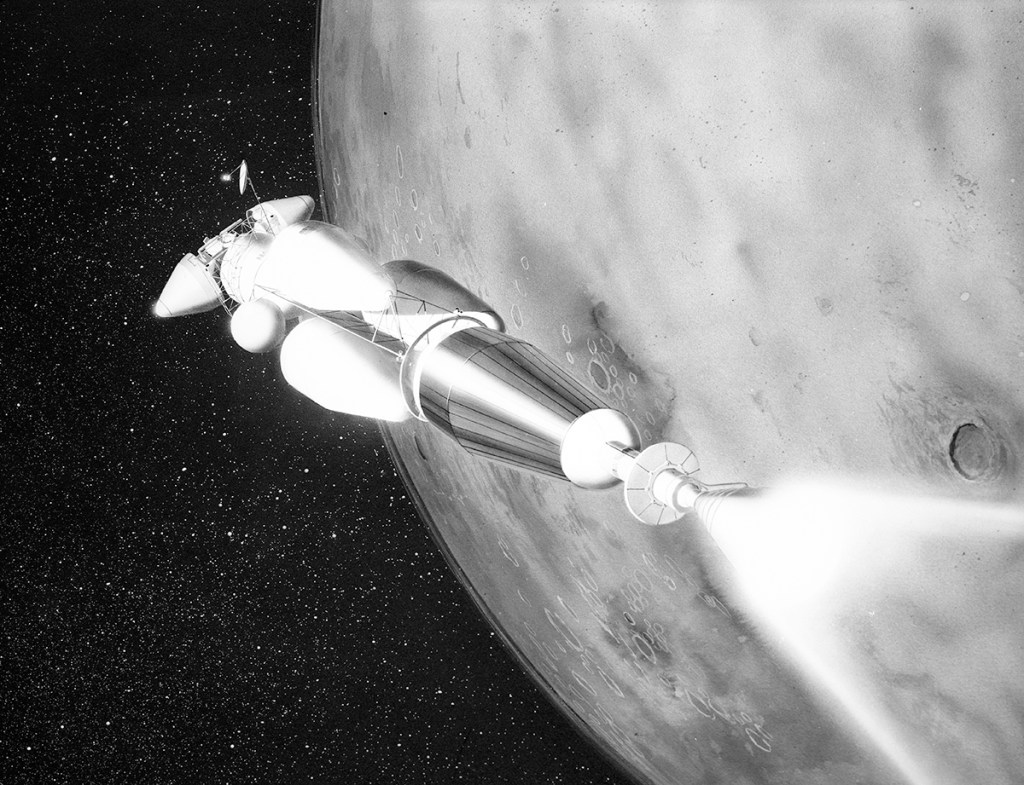
Image credit: SAIC
Image source: National Archives
Image credit: SAIC
Image source: National Archives
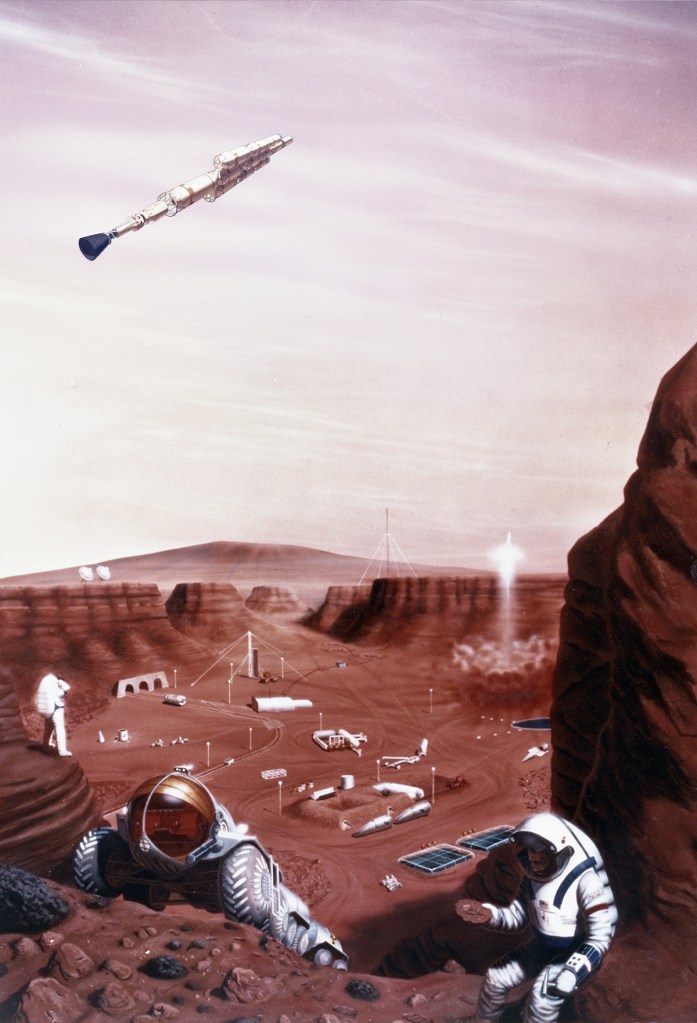
Image credit: NASA
Image source: National Archives
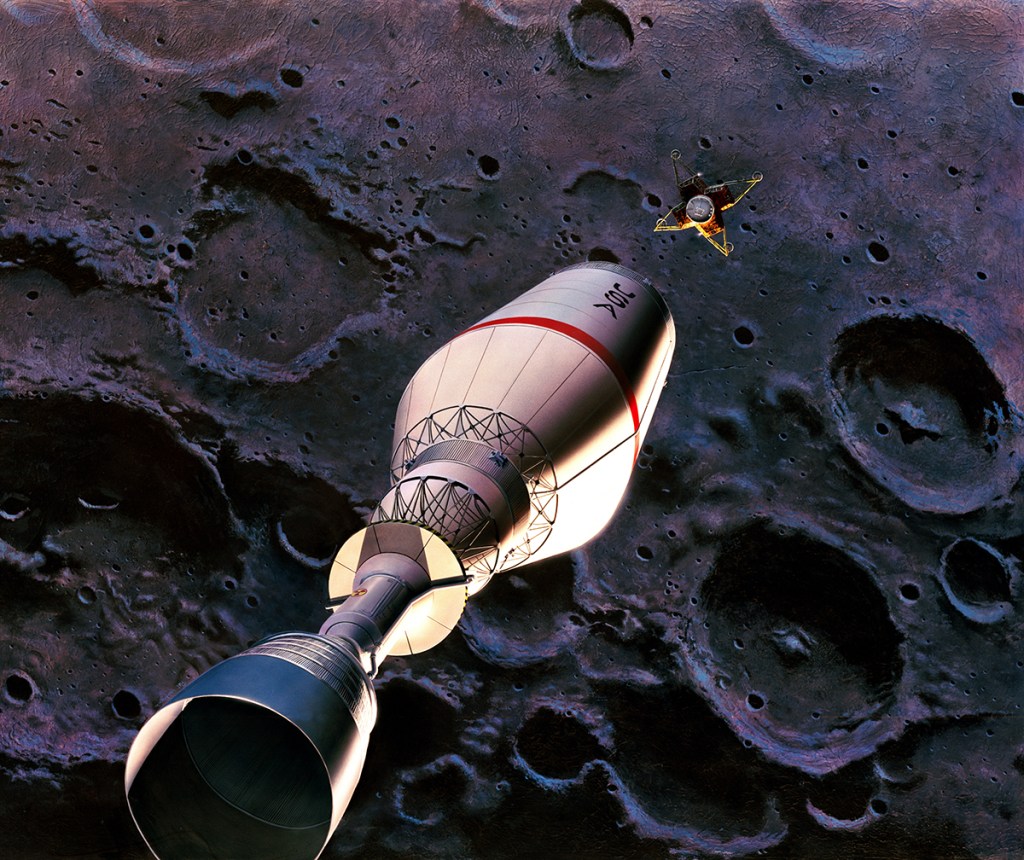
S92-49970 (February 1992) — (Artist’s concept of possible exploration programs.( Passing from sunlight into the Earth-lit shadow of the Moon, a nuclear thermal transfer vehicle prepares to dock with a lunar lander. Using a building block approach, a Mars transfer vehicle could be constructed from components common to the lunar stage. Artwork by Pat Rawlings, of SAIC.
Image credit: NASA
Image source: National Johnson
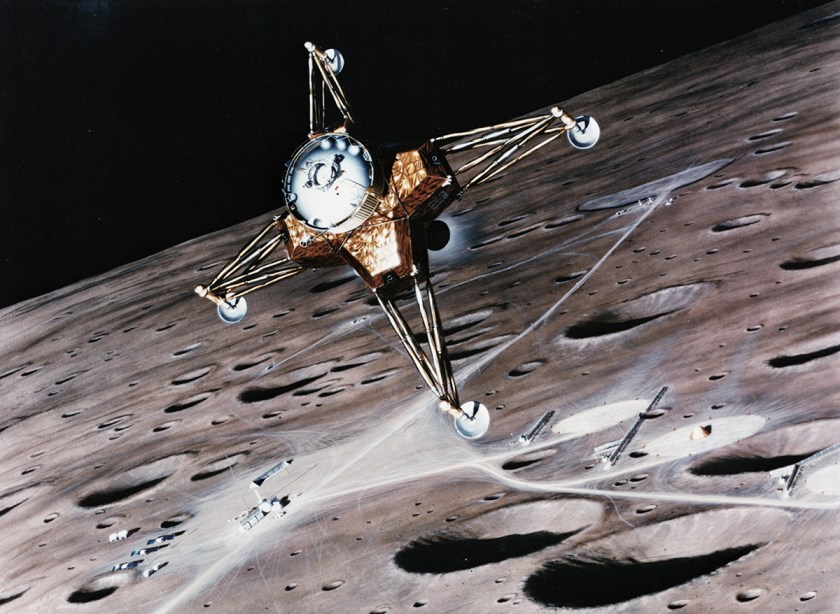
Image credit: NASA
Image source: National Archives
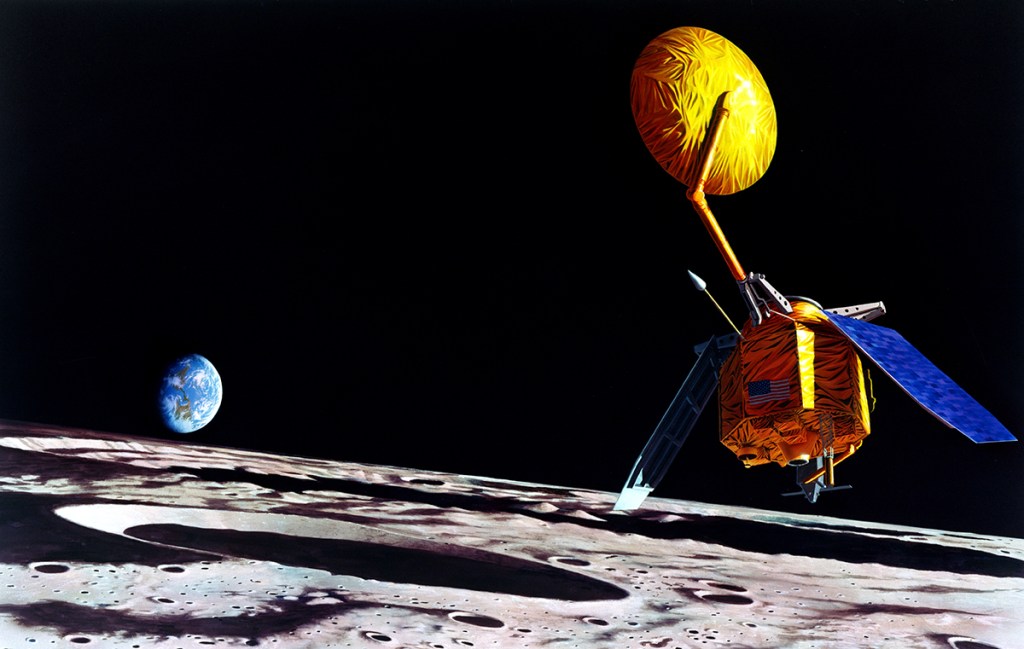
S95-01072 (January 1995) — This artwork is part of a series of depiction’s of proposed projects involving the National Aeronautics and Space Administration (NASA). The Lunar Discovery Orbiter (LDO) is depicted skimming just 20 kilometers over the lunar surface as it approaches Amundsen, a large terraced crater near the Moon’s south pole. Shadows in the crater and in nearby areas may conceal deposits of ice permanently shadowed from the Sun’s rays but quantifiable with LDO’s instruments. LDO is expected to accomplish the first high-resolution global survey of the Moon. Developed by the University of Arizona, the Boeing Defense and Space Group and NASA’s Johnson Space Center (JSC), Houston, Texas, this mission addresses the fundamental questions in lunar and planetary science and prepares for future exploration and use of the Moon. This artwork is a painting done by Pat Rawlings, of SAIC, for NASA.
Image credit: NASA
Image source: NASA Johnson
Image credit: NASA
Image source: NASA NTRS
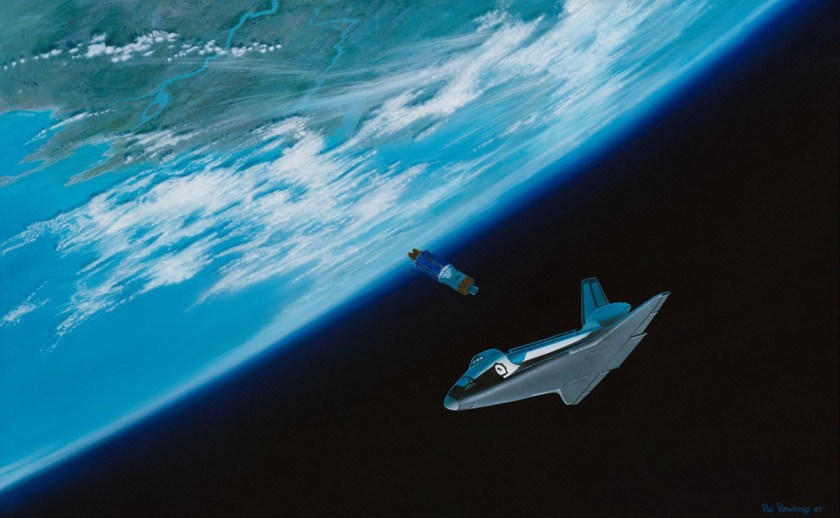
STS-26 Discovery, Orbiter Vehicle (OV) 103, artwork depicts tracking and data relay satellite C (TDRS-C) deployment. OV-103 orbits above Earth in bottom-to-sun attitude, moments after TDRS-C’s release into space. TDRS-C is seen just below open payload bay (PLB). Artwork was done by Pat Rawlings of Eagle Engineering.
Image credit: NASA JSC
Image source: NASA Images
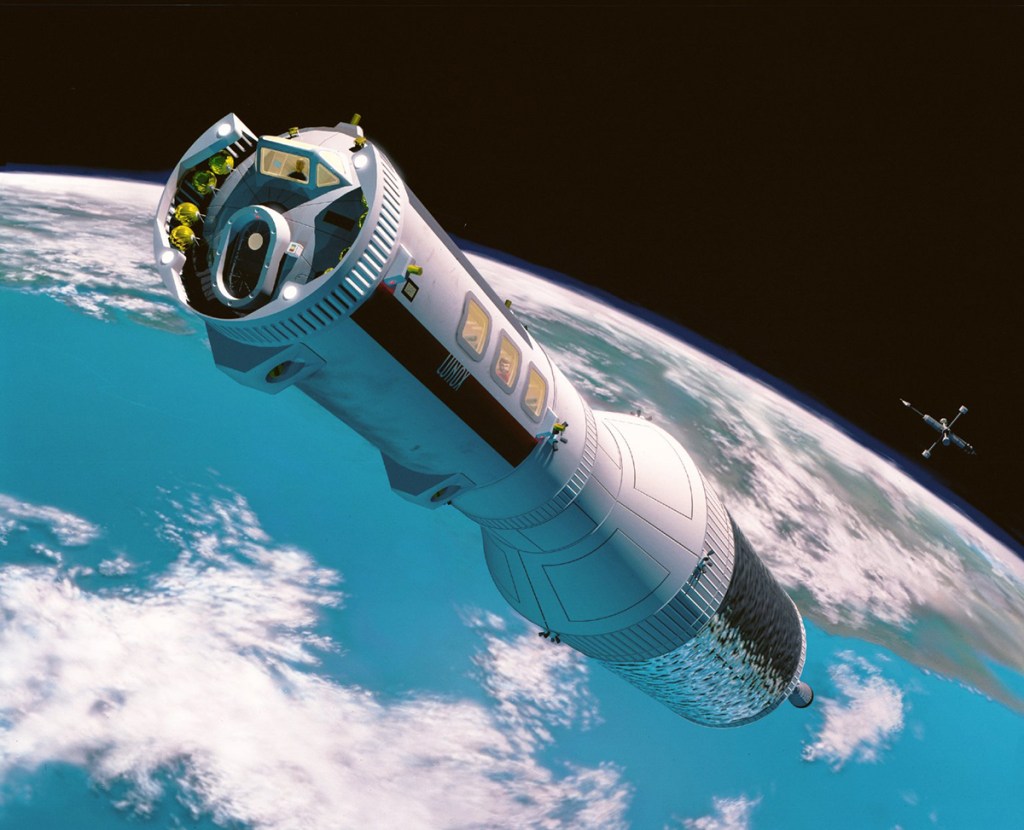
S99-04186 (1996) — Routine 24-hour flights to the Moon could employ detachable crew modules atop nuclear thermal transfer vehicles. By transferring the module from one propulsion element to the next, the passengers could complete their trip to the lunar surface without ever leaving the module. This image produced for NASA by Pat Rawlings and Bill Gleason, (SAIC). Technical concepts for NASA’s Exploration Office, Johnson Space Center (JSC).
Image credit: NASA LRC
Image source: Internet Archive
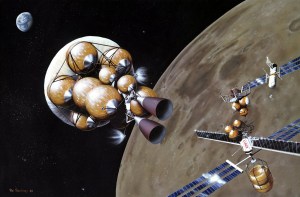
S83-28321 (14 March 1983) — In this artist’s concept of future lunar operations, a lunar ferry is about to burn out of lunar orbit for the trip back to facilities in low Earth orbit. The ferry vehicle carries tank modules filled with liquid oxygen, which has been produced from mining operations on the surface of the Moon. One possibility for such operations would be to have manned facilities in low lunar orbit, such as illustrated here. At the upper right side of the photo is a small orbiting manned station. At the lower right side of the photo is a liquid oxygen propellant dump, to which a lunar landing vehicle carrying liquid oxygen is about to dock. The lunar ferry vehicle itself is representative of one type of aerobraking system. The balloon-like torus around the center of the ferry-craft would inflate to several times its illustrated size and, once the vehicle has swooped down close to the Earth’s outer atmosphere on the return journey, would use atmospheric drag to slow the craft and place itself in low Earth orbit. The liquid oxygen would then be used in operations there for fueling various vehicles, including an orbital transfer vehicle for trips to geosynchronous Earth orbit. This concept is part of a study done for the Johnson Space Center by Eagle Engineering of Houston. The artist was Pat Rawlings.
Image credit: Eagle Engineering
Image source: Internet Archive
