Hubble Space Telescope

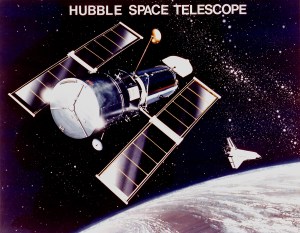
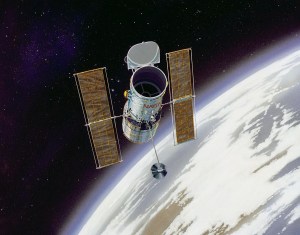
This is an artist’s concept of the Hubble Space Telescope (HST). The HST is the product of a partnership between NASA, European Space Agency Contractors, and the international community of astronomers. It is named after Edwin P. Hubble, an American Astronomer who discovered the expanding nature of the universe and was the first to realize the true nature of galaxies. The purpose of the HST, the most complex and sensitive optical telescope ever made, is to study the cosmos from a low-Earth orbit. By placing the telescope in space, astronomers are able to collect data that is free of the Earth’s atmosphere. The HST detects objects 25 times fainter than the dimmest objects seen from Earth and provides astronomers with an observable universe 250 times larger than is visible from ground-based telescopes, perhaps as far away as 14 billion light-years. The HST views galaxies, stars, planets, comets, possibly other solar systems, and even unusual phenomena such as quasars, with 10 times the clarity of ground-based telescopes. The major elements of the HST are the Optical Telescope Assembly (OTA), the Support System Module (SSM), and the Scientific Instruments (SI). The HST is approximately the size of a railroad car, with two cylinders joined together and wrapped in a silvery reflective heat shield blanket. Wing-like solar arrays extend horizontally from each side of these cylinders, and dish-shaped anternas extend above and below the body of the telescope. The HST was deployed from the Space Shuttle Discovery (STS-31 mission) into Earth orbit in April 1990. The Marshall Space Flight Center had responsibility for design, development, and construction of the HST. The Perkin-Elmer Corporation, in Danbury, Connecticut, developed the optical system and guidance sensors. The Lockheed Missile and Space Company of Sunnyvale, California produced the protective outer shroud and spacecraft systems, and assembled and tested the finished telescope.

Image credit: NASA MSFC
Image source: NASA Images
S90-34002

This artist concept shows the Hubble Space Telescope (HST) in operational configuration orbiting the Earth after its deployment from Discovery, Orbiter Vehicle (OV) 103 during STS-31. The high gain antennas (HGAs) and solar arrays (SAs) have been extended. HST’s aperture door is open as it views the universe from a vantage point above the Earth’s atmosphere. View provided by the Marshall Space Flight Center (MSFC).

Image credit: NASA MSFC
Image source: NASA Images
Nova Apollo

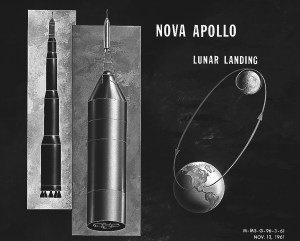
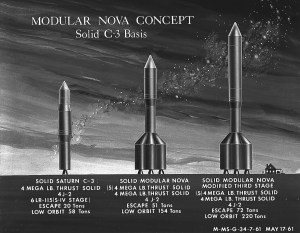
This artist’s concept illustrates the Module Nova concept – Solid C-3 Basis. From 1960 to 1962, the Marshall Space Flight Center considered the Nova launch vehicle as a means to achieve a marned lunar landing with a direct flight to the Moon. Various configurations of the vehicle were examined. The latest configuration was a five-stage vehicle using eight F-1 engines in the first stage. Although the program was canceled after NASA planners selected the lunar/orbital rendezvous mode, the proposed F-1 engine would eventually be used in the Apollo Program to propel the first stage of the Saturn V launch vehicle.

This artist’s concept illustrates the Module Nova concept – Solid C-3 Basis. From 1960 to 1962, the Marshall Space Flight Center considered the Nova launch vehicle as a means to achieve a marned lunar landing with a direct flight to the Moon. Various configurations of the vehicle were examined. The latest configuration was a five-stage vehicle using eight F-1 engines in the first stage. Although the program was canceled after NASA planners selected the lunar/orbital rendezvous mode, the proposed F-1 engine would eventually be used in the Apollo Program to propel the first stage of the Saturn V launch vehicle.

Image credit: NASA MSFC
Image source: NASA Images
Artist’s Concept – Side View

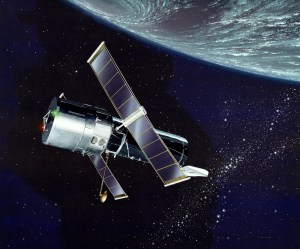
This illustration depicts a side view of the Hubble Space Telescope (HST). The HST is the product of a partnership between NASA, European Space Agency Contractors, and the international community of astronomers. It is named after Edwin P. Hubble, an American Astronomer who discovered the expanding nature of the universe and was the first to realize the true nature of galaxies. The purpose of the HST, the most complex and sensitive optical telescope ever made, is to study the cosmos from a low-Earth orbit. By placing the telescope in space, astronomers are able to collect data that is free of the Earth’s atmosphere. The HST detects objects 25 times fainter than the dimmest objects seen from Earth and provides astronomers with an observable universe 250 times larger than visible from ground-based telescopes, perhaps as far away as 14 billion light-years. The HST views galaxies, stars, planets, comets, possibly other solar systems, and even unusual phenomena such as quasars, with 10 times the clarity of ground-based telescopes. The major elements of the HST are the Optical Telescope Assembly (OTA), the Support System Module (SSM), and the Scientific Instruments (SI). The HST is approximately the size of a railroad car, with two cylinders joined together and wrapped in a silvery reflective heat shield blanket. Wing-like solar arrays extend horizontally from each side of these cylinders, and dish-shaped anternas extend above and below the body of the telescope. The HST was deployed from the Space Shuttle Discovery (STS-31 mission) into Earth orbit in April 1990. The Marshall Space Flight Center had responsibility for design, development, and construction of the HST. The Perkin-Elmer Corporation, in Danbury, Connecticut, developed the optical system and guidance sensors. The Lockheed Missile and Space Company of Sunnyvale, California produced the protective outer shroud and spacecraft systems, and assembled and tested the finished telescope.

Image credit: NASA KSC
Image source: NASA Images

S75-25941

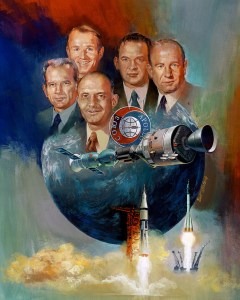
S75-25941 (April 1975) — An Apollo-Soyuz Test Project (ASTP) symbolic painting by artist Bert Winthrop of Rockwell International Space Division, Downey, California. The artwork is composed of the ASTP mission insignia, the docked Apollo-Soyuz spacecraft, and portraits of the five ASTP prime crewmen, all superimposed against Earth’s sphere in the center of the picture. The launches of both the American ASTP space vehicle (on left) and the Soviet ASTP space vehicle are depicted in the lower right corner. The five crewmen are, clockwise from the ASTP emblem, astronaut Thomas P. Stafford, commander of the American crew; astronaut Donald K. Slayton, docking module pilot of the American crew; astronaut Vance D. Brand, command module pilot of the American crew; cosmonaut Valeriy N. Kubasov, engineer on the Soviet crew; and cosmonaut Aleksey A. Leonov, commander of the Soviet crew. The joint U.S.-USSR ASTP docking mission in Earth orbit is scheduled for July 1975.

Image credit: NASA JSC
Image source: NASA Images

6868469

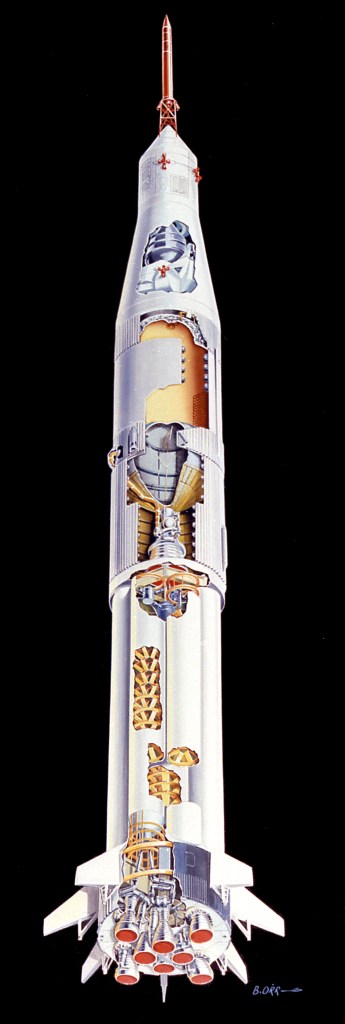
This undated cutaway drawing illustrates the Saturn IB launch vehicle with its two booster stages, the S-IB and S-IVB. Developed by the Marshall Space Flight Center (MSFC) as an interim vehicle in MSFC’s “building block” approach to the Saturn rocket development, the Saturn IB utilized Saturn I technology to further develop and refine the larger boosters and the Apollo spacecraft capabilities required for the marned lunar missions.

Image credit: NASA MSFC
Image source: NASA Images
Gemini IV

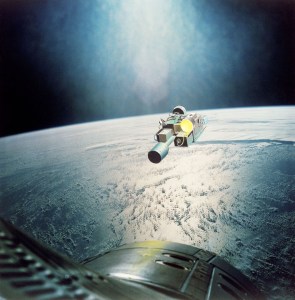
S65-28653 (August 1965) — Rendezvous Evaluation Pod (REP) in orbit is approached by Gemini spacecraft as seen in this artist’s concept using an actual photograph taken on the Gemini-4 mission. The REP is superimposed over a Gemini-4 Earth-sky picture of cloud formations over an ocean. The REP will be used by the crew of the Gemini-5 spacecraft to practice rendezvous techniques.

Image credit: NASA JSC
Image source: NASA Images

S71-39481

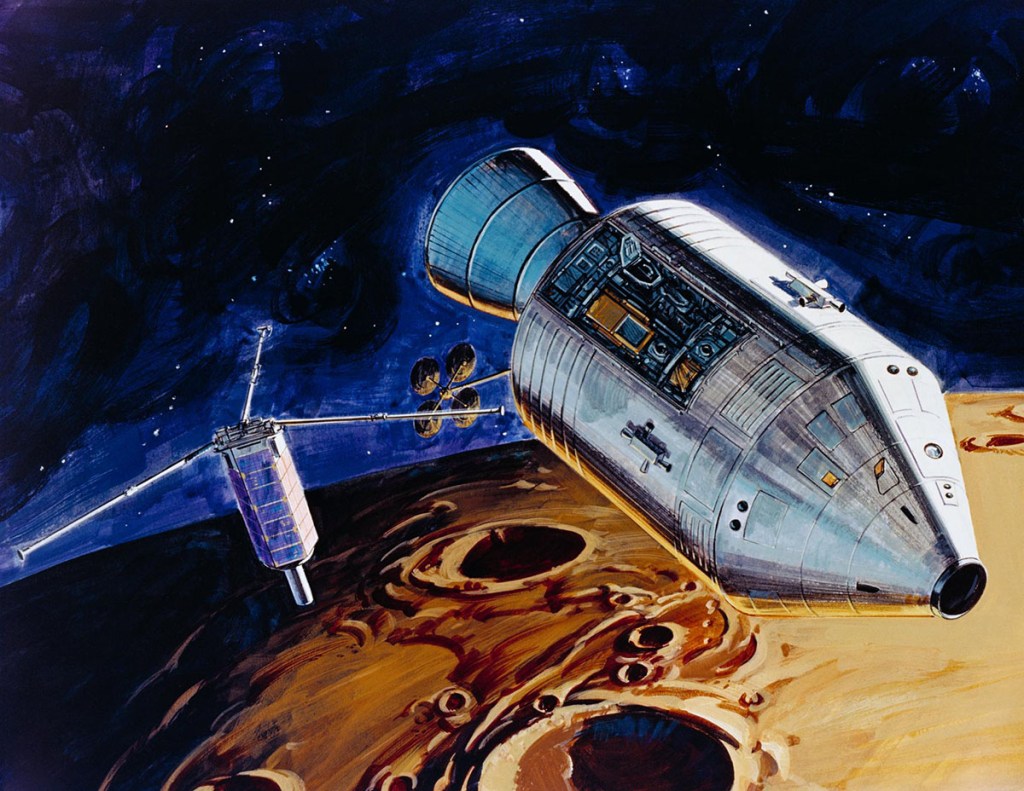
S71-39481 (July 1971) — An artist’s concept showing TRW’s small lunar subsatellite being ejected into lunar orbit from the SIM bay of the Apollo 15 Service Module. The 80-pound satellite will remain in orbit a year or more, carrying scientific experiments to study space in the vicinity of the moon. The satellite carries three experiments: S-Band Transponder; Particle Shadows/Boundary Layer Experiment; and Subsatellite Magnetometer Experiment. The subsatellite is housed in a container resembling a rural mailbox, and when deployed is spring-ejected out-of-plane at 4 fps with a spin rate of 140 rpm. After the satellite booms are deployed, the spin rate is stabilized at about 12 rpm. The subsatellite is 31 inches long and has a 14 inch hexagonal diameter. The exact weight is 78.5 pounds. The folded booms deploy to a length of five feet. Subsatellite electrical power is supplied by a solar cell array outputting 25 watts for dayside operation and a rechargeable silver-cadmium battery for nightside passes.

Image credit: NASA JSC
Image source: NASA Images