Can We Get to MARS?

  1. Cutaway of plane in the foreground shows personnel, tractors in ship.
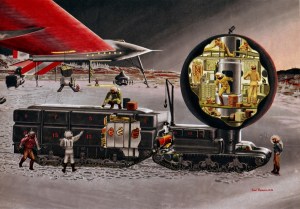
  2. Advance party, after landing on Martian snow in ski-equipped plane, prepares for trip to equator. Men live in inflatable, pressurized spheres mounted on tractors, enter and leave through air locks in the central column. Sphere on tractor is just being blown up. Cutaway of tractor, foreground, shows closed-circuit engine, run by hydrogen peroxide, oil. Trailer cutaway shows fuel supply, cargo.

Is there Life on Mars?
Collier’s, April 30, 1954

Image credit: Collier’s
Image source: AIAA Houston

620 Miles Above Mars

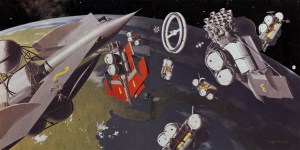
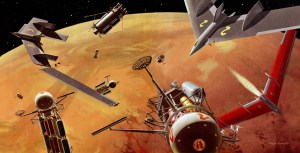
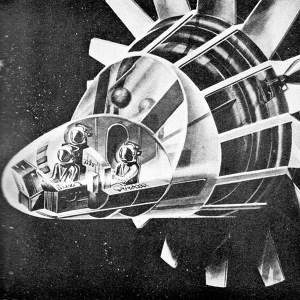
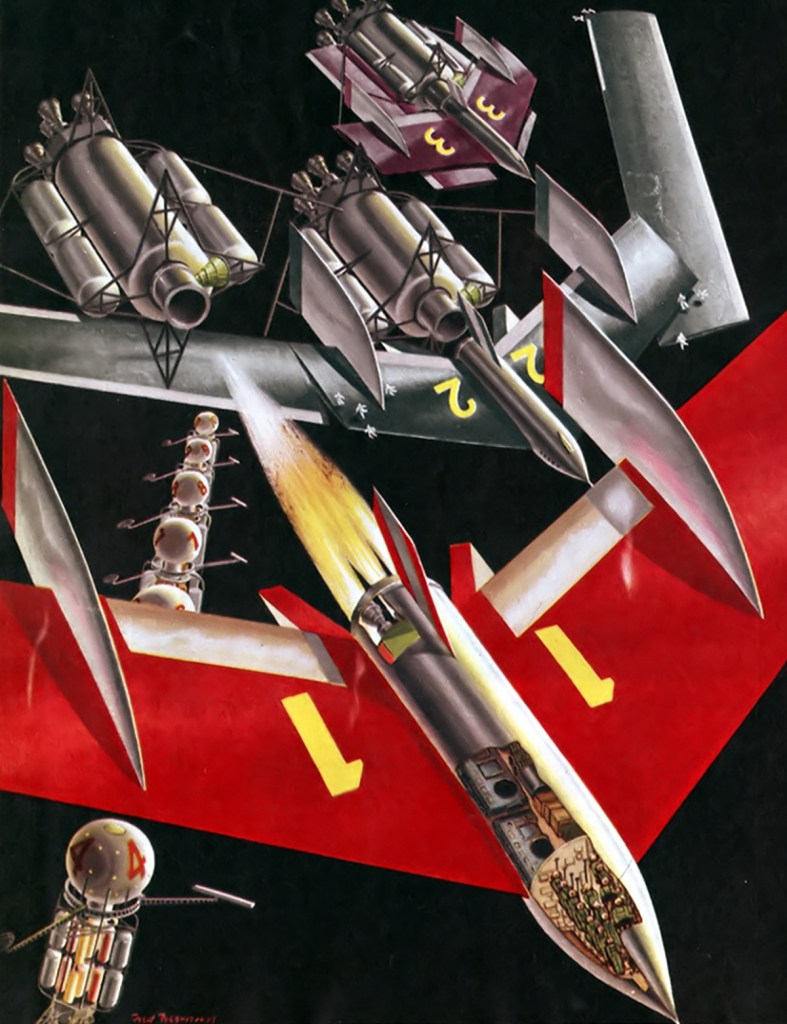
  1. Near wheel-shaped space station 1,000 miles from the earth, built especially for assembly of the Mars expedition, weightless workers put together 10 rocket ships required for the flight. Three of the huge space craft have torpedo noses which convert to planes for landing on the planet.
  2. The first landing party takes off for Mars. Two other landing planes will wait until runway is prepared for them, and then the remaining seven ships will stay in 600-mile orbit. Arms on cargo ships hold screenlike dish antennas (for communication), trough-shaped solar mirrors (for power).

Is there Life on Mars?
Collier’s, April 30, 1954

Image credit: Collier’s
Image source: AIAA Houston

Return Flight

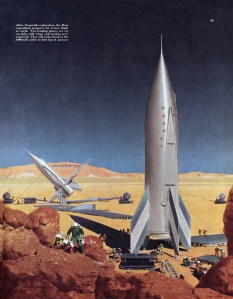
After 15 month exploration, the Mars expedition prepares for return flight to earth. Two landing planes are set on tails, with wings and landing gear removed. They will rocket back to the 600-mile orbit on first leg of journey.

Is there Life on Mars?
Collier’s, April 30, 1954

Image credit: Collier’s
Image source: AIAA Houston

Unloading on the Moon

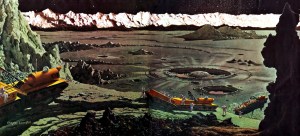
The unloading on the moon. Twenty-four hours after landing, supplies have been stowed in caterpillar tractors. Hold of cargo ship (r.) is being lowered to ground in sections, to be used as prefabricated headquarters, Earth is at center; halo effect is caused by sun, hidden behind sphere of rocket ship at left. Diagonal streak in sky, the zodiacal light, is caused by sun’s ray reflecting from cosmic dust. The red star at left is Mars.

More about Man on the Moon
Collier’s, October 25, 1952

Image credit: Collier’s
Image source: AIAA Houston
The Exploration

Causing moonquakes. Rockets with explosive war heads are fired off and scientists check the vibrations waves caused by distant blast, to determine interior composition of the moon. Seismograph in foreground is push-button controlled and surveying instrument to it’s left has cupped headpiece, to accommodate hooks and helmets of expedition members.

More about Man on the Moon
Collier’s, October 25, 1952

Image credit: Collier’s
Image source: AIAA Houston
The Journey

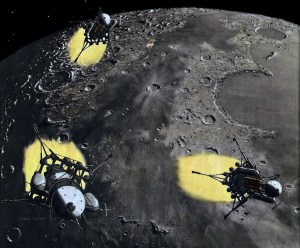
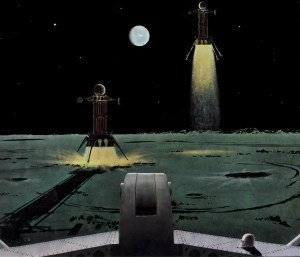
Landing on the moon. Ten minutes before touchdown, rocket motors are switched on to slow down ships’ high-speed fall caused by the moon’s gravity. Vehicles are maneuvering 550 miles above landing area known as Sinus Roris (Dewy Bay), dark plain above cargo ship in lower left.

Man on the Moon
Collier’s, October 18,1952

Image credit: Colliers
Image source: AIAA Houston
Stowed Vent Array

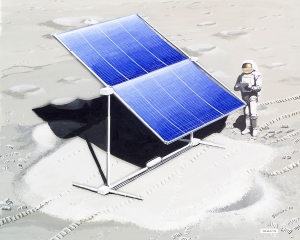
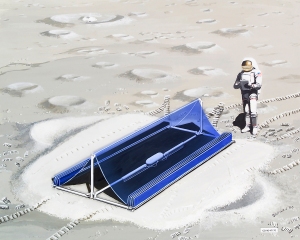
In this series by Lewis Research Center artist Les Bossinas, an astronaut demonstrates multi-purpose solar arrays. As it harnesses the power of the sun, the first can be configured as a wind-tunnel for protecting strawberries or used as a tent for children’s garden parties. The second model can be used as a balance beam for gymnastics, a ping pong table, or folded up to create a porch screen. Just the thing for an evening cocktail while watching the sunset.

Image credit: NASA LRC
Image source: DVIDS

Moving The Playhouse

Or, “Articulated Lunar Rover Lunar Excavator.”

Image credit: NASA LRC
Image source: DVIDS

Ready Or Not!

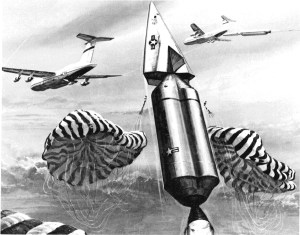
A Lockheed artist’s impression of a novel method of taking a unique and untried method of orbital delivery and making it even more unique and more untried. As my wife said to me in the giftshop of the Palm Springs Aerial Tramway, “Baby, I’ll take the car and see you up there!”

Image credit: Lockheed
Image source: AFMC 

Martin Apollo

see also:

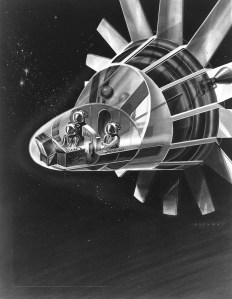
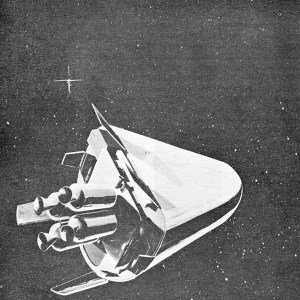
L. Apollo is pictured here by an artist of The Martin Co., one of three leading Space Age manufacturers awarded study contracts on project by NASA. Apollo was a god of Ancient Greece, son of Clymene and Titan. This is nicely appropriate, since Martin produces the mighty Titan intercontinental ballistic missile.

R. The Apollo lunar spacecraft planned to carry 3 crewmen on round trip between earth and the moon is shown above here enroute among the stars. Protruding fan-shapes are solar arrays to gather energy from sun for use aboard. Apollo was said to have been the triumphant participant in Olympic games. Homer called him the “god of prophecy.”

America’s Mightiest Missile
by Larry Eisinger
Arco Publishing, 1961

Image credit: NASA
Image source(s): Mike Acs, Numbers Station

Short Final

Stunning representation of a NAR Phase A orbiter about to land by Henry Lozano Jr., from the collection of everyone’s favorite space archivist.

Image credit: North American Rockwell
Image source: Mike Acs