Image credit: Convair
Image source: SDASM Archives
Image credit: Convair
Image source: SDASM Archives
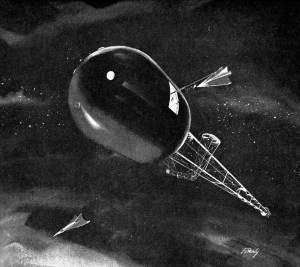
A Boeing design for a manned orbital or interplanetary reconnaissance vehicle. The vehicle would be built in orbit around the earth around the Earth, inside a plastic bubble having controlled atmosphere and pressure, permitting technicians to work without space suits. Propelled by a nuclear-powered plasma jet, it could travel to planets within our solar-system , carrying shuttle vehicles to make the actual observations of planet surfaces. Nylon nets, rather than flooring, would divide the vehicle into seven levels.
Eagle Book of Rockets and Space
by John W.R. Taylor and Maurice Allward
Longacre Press, 1961
Image credit: Boeing Aircraft Company
Image source: Numbers Station
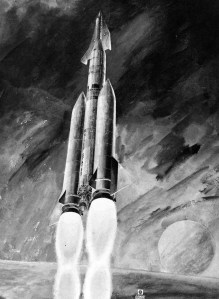
330-PSA-279-62 (USAF 167026): Artwork by George Mathis of how the Air Force Titan III Standard Launch Vehicle may look boosting the United States Air Force X-20 (Dyna-Soar) into orbit, August 1962.
Image credit: Boeing
Image source: National Museum of U.S. Navy
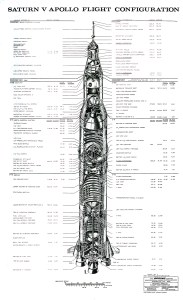
The Saturn V configuration is shown in inches and meters as illustrated by the Boeing Company. The Saturn V vehicle consisted of three stages: the S-IC (first) stage powered by five F-1 engines, the S-II (second) stage powered by five J-2 engines, the S-IVB (third) stage powered by one J-2 engine. A top for the first three stages was designed to contain the instrument unit, the guidance system, the Apollo spacecraft, and the escape system. The Apollo spacecraft consisted of the lunar module, the service module, and the command module. The Saturn V was designed perform lunar and planetary missions and it was capable of placing 280,000 pounds into Earth orbit.
Image credit: NASA MSFC
Image source: NASA Images
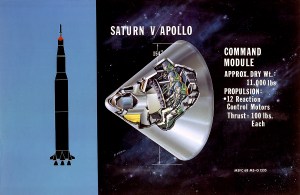
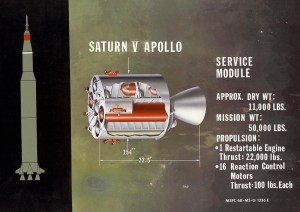
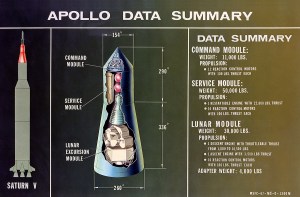
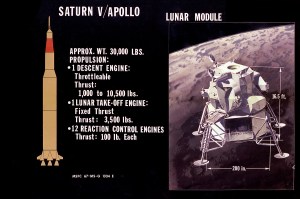
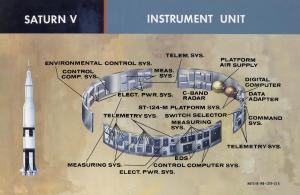
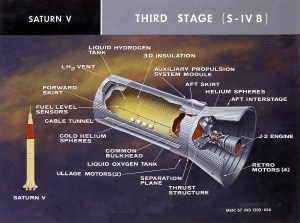
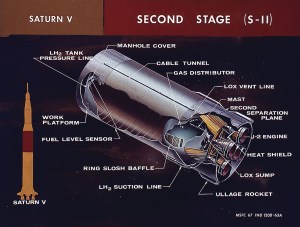
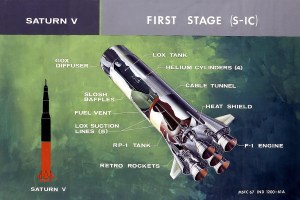
Image credit: NASA MSFC
Image source: NASA Images
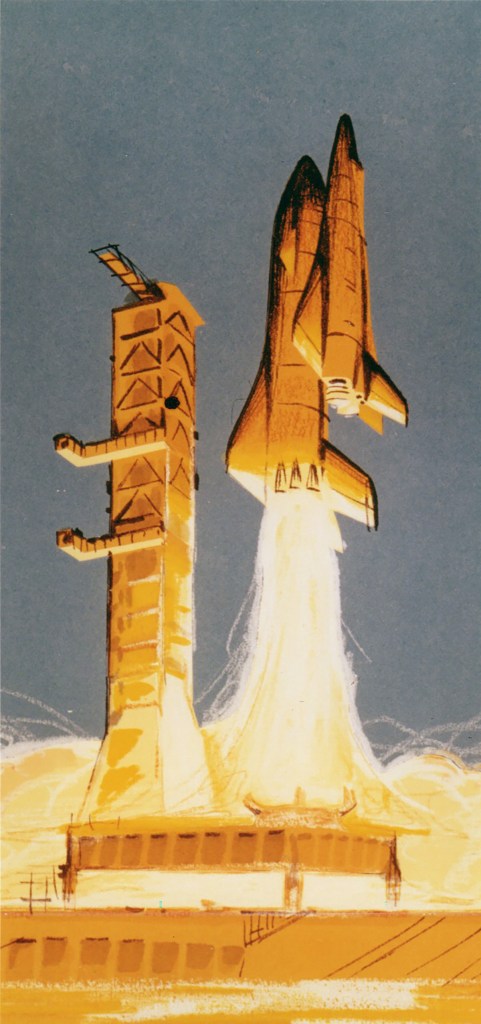
Image credit: North American Rockwell
Image source: Numbers Station
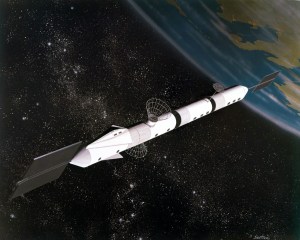
Image credit: Convair
Image source: SDASM Archives
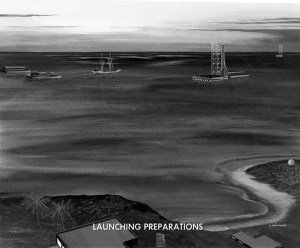
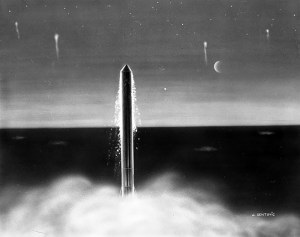
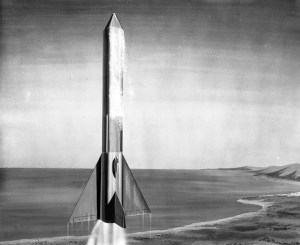

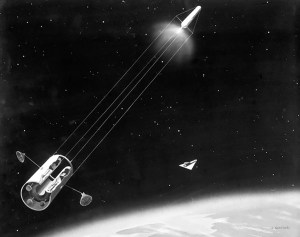
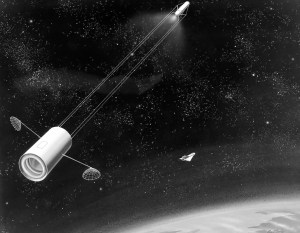
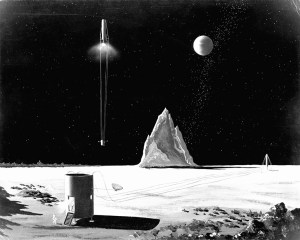
Image credit: Convair
Image source: SDASM Archives
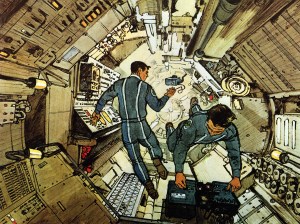
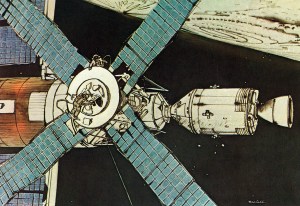
Our World in Space
Robert McCall & Isaac Asimov
New York Graphic Society, 1974
Image credit: NASA
Image source: Numbers Station
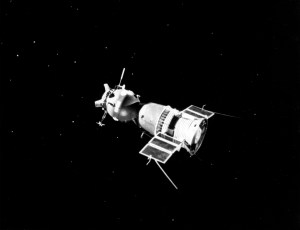
DECEMBER 1974
MOSCOW, UNION OF SOVIET SOCIALIST REPUBLICS
SOYUZ 16 CONCEPT —- An artist’s concept depicting the Soviet Soyuz 16 spacecraft in Earth orbit. The six-day Soyuz 16 Earth-orbital mission flown December 2-8, 1974, was a Soviet rehearsal for the joint U.S.-USSR Apollo-Soyuz Test Project. The crew of Soyuz 16 was Cosmonauts Anatolly V. Filipophenko, commander; and Hikolay H. Rukavishnikov, engineer. These two me are the Soviet ASTP second (back-up) crew, also. The three major components of the Soyuz spacecraft are the sphere-shaped orbital module, the decent vehicle (in center), and the instrument assembly module. Two solar panels extend out from the IA module. A docking mechanism to test the Soviet ASTP androgenous docking system (seen attached to the orbital module) was flown on the Soyuz 16 flight. This picture was made from a frame of 35mm motion picture film.
PHOTO COURTESY: USSR ACADEMY OF SCIENCES
PHOTO CREDIT: NASA or National Aeronautics and Space Administration
Image credit: NASA
Image source: Numbers Station
Image credit: North American Rockwell
Image source: Numbers Station