Project Viking: Space Conquest Beyond the Moon
by Irwin Stambler
G.P. Putnam’s Sons, 1970
Image credit: NASA
Image source: Numbers Station
Project Viking: Space Conquest Beyond the Moon
by Irwin Stambler
G.P. Putnam’s Sons, 1970
Image credit: NASA
Image source: Numbers Station
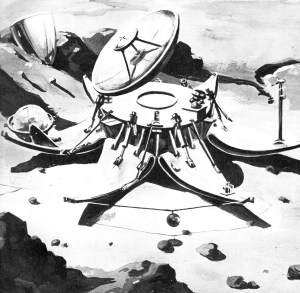
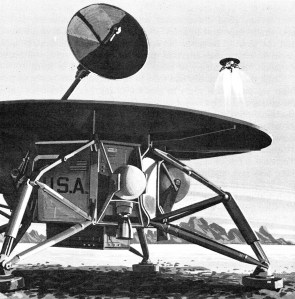
Prime goal of Project Viking is this National Aeronautics and Space Administration sketch, to land a biological laboratory on the surface of Mars. The picture shows a design in which the protective housing around the experiments unfolds in petal fashion once the laboratory is safely on the Martian surface.
Project Viking: Space Conquest Beyond the Moon
by Irwin Stambler
G.P. Putnam’s Sons, 1970
Image credit: NASA
Image source: Numbers Station
Project Viking: Space Conquest Beyond the Moon
by Irwin Stambler
G.P. Putnam’s Sons, 1970
Image credit: NASA
Image source: Numbers Station
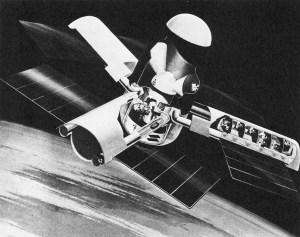
Three-armed LORL is shown in this artist’s sketch. Center hub, which contains parking area for several space ferries, does not rotate and thus remains weightless. Under the parking area is a laboratory for study of weightlessness. The three arms rotate around the hub to create artificial gravity. Cutaway of one arm shows it to contain a series of rooms for other laboratory requirements and studies.
Orbiting Stations: Stopovers to Space Travel
Irwin Stambler
G.P. Putnam’s Sons, 1965
Image credit: Lockheed
Image source: Numbers Station

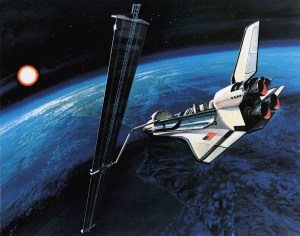
A spaceport and supply rocket designed by the Martin Marietta Corporation in mid-air in this scene from the Hall of Science space show. In such a port, astronauts may orbit for half a year.
New York World’s Fair 1964/1965
Official Souvenir Book
Time Life, 1964
Image credit: Martin Marietta
Image source: Numbers Station

Image credit: Lockheed
Image source: AFMC



Orbiting Stations: Stopovers to Space Travel
Irwin Stambler
G.P. Putnam’s Sons, 1965
Image credit: Martin Marietta
Image source: Numbers Station