Image credit: NASA
Image source: Mike Acs
Image credit: General Electric
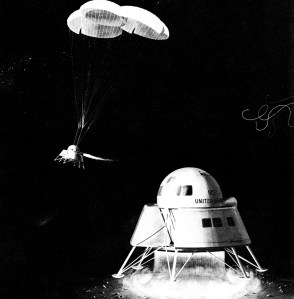
First manned landing on Mars! This Northrop sketch shows how a soft landing on the red planet might look from ground level. A steerable gliding cloverleaf parachute slows the craft down as the retrorockets start to fire. The parachute is then jettisoned, and the retrorockets perform the final maneuver for touchdown. Retrorocket braking was perfected in the 1960’s to provide the soft landings for the Surveyor moon probe.
Project Viking: Space Conquest Beyond the Moon
by Irwin Stambler
G.P. Putnam’s Sons, 1970
Image credit: NASA
Image source: Numbers Station
Project Viking: Space Conquest Beyond the Moon
by Irwin Stambler
G.P. Putnam’s Sons, 1970
Image credit: NASA
Image source: Numbers Station
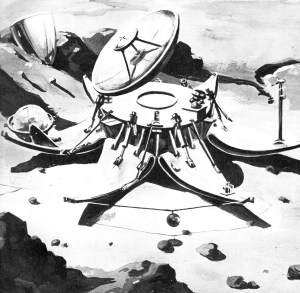
Prime goal of Project Viking is this National Aeronautics and Space Administration sketch, to land a biological laboratory on the surface of Mars. The picture shows a design in which the protective housing around the experiments unfolds in petal fashion once the laboratory is safely on the Martian surface.
Project Viking: Space Conquest Beyond the Moon
by Irwin Stambler
G.P. Putnam’s Sons, 1970
Image credit: NASA
Image source: Numbers Station
Project Viking: Space Conquest Beyond the Moon
by Irwin Stambler
G.P. Putnam’s Sons, 1970
Image credit: NASA
Image source: Numbers Station
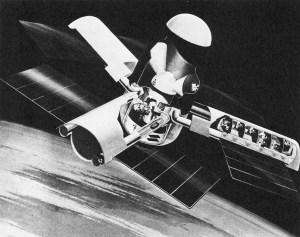
Three-armed LORL is shown in this artist’s sketch. Center hub, which contains parking area for several space ferries, does not rotate and thus remains weightless. Under the parking area is a laboratory for study of weightlessness. The three arms rotate around the hub to create artificial gravity. Cutaway of one arm shows it to contain a series of rooms for other laboratory requirements and studies.
Orbiting Stations: Stopovers to Space Travel
Irwin Stambler
G.P. Putnam’s Sons, 1965
Image credit: Lockheed
Image source: Numbers Station

Image credit: Lockheed
Image source: AFMC
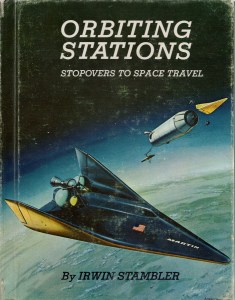
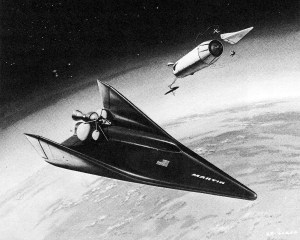
Orbiting Stations: Stopovers to Space Travel
Irwin Stambler
G.P. Putnam’s Sons, 1965
Image credit: Martin Marietta
Image source: Numbers Station