Image credit: NASA
Image source: Numbers Station
Image credit: NASA
Image source: Numbers Station
Image credit: NASA
Image source: NM Museum of Space History
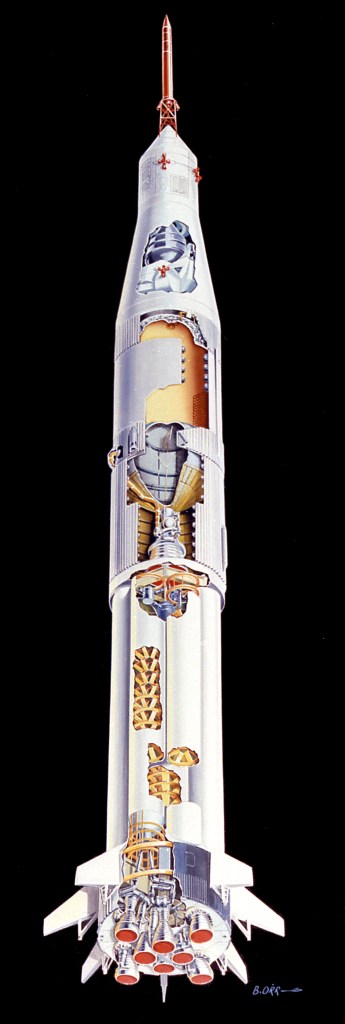
This undated cutaway drawing illustrates the Saturn IB launch vehicle with its two booster stages, the S-IB and S-IVB. Developed by the Marshall Space Flight Center (MSFC) as an interim vehicle in MSFC’s “building block” approach to the Saturn rocket development, the Saturn IB utilized Saturn I technology to further develop and refine the larger boosters and the Apollo spacecraft capabilities required for the marned lunar missions.
Image credit: NASA MSFC
Image source: NASA Images
Image credit: NASA
Image source: NASA Johnson
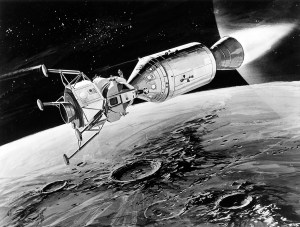
Image credit: NASA
Image source: Mike Acs
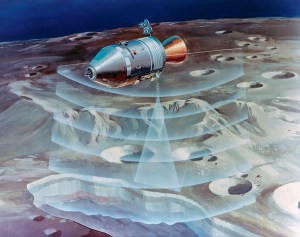
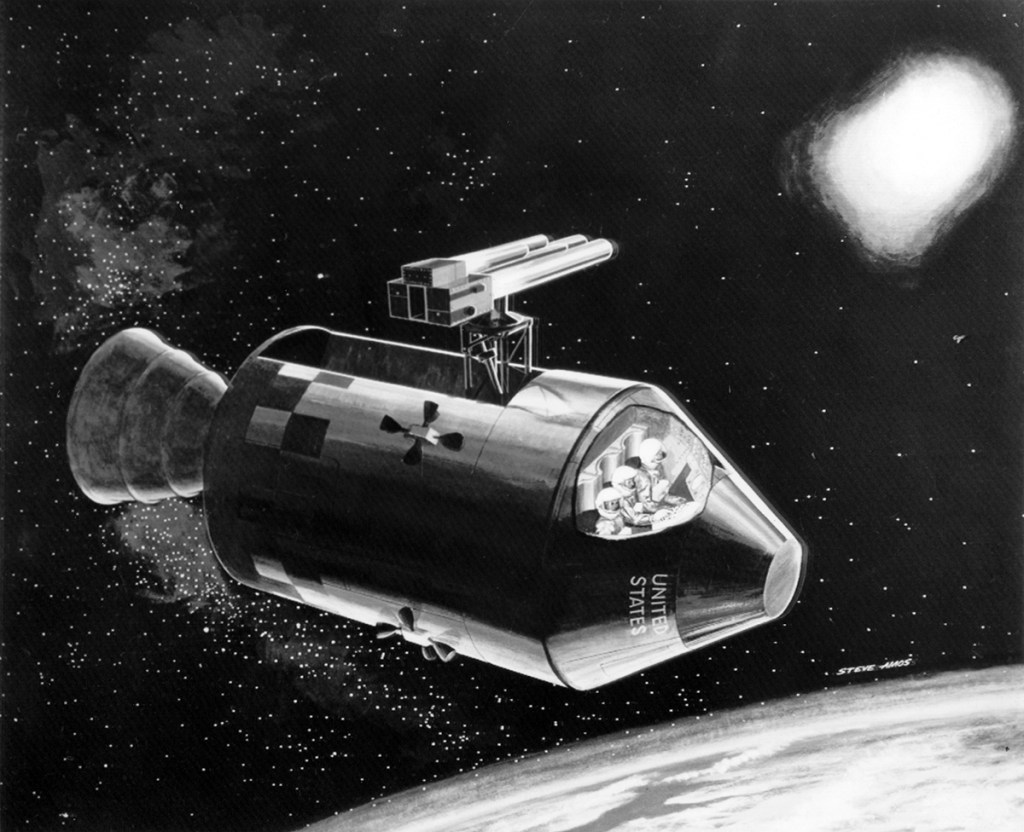
S72-53472 (November 1972) — An artist’s concept illustrating how radar beams of the Apollo 17 lunar sounder experiment will probe three-quarters of a mile below the moon’s surface from the orbiting spacecraft. The Lunar Sounder will be mounted in the SIM bay of the Apollo 17 Service Module. Electronic data recorded on film will be retrieved by the crew during trans-Earth EVA. Geologic information on the lunar interior obtained by the sounder will permit scientific investigation of underground rock layers, lava flow patterns, rille (canyon) structures, mascon properties, and any areas containing water. A prototype lunar sounder has been flight tested in aircraft over selected Earth sites to confirm the equipment design and develop scientific analysis techniques. The Lunar Sounder Experiment (S-209) was developed by North American Rockwell’s (NR) Space Division for NASA’s Manned Spacecraft Center to provide data for a scientific investigation team with representatives from the Jet Propulsion Laboratory, University of Utah, University of Michigan, U.S. Geological Survey, and NASA Ames Research Center.
Image credit: NASA JSC
Image source: NASA Images

Image credit: NASA
Image source: National Archives
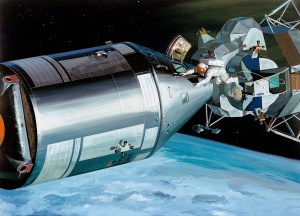
S69-18547 (1969) — North American Rockwell artist’s concept illustrating a part of the planned Apollo 9 extravehicular activity on the fourth day of the mission as the Command and Service Modules are docked to the Lunar Module. The figure performing the EVA represents astronaut Russell L. Schweickart, Apollo 9 lunar module pilot.
Image credit: NASA Johnson
Image source: NASA Images