Image credit: General Electric
Image credit: General Electric
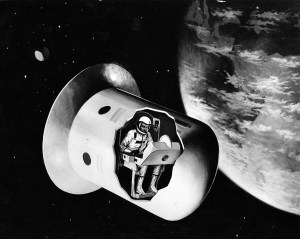
Image credit: General Electric
Image source: Numbers Station
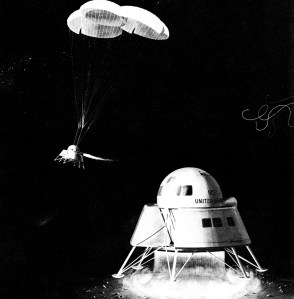
First manned landing on Mars! This Northrop sketch shows how a soft landing on the red planet might look from ground level. A steerable gliding cloverleaf parachute slows the craft down as the retrorockets start to fire. The parachute is then jettisoned, and the retrorockets perform the final maneuver for touchdown. Retrorocket braking was perfected in the 1960’s to provide the soft landings for the Surveyor moon probe.
Project Viking: Space Conquest Beyond the Moon
by Irwin Stambler
G.P. Putnam’s Sons, 1970
Image credit: NASA
Image source: Numbers Station
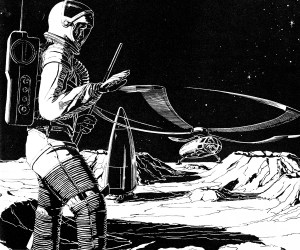
Project Viking: Space Conquest Beyond the Moon
by Irwin Stambler
G.P. Putnam’s Sons, 1970
Image credit: NASA
Image source: Numbers Station
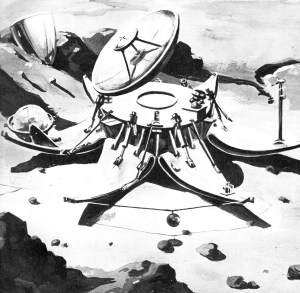
Prime goal of Project Viking is this National Aeronautics and Space Administration sketch, to land a biological laboratory on the surface of Mars. The picture shows a design in which the protective housing around the experiments unfolds in petal fashion once the laboratory is safely on the Martian surface.
Project Viking: Space Conquest Beyond the Moon
by Irwin Stambler
G.P. Putnam’s Sons, 1970
Image credit: NASA
Image source: Numbers Station
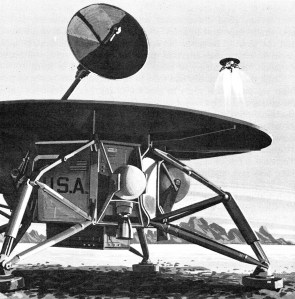
Project Viking: Space Conquest Beyond the Moon
by Irwin Stambler
G.P. Putnam’s Sons, 1970
Image credit: NASA
Image source: Numbers Station
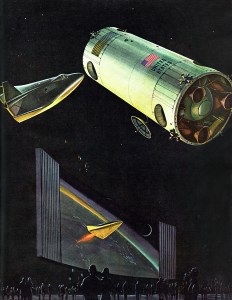
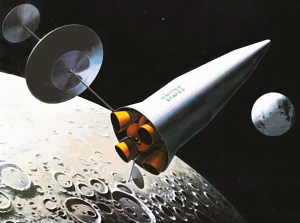
A spaceport and supply rocket designed by the Martin Marietta Corporation in mid-air in this scene from the Hall of Science space show. In such a port, astronauts may orbit for half a year.
New York World’s Fair 1964/1965
Official Souvenir Book
Time Life, 1964
Image credit: Martin Marietta
Image source: Numbers Station

Image credit: Convair
Image source: SDASM Archives
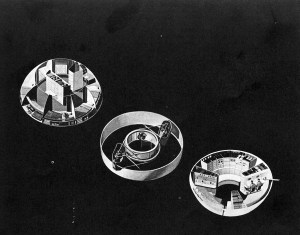
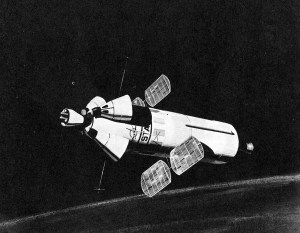
Space World
November 1964, VOL. A-13
Image credit: Douglas
Image source: SDASM Archives

A manned orbital space space laboratory would be able to operate for several months without resupply. Basic Garrett-AiResearch systems could be slightly modified to meet requirements for environmental control, life support, cryogenic storage, power and attitude control for both the command module and laboratory.
Space World
December 1964, VOL. A-14
Image credit: Garrett-AiResearch
Image source: Numbers Station
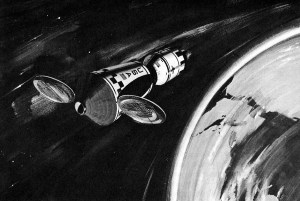
Medium-sized orbiting lab is this Manned Orbital Research Laboratory (MORL) developed for NASA’s Langley Lab by Douglas Missiles & Spacecraft Division. The lab which weighs about 35,000 pounds, could maintain 3 to 6 men in orbit for a year.
Orbiting Stations: Stopovers to Space Travel
Irwin Stambler
G.P. Putnam’s Sons, 1965
Image credit: Douglas
Image source: SDASM Archives