S89-20088

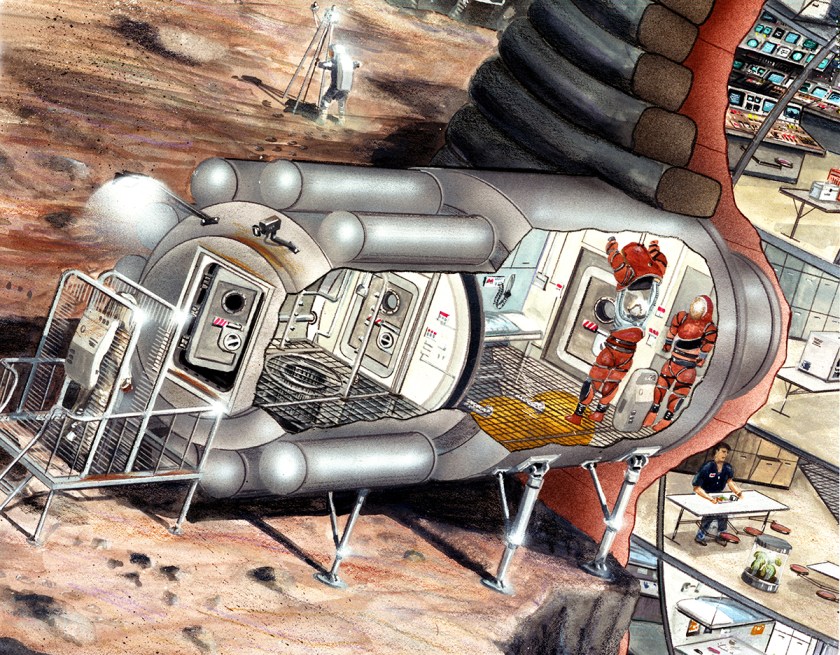
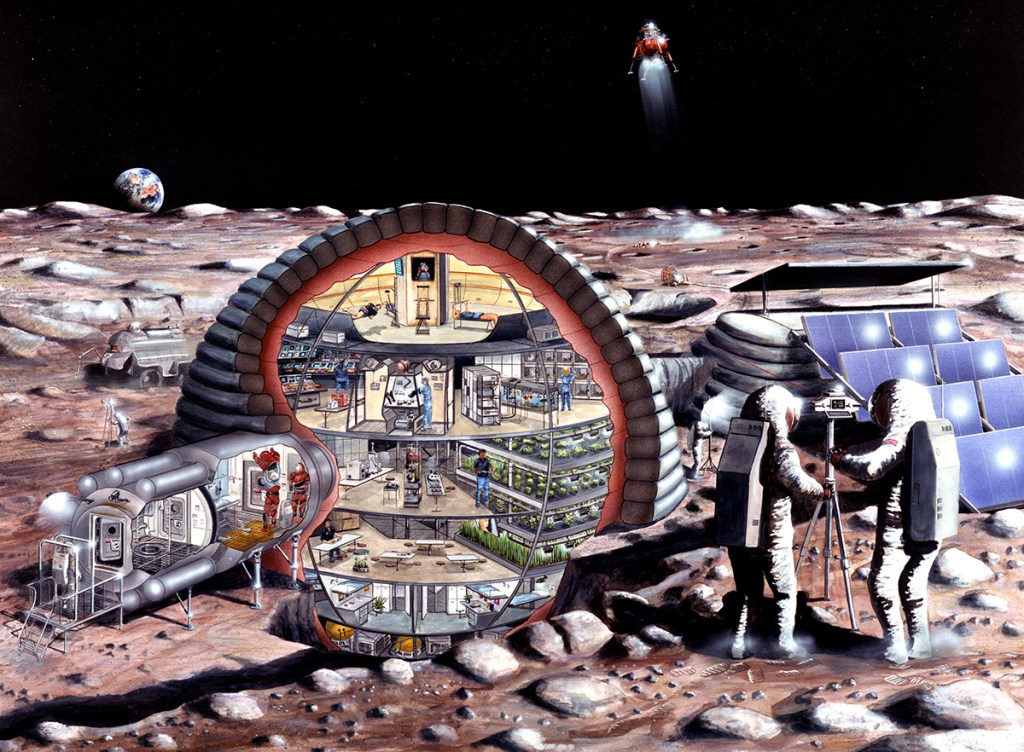
S89-20088 (July 1989) — With a number of studies ongoing for possible lunar explorations, many concepts for living and working on Earth’s natural satellite have been examined. This art concept reflects the evaluation and study at JSC by the Man Systems Division and Johnson Engineering personnel. A major concern of planners is the fine dust which covers the lunar surface and collects easily on astronauts garments, as evidenced by six crews of Apollo moon explorers. This special annex to the 16-meter diameter inflatable habitat (depicted in S89-20084/85) provides possible solutions to the dust problems, according to teams studying possible lunar expeditions. As much dust as possible must be removed, they say, before re-entering the habitat. The astronauts might pass through wickets (far left) which remove much of the dust. A performated metal “porch” would allow dust to fall through. Once inside the dust lock (center) the astronauts would remove their white coveralls. This outer garment would provide an extra layer of dust control and protection for the precision moving joints of the space suit from gritty dust. An air shower could remove remaining dust with strong jets of air. An astronaut at right, after having removed as much dust as possible, would be able then to move into the airlock to doff his suit. The airlock could accommodate up to four astronauts at one time. Suits could be stored there when not in use.

Image credit: NASA

Image source: NASA Johnson
S89-20084

S89-20084 (July 1989)— With a number of studies ongoing for possible lunar expeditions, many concepts for living and working on Earth’s natural satellite have been examined. This art concept reflects the evaluation and study at JSC by the Man Systems Division and Johnson Engineering personnel. A sixteen-meter diameter inflatable habitat such as the one depicted here could accommodate the needs of a dozen astronauts living and working on the surface of the Moon. Depicted are astronauts exercising, a base operations center, a pressurized lunar rover, a small clean room, a fully equipped life sciences lab, a lunar lander, selenological work, hydroponic gardens, a wardroom, private crew quarters, dust-removing devices for lunar surface work and an airlock.

Image credit: NASA

Image source: NASA Johnson
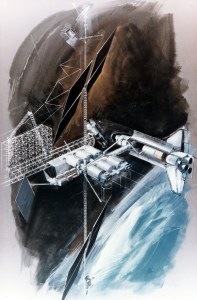
Boeing Promo Photo

Image credit: Boeing
Image source: Mike Acs

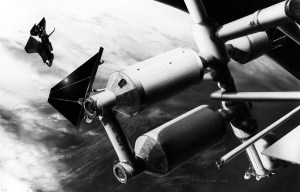
Boeing Space Operations Center

Image credit: Boeing
Image source: Mike Acs

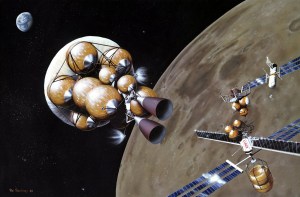
S-83-28321

S83-28321 (14 March 1983) — In this artist’s concept of future lunar operations, a lunar ferry is about to burn out of lunar orbit for the trip back to facilities in low Earth orbit. The ferry vehicle carries tank modules filled with liquid oxygen, which has been produced from mining operations on the surface of the Moon. One possibility for such operations would be to have manned facilities in low lunar orbit, such as illustrated here. At the upper right side of the photo is a small orbiting manned station. At the lower right side of the photo is a liquid oxygen propellant dump, to which a lunar landing vehicle carrying liquid oxygen is about to dock. The lunar ferry vehicle itself is representative of one type of aerobraking system. The balloon-like torus around the center of the ferry-craft would inflate to several times its illustrated size and, once the vehicle has swooped down close to the Earth’s outer atmosphere on the return journey, would use atmospheric drag to slow the craft and place itself in low Earth orbit. The liquid oxygen would then be used in operations there for fueling various vehicles, including an orbital transfer vehicle for trips to geosynchronous Earth orbit. This concept is part of a study done for the Johnson Space Center by Eagle Engineering of Houston. The artist was Pat Rawlings.

Image credit: Eagle Engineering
Image source: Internet Archive

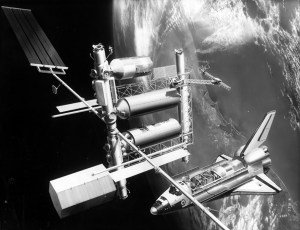
Space Ops Center

Image credit: Boeing
Image source: SDASM Archives