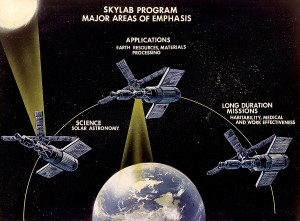
Art Concepts

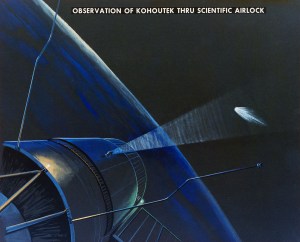
S73-37274 (1973) — An artist’s concept illustrating how the Skylab 4 astronauts will observe, through the scientific airlock of the Orbital Workshop, the passing of the newly-discovered Comet Kohoutek. The favorable location of the Skylab space station in Earth orbit will help provide a comprehensive investigation of the nature and evolution of the coma and tails as the comet approaches, passes, and recedes from the sun. Photo credit: NASA

Image credit: NASA JSC
Image source: NASA Images

Art Concepts

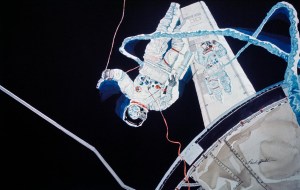
S75-21432 (March 1975) — An artist’s concept illustrating a scene during the June 7, 1973 Skylab 2 extravehicular activity in Earth orbit when astronauts Joseph P. Kerwin (larger figure) and Charles Conrad Jr. cut the aluminum strapping which prevented the Skylab Orbital Workshop solar array system wing from deploying. The solar panel was successfully deployed. The painting is by artist Paul Fjeld. The action portrayed here is about two to four seconds after using the beam erection tether, the two crewmen broke the frozen SAS beam actuators. This artistic effort took weeks to research and a day and a half to paint. Fjeld said that he needed some hundred or so photographs to get all the details for the painting. He struggled through about 300 pages of transcripts from the flight. Also, he used several pages of teleprinter messages which were the actual instructions on the EVA that the two astronauts used in flight. Photo credit: NASA

Image credit: NASA Marshall
Image source: NASA Images
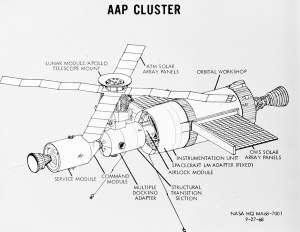
AAP Cluster

Image credit: NASA Marshall
Image source: NASA Images
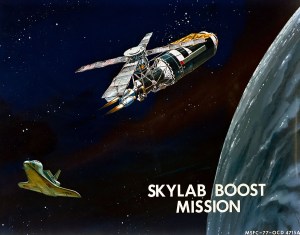
Skylab Boost Mission

Image credit: NASA Marshall
Image source: NASA Images
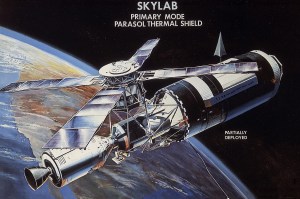
Parasol Thermal Shield

Image credit: NASA
Image source: NASA Marshall

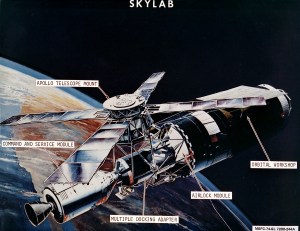
74-SL-7200-244A

Image credit: NASA Marshall
Image source: NASA Images
Skylab

Image credit: NASA Marshall
Image source: NASA Images
Outpost Facilities

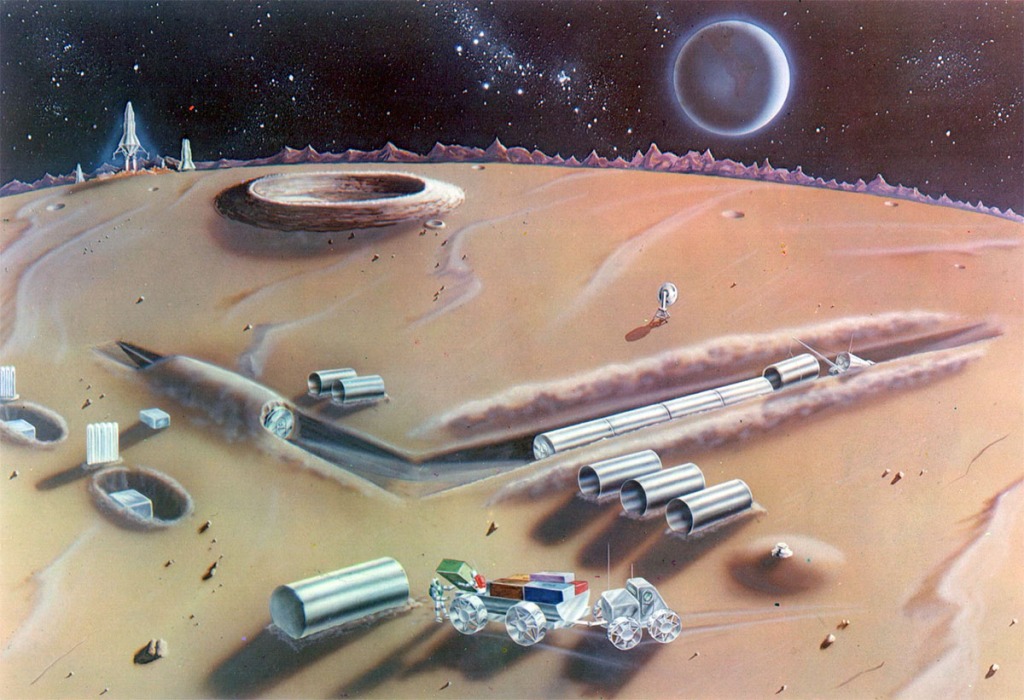
The HORIZON outpost as it appears in late 1965, after about six months of construction effort. The basic building block for the outpost will be cylindrical metal tanks ten feet in diameter and twenty feet in length.

Image credit: United States Army
Image source: NASM

Propellant Transfer

Conceptual view of the operations in the equatorial earth orbit. The operation in orbit is principally one of propellant transfer and it not an assembly job. The vehicle being fueled is the third stage of a SATURN II with a lunar landing and return vehicle attached. The third stage of the SATURN II was used in the combination into orbit and has thus expended its propellants. This stage is fueled into orbit by a detachment of approximately ten men after which the vehicle then proceeds on the moon.

Image credit: United States Army
Image source: NASM