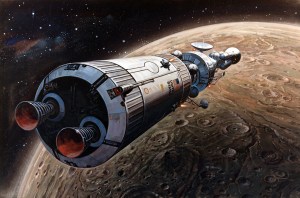
Image credit: Rockwell International
Image source: Mike Acs
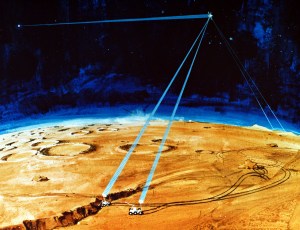
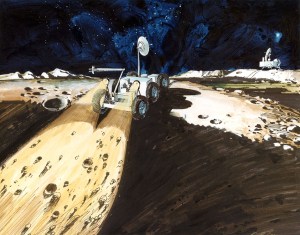
S88-29650 (February 1988)— In this artist’s concept of a 1984 mission to Mars, a pair of Rovers (Vikings on Wheels) would follow up and extend the 1976 Martian explorations. The Rovers would gather scientific data from several wide-ranging areas and send it to the mother Orbiter for relay to Earth. Two pairs of rovers could traverse up to 5 kilometers (3 miles) daily each and help one another as needed.
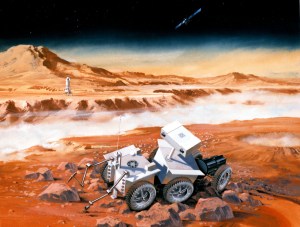
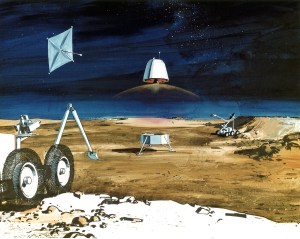
S87-35313 (15 May 1987)— This artist’s rendering illustrates a Mars Sample Return mission under study at Jet Propulsion Laboratory (JPL) and the NASA Johnson Space Center (JSC). As currently envisioned, the spacecraft would be launched in the mid to late 1990’s into Earth-orbit by a space shuttle, released from the shuttle’s cargo bay and propelled toward Mars by an upper-stage engine. A lander (left background) would separate from an orbiting vehicle (upper right) and descend to the planet’s surface. The lander’s payload would include a robotic rover (foreground), which would spend a year moving about the Martian terrain collecting scientifically significant rock and soil samples. The rover would then return to the lander and transfer its samples to a small rocket that would carry them into orbit and rendezvous with the Orbiter for a return to Earth. As depicted here the rover consists of three two-wheeled cabs, and is fitted with a stereo camera vision system and tool-equipped arms for sample collection. The Mars Sample Return studies are funded by NASA’s Office of Space Science and Applications.
Image credit: NASA Johnson
Image source: NASA Images
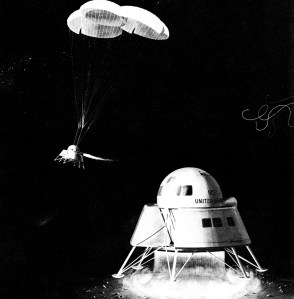
First manned landing on Mars! This Northrop sketch shows how a soft landing on the red planet might look from ground level. A steerable gliding cloverleaf parachute slows the craft down as the retrorockets start to fire. The parachute is then jettisoned, and the retrorockets perform the final maneuver for touchdown. Retrorocket braking was perfected in the 1960’s to provide the soft landings for the Surveyor moon probe.
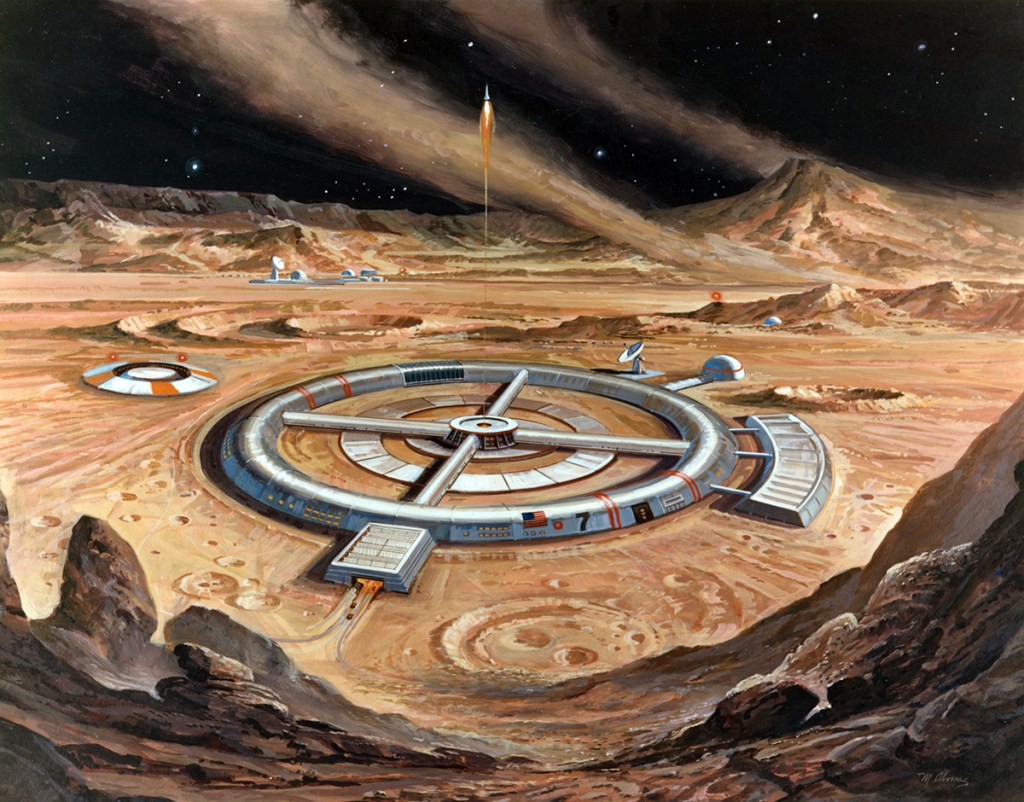
Project Viking: Space Conquest Beyond the Moon
by Irwin Stambler
G.P. Putnam’s Sons, 1970
Image credit: NASA
Image source: Numbers Station
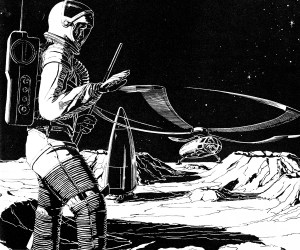
Project Viking: Space Conquest Beyond the Moon
by Irwin Stambler
G.P. Putnam’s Sons, 1970
Image credit: NASA
Image source: Numbers Station