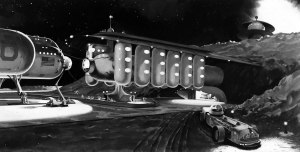
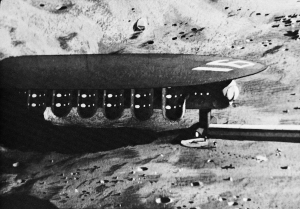
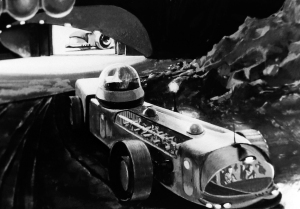
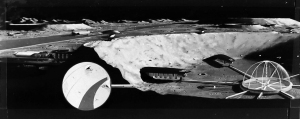
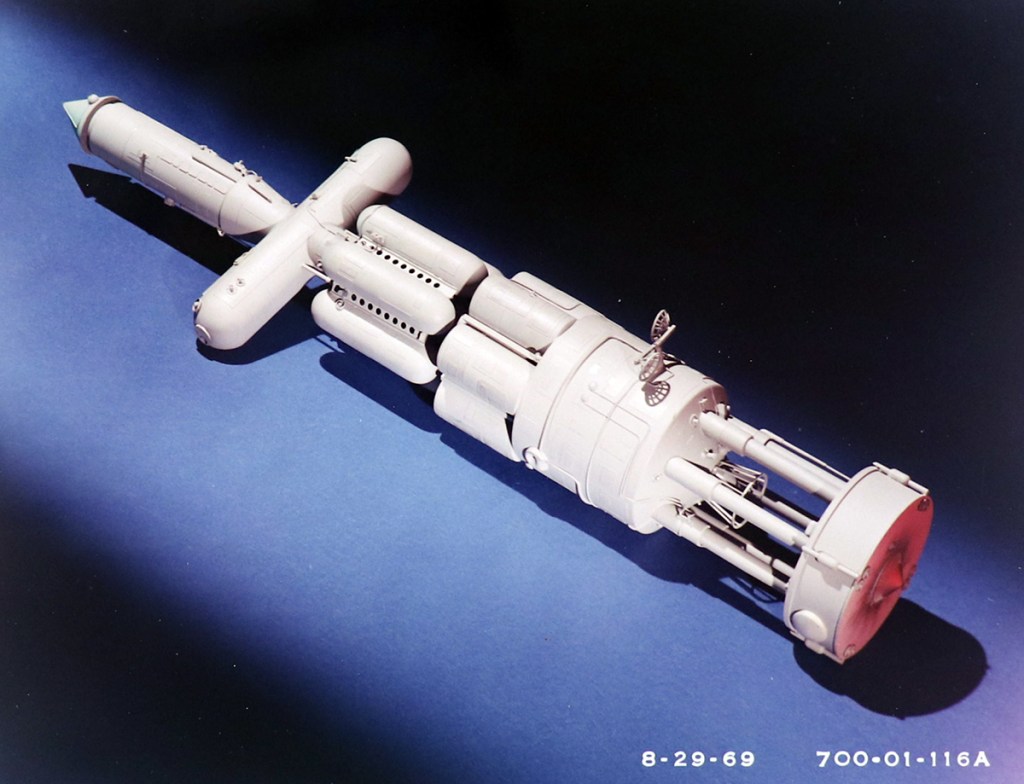
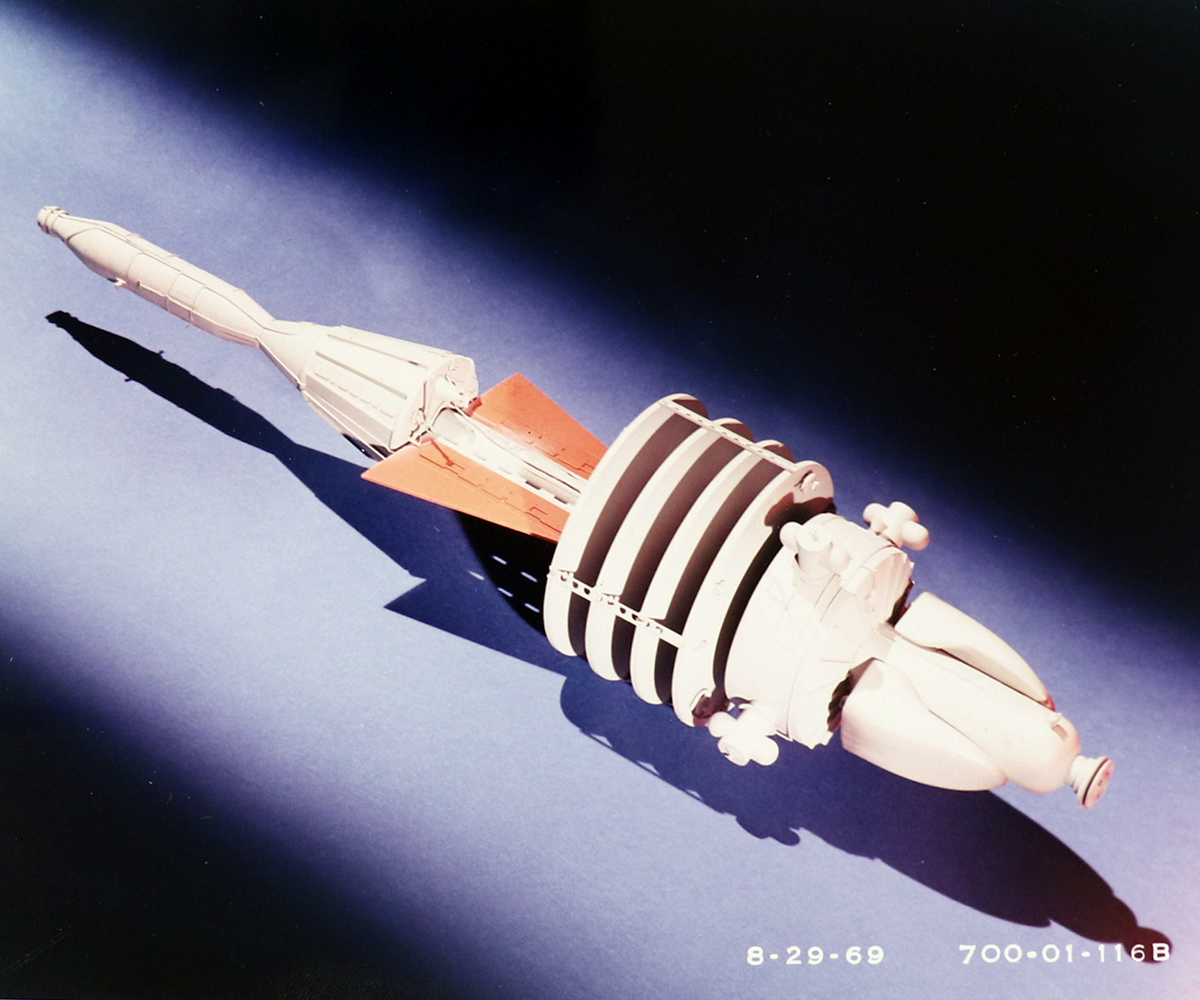
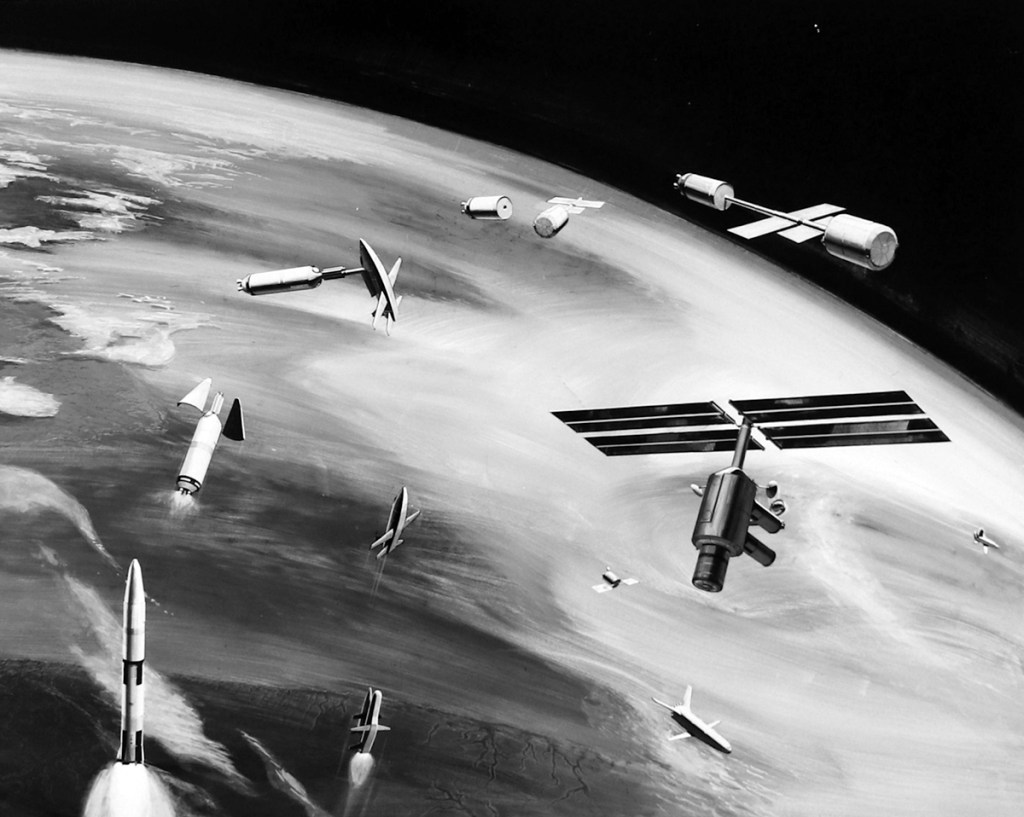
Earth-moon based planetary space port in 1988. Spacecraft are nuclear propelled interplanetary vehicles, launched by solid propellant lift-off rockets side-mounted around center section which, like the cylinders at the spacecraft’s center section, contain nuclear pulse units. In background a large antenna, belonging to the lunar deep space network is visible.
Selenopolis, named after Selene, Goddess of the Moon, is a lunar city-state that could exist by 2029. With a population of about 100,000, it contains all the comforts of “home” (Earth) — plus many features that we don’t have in the terrestrial environment.
Selenopolis is a network of “Quonset hut” – shaped “half tunnel” sections stretching across the lunar surface and covering about 100 square miles. Each section is several miles long, with internal dimensions of 3200 feet across at floor level, and 1600 feet height to the center of a curved ceiling. The sections are joined at dome-shaped intersections. The entire complex is laid out for expansion.
On the inside, each section is separated from the other by a solid but transparent “curtain”, because each section of the habitat represents a different Earth-like climate and season. Selenopolis embodies urban, rural, agricultural, industrial and resort areas, and the “weather” inside is controlled and simulated accordingly. In other words, normal atmosphere conditions for Earth are maintained, and the regional climates of Earth are simulated.
Real sunlight illuminates the interior. A system of mirrors reflects it through the ceiling. Since a lunar day is 15 Earth-dats long, some of the mirrors are colored to provide the same time-changes and sky colors that we experience on Earth, from morning to night, and from season to season.
Public utilities (water, power etc.) are sub-surface. There is also a sub surface lake.
Image credit: Krafft Ehricke Papers / Space Global Image source: NASM
Solar Transportation was a presentation given by Krafft Ehrikke at the American Astronautical Society in 1966. In essence, the lecture describes how our solar system might be navigated in the year 2000. As reprinted in the book by Marsha Freeman, it’s a surprisingly enjoyable read.
The summary includes a wish list of propulsion systems to be developed.
Late 70s and most of the 80s
Solid core nuclear reactors, especially NERVA
Late 80s and 90s
Nuclear pulse (NP) (non-steady nuclear fission and fusion drive)
Controlled thermonuclear reactor (CTR) (steady nuclear fusion drive) or, if neither one of these developments is undertaken,
Nuclear-electrostatic drive.
Ehrikke then presents a timetable, representing a “sensible and likely” evolution of manned helionautical missions.
1970s
An orbital operations capability would be developed, facilitating cislunar and heliocentric excursion missions.
1980s
In 1982, a 69 day Mars capture mission launches. The crew conducts intensive reconnaissance both from orbit, and using probes – including landers and returners – but no manned surface excursions are planned. A mission launched between 1984 is one-way, involving a 529 day stay on Mars. A follow-on mission in 1985 (via Venus) retrieves the crew.
By the end of the ’80s, a capability is established for a Venus landing. A solar physics laboratory is erected on Mercury. These missions are based on the NP and CTR drives.
I990s
Regular transfers begin between Earth and Mars.
Exploration of Jupiter and Saturn and their moons.
Manned missions to asteroids and comets.
Beginning of utilization of the raw material resources of asteroids and planets of the inner solar system.
Solar Transportation then goes back the future and the fall of the year 2000, looking back at the events that led to the interplanetary travel we enjoy at the dawn of the new millennium. The interplanetary corridors between Mercury and Saturn are alive with manned vehicles. Unmanned probes have reached the Sun. Food is grown on Mars and it is expected that exports to Earth will begin within fifty years. An orbital supply and rescue station is established at Venus, acting as a helionautical coast guard station. But like I said already, go and read it yourself.
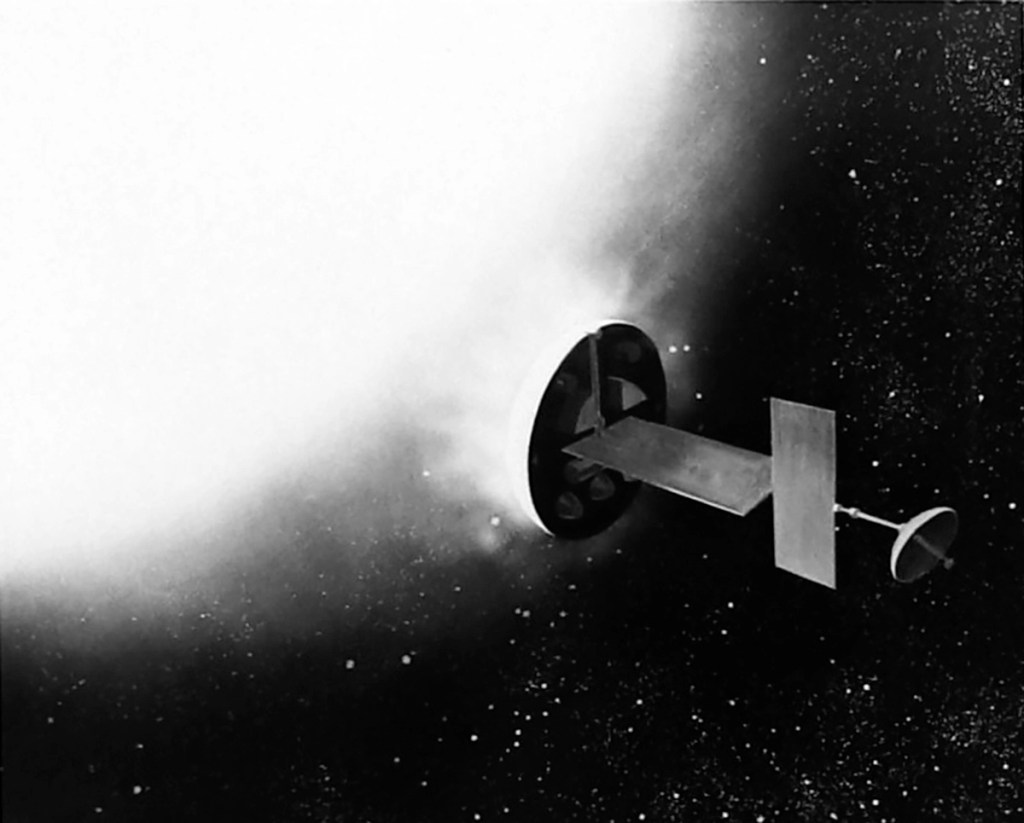
Mars Capture Mission in 1982. Orbit crew inspects the nuclear twin engine NERVA II system of the Earth Departure Module. Each engine delivers 250, 000 lbs. of thrust.
Space Taxis (ST) and associated auxiliary vehicles
Long duration ecological system
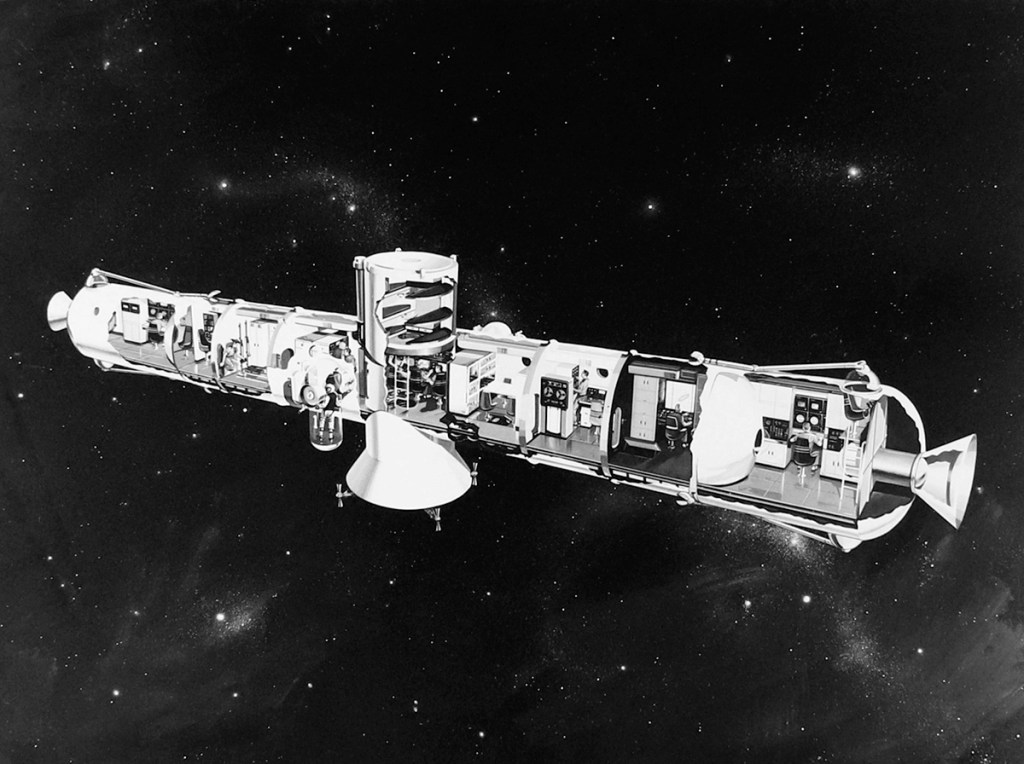
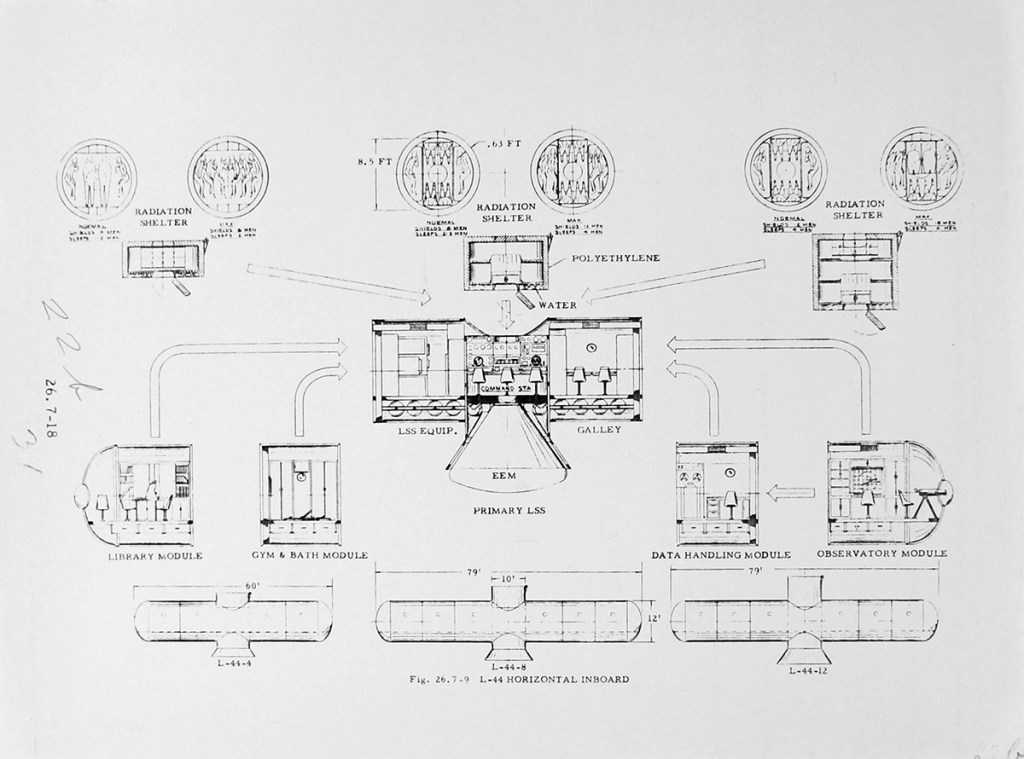
A set of mission modules referred to summarily as Life Support Section (LSS),including a radiation shelter, command module, ecology module, and others such as a workshop module, data transmission module and a more for electric power generation.
Orbit Launch Preparation Modules (OLPM) to support fueling and checkout activities.
An Earth Entry Module (EEM)
Propulsion Modules, for the Heliocentric Interorbital Space Vehicle
An Orbital Tanker Vehicle (OTV)
A Destination Space Vehicle (DSV) if secondary (excursions) missions are planned at the destination
Christmas in Selenopolis: While some of the residents of the lunar city enjoy ice skating and other winter sports, other citizens are visiting the Hall of Astronauts museum, on the left. Others travel on the indoor monorail, seen on the right, visiting friends, or perhaps doing last-minute shopping.
Image credit: Krafft Ehricke Papers / Space Global Image source: NASM