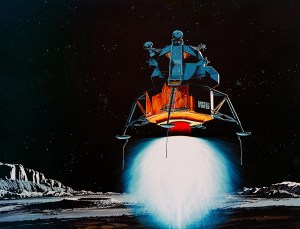
S69-39011

S69-39011 (July 1969) — TRW Incorporated’s artist concept depicting the Apollo 11 Lunar Module (LM) descending to the surface of the moon. Inside the LM will be astronauts Neil A. Armstrong, commander, and Edwin E. Aldrin Jr., lunar module pilot. Astronaut Michael Collins, command module pilot, will remain with the Command and Service Modules (CSM) in lunar orbit. TRW’s LM descent engine will brake Apollo 11’s descent to the lunar surface. The throttle-able rocket engine will be fired continuously the last 10 miles of the journey to the moon, slowing the LM to a speed of two miles per hour at touchdown. TRW Incorporated designed and built the unique engine at Redondo Beach, California under subcontract to the Grumman Aircraft Engineering Corporation, Bethpage, New York, the LM prime contractor.

Image credit: NASA JSC
Image source: NASA Images
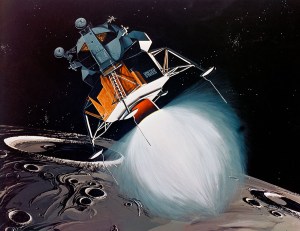
S69-33765

S69-33765 (12 May 1969) — Artist’s concept depicting the firing of the Apollo 10 Lunar Module descent engine for 42 seconds to propel “Snoopy” back into a higher lunar orbit for rendezvous and docking with the Command and Service Modules. Earlier, the LM descent engine will be fired for 27 seconds to take astronauts Thomas P. Stafford, Apollo 10 commander; and Eugene A. Cernan, lunar module pilot, to within 10 miles of the moon’s surface. Astronauts John W. Young, command module pilot, will remain in the Command Module, “Charlie Brown,” in lunar orbit. Developed by TRW’s Systems Group at Redondo Beach, California, under Grumman subcontract, the throttleable descent engine will be used to soft land the LM on the lunar surface during Apollo 11 and subsequent Apollo missions.

Image credit: NASA JSC
Image source: NASA Images
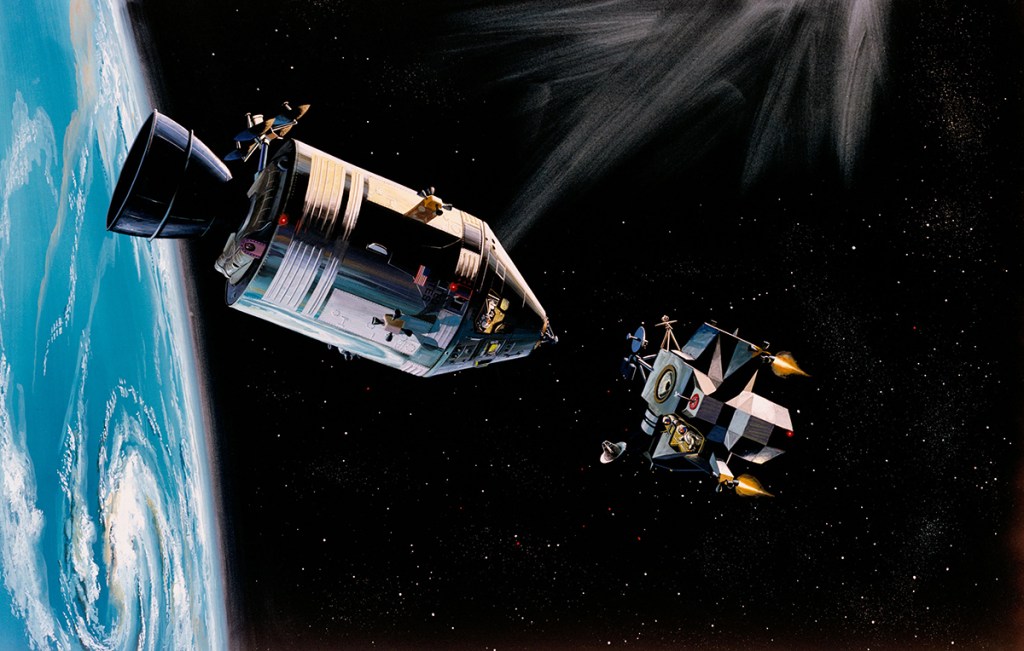
S69-18546

S69-18546 (February 1969) — North American Rockwell artist’s concept illustrating the docking of the Lunar Module ascent stage with the Command and Service Modules during the Apollo 9 mission. The two figures in the Lunar Module represent astronauts James A. McDivitt, Apollo 9 commander; and Russell L. Schweickart, lunar module pilot. The figure in the Command Module represents astronaut David R. Scott, command module pilot. The Apollo 9 mission will evaluate spacecraft lunar module systems performance during manned Earth-orbital flight.

Image credit: NASA JSC
Image source: NASA Images
108-KSC-69P-74

108-KSC-69P-74 UNCL. 1-27-69
69-HC-85
69-H-139

NASA/APOLLO

ARTIST’S CONCEPT OF THE APOLLO COMMAND MODULE AND SERVICE MODULE DOCKED WITH THE LUNAR MODULE. ONE ASTRONAUT HAS ALREADY BEEN TRANSFERRED TO THE LM AND THE SECOND IS MANEUVERING HIMSELF THROUGH THE FORWARD HATCH CONNECTING THE TWO SPACECRAFT.

Image credit: NASA
Image source: Numbers Station

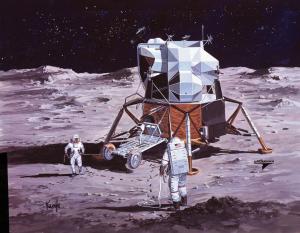
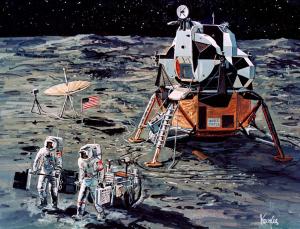
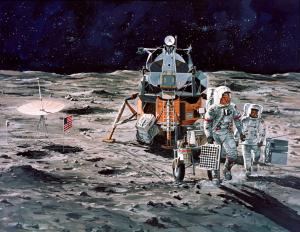
Deployment of LRV

Image credit: NASA
Image source: NASA JSC

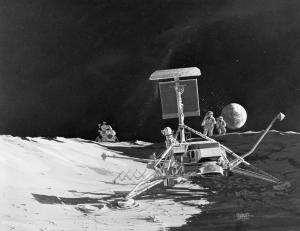
Ocean of Storms

Ryan Aeronautical Company artist’s concept depicting a close-up view of Surveyor 3 resting in the Ocean of Storms on the lunar nearside. Two Apollo 12 astronauts are seen approaching in the background. The Apollo 12 Lunar Module (LM) is in the left background. The Earth is in the right background. The inspection of Surveyor 3, which has been resting on the moon since April 1967, is an important objective of the Apollo 12 lunar landing mission. Selected pieces of Surveyor 3 will be brought back to Earth for scientific examination. Ryan landing radar has guided both Surveyor and Apollo spacecraft to soft landings on the moon.

Image credit: NASA JSC
Image source: NASA Images