Dyna-Soar On A Leash

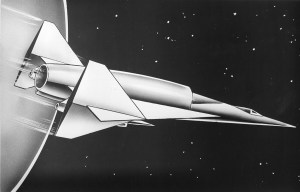
This drawing from the magazine Air Force and Space Digest shows a proposed NASA “ONE-STAGE-TO-ORBIT” aerospace plane. The craft would be able to take off from a regular airport using turbojet engines, then switch to ramjet propulsion at supersonic speed. To reach orbital speed in space, the aerospace plane would use a third set of engines using rocket propulsion.

In the drawing (above) the combination turbo-ramjet engines are housed in pods, just inside the vertical tailfins (on either side). The huge scoop atop the rear half of the fuselage contains the rocket engines and a novel collection and compression unit for gathering oxygen to burn in the rockets. The other propellant would be liquid oxygen carried in the craft’s tanks.

After it’s orbital mission, the aerospace plane would be able to reenter the atmosphere and land as a conventional aircraft at an airfield. The craft would be about 90 feet long and weigh some 100,000 pounds.

CREDIT LINE (UPI PHOTO) 7-21-62 (ML)
UNITED PRESS INTERNATIONAL ROTO SERVICE

Image credit: USAF
Image source: Numbers Station
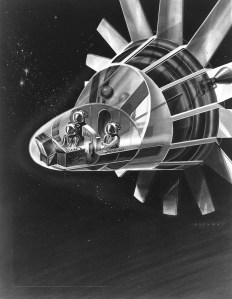
Martin Apollo

see also:

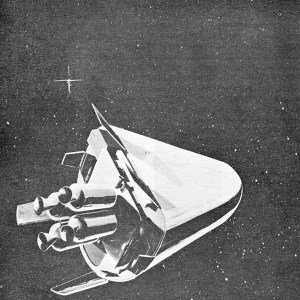
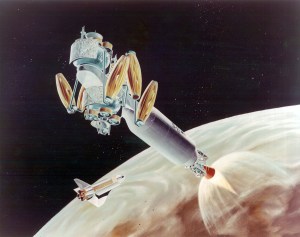
L. Apollo is pictured here by an artist of The Martin Co., one of three leading Space Age manufacturers awarded study contracts on project by NASA. Apollo was a god of Ancient Greece, son of Clymene and Titan. This is nicely appropriate, since Martin produces the mighty Titan intercontinental ballistic missile.

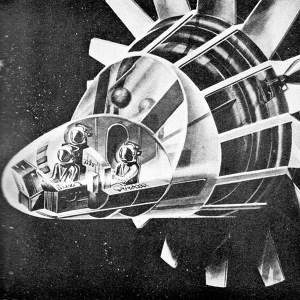
R. The Apollo lunar spacecraft planned to carry 3 crewmen on round trip between earth and the moon is shown above here enroute among the stars. Protruding fan-shapes are solar arrays to gather energy from sun for use aboard. Apollo was said to have been the triumphant participant in Olympic games. Homer called him the “god of prophecy.”

America’s Mightiest Missile
by Larry Eisinger
Arco Publishing, 1961

Image credit: NASA
Image source(s): Mike Acs, Numbers Station

Sol Dember

Eagle Book of Rockets and Space
by John W.R. Taylor and Maurice Allward
Longacre Press, 1961

Image credit: NASA
Image source: Numbers Station
Pioneer G

Image credit: NASA
Image source: Numbers Station
SPACE II

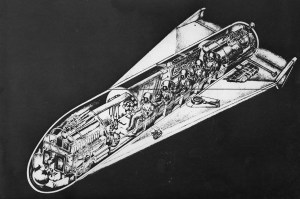
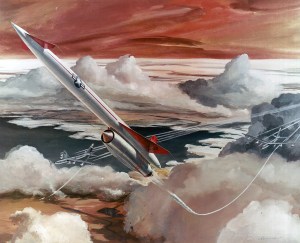
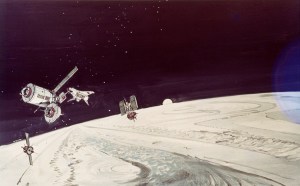
This is a Martin Co. engineering design of a shuttle vehicle to carry five men, or an equivalent amount of equipment, to a rendezvous in orbit with a space station. After delivering it’s load, this vehicle returns to earth by following a glide pattern and slowing in the earth’s atmosphere until landing speed can be attained.

Image credit: Martin
Image source: Numbers Station
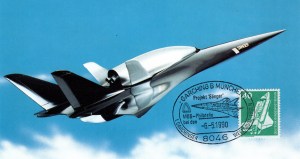
Projekt ‘Sänger’

Image credit: MBB
Image source: Numbers Station

Deployment

Image credit: NASA
Image source: Numbers Station
72-HC-468

Image credit: NASA
Image source: Numbers Station