Image credit: NASA JSC
Image source: NASA Images
Image credit: NASA JSC
Image source: NASA Images
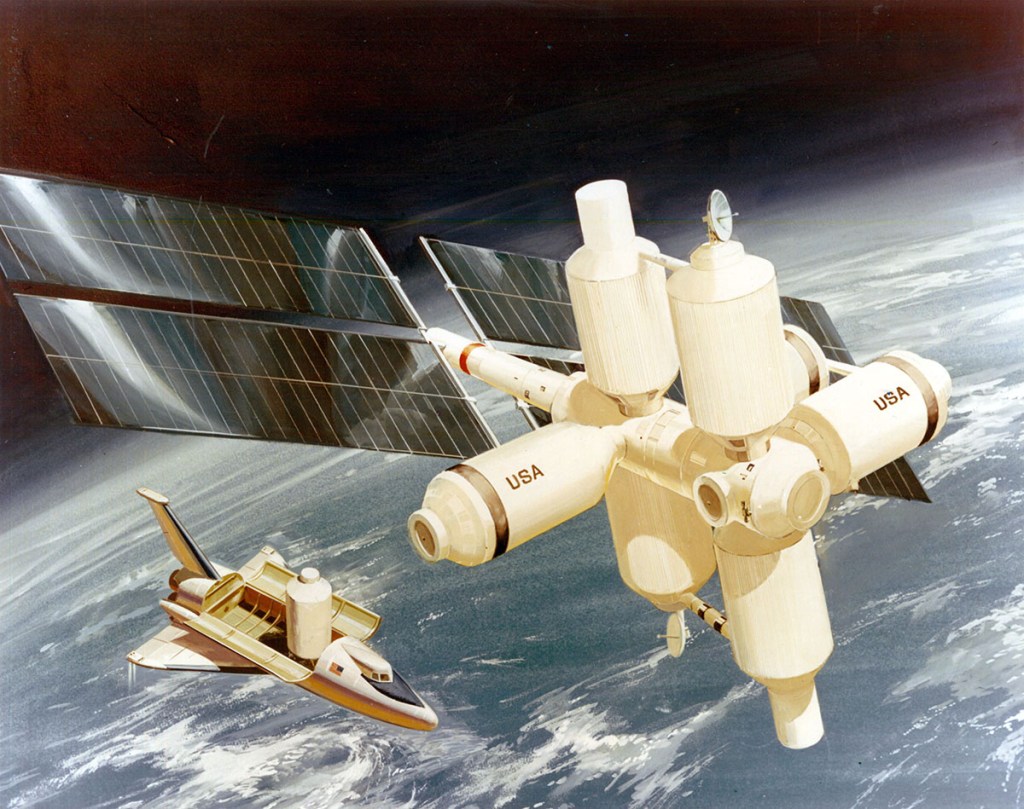
Image credit: NAR / NASA MSFC
Image source: Numbers Station

The solid-rocket boosters (SRB’s) are separated during ascent when Space Shuttle is about 28 miles (45 km) above the earth. Landing in the ocean, the SRB’s are recovered, refurbished and reused. Propelled by it’s three own engines, Shuttle continues its climb with increasing velocity.
Rockwell International
Space Systems Group
Image credit: NASA
Image source: Numbers Station
Image credit: North American Aviation
Image source: Numbers Station
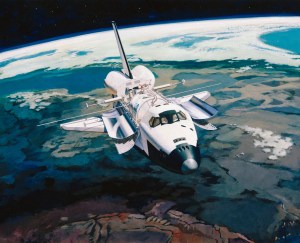
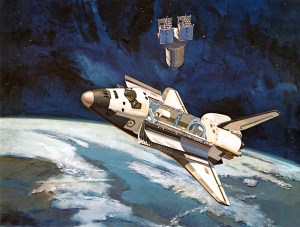
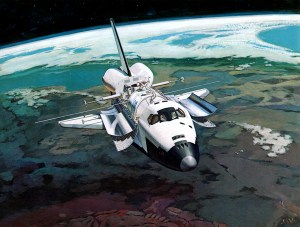
Artist Concept of Shuttle in-orbit flight with Earth limb in the background.
Image credit: NASA JSC
Image source: NASA Images
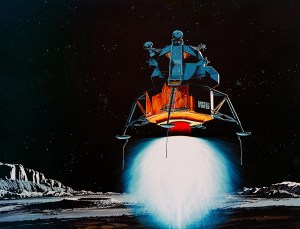
S69-39011 (July 1969) — TRW Incorporated’s artist concept depicting the Apollo 11 Lunar Module (LM) descending to the surface of the moon. Inside the LM will be astronauts Neil A. Armstrong, commander, and Edwin E. Aldrin Jr., lunar module pilot. Astronaut Michael Collins, command module pilot, will remain with the Command and Service Modules (CSM) in lunar orbit. TRW’s LM descent engine will brake Apollo 11’s descent to the lunar surface. The throttle-able rocket engine will be fired continuously the last 10 miles of the journey to the moon, slowing the LM to a speed of two miles per hour at touchdown. TRW Incorporated designed and built the unique engine at Redondo Beach, California under subcontract to the Grumman Aircraft Engineering Corporation, Bethpage, New York, the LM prime contractor.
Image credit: NASA JSC
Image source: NASA Images
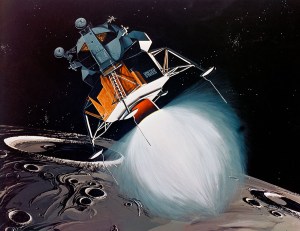
S69-33765 (12 May 1969) — Artist’s concept depicting the firing of the Apollo 10 Lunar Module descent engine for 42 seconds to propel “Snoopy” back into a higher lunar orbit for rendezvous and docking with the Command and Service Modules. Earlier, the LM descent engine will be fired for 27 seconds to take astronauts Thomas P. Stafford, Apollo 10 commander; and Eugene A. Cernan, lunar module pilot, to within 10 miles of the moon’s surface. Astronauts John W. Young, command module pilot, will remain in the Command Module, “Charlie Brown,” in lunar orbit. Developed by TRW’s Systems Group at Redondo Beach, California, under Grumman subcontract, the throttleable descent engine will be used to soft land the LM on the lunar surface during Apollo 11 and subsequent Apollo missions.
Image credit: NASA JSC
Image source: NASA Images
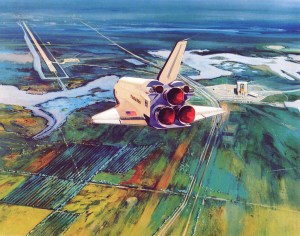
Shuttle Orbiter Landing Approach at Kennedy Space Center
SPACE SHUTTLE LANDING APPROACH. A Space Shuttle Orbiter approaches a landing field at NASA’s Kennedy Space Center, Florida, following a flight in space. The Orbiter will be able to land on a conventional runway similar to that used by present-day jet aircraft. The development and integration of the Space Shuttle system is the responsibility of NASA’s Johnson Space Center. Rockwell international Space Division, Downey , California is building the Orbiter under contract to NASA.
JSCL – 154
U.S. GOVERNMENT PRINTING OFFICE: 1977 772-876
Image credit: North American Rockwell
Image source: Numbers Station
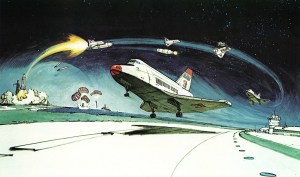
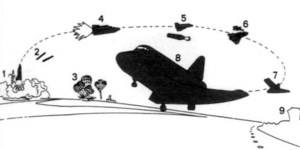
The Space Shuttle will take off vertically with a pilot and a c0-pilot at the helm and two other crew members. In early operations, the Shuttle port will be at Kennedy Space Center, Florida, for east-west orbits. Later a port will be added at Vandenberg Air For Base, California for north-south orbits.
Two solid-propellant booster rockets will supply most of the power (1). About 40 kilometers (25 miles) high, the boosters will separate (2) and descend by parachute to the ocean surface (3). There they will be recovered and returned to the launch site for reuse.The main section of the Shuttle, called the Orbiter, will continue flying (4) on the power of its liquid-propellant engines, supplied by a large external tank. After these two sections reach orbit, the tank will separate (5) and land in a remote ocean area. The Orbiter will be able to carry out space missions lasting at least seven days (6). Special materials covering its entire surface will protect the interior from the searing heat of re-entry. The Orbiter will fly horizontally like an airplane during the latter phase of descent (7) and it will land on a runway (8) near the launch site (9). As ground crews gain experience in readying it for subsequent flights, the turnaround time will be reduced to two weeks.
Our World in Space
Robert McCall & Isaac Asimov
New York Graphic Society, 1974
Image credit: NASA
Images: Numbers Station
Image credit: NAR / NASA MSFC
Image source: Numbers Station

Image credit: North American Rockwell
Image source: Internet Archive