Image credit: NASA
Image source: Mike Acs
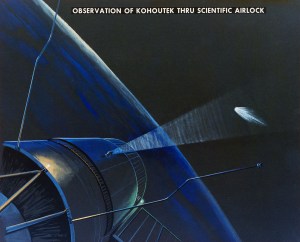
S73-37274 (1973) — An artist’s concept illustrating how the Skylab 4 astronauts will observe, through the scientific airlock of the Orbital Workshop, the passing of the newly-discovered Comet Kohoutek. The favorable location of the Skylab space station in Earth orbit will help provide a comprehensive investigation of the nature and evolution of the coma and tails as the comet approaches, passes, and recedes from the sun. Photo credit: NASA
Image credit: NASA JSC
Image source: NASA Images
Image credit: Convair
Image source: SDASM Archives
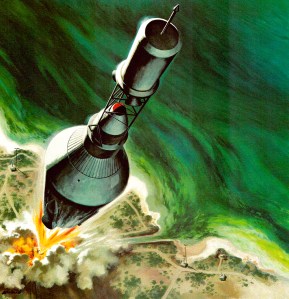
Image credit: NASA
Image source: Numbers Station
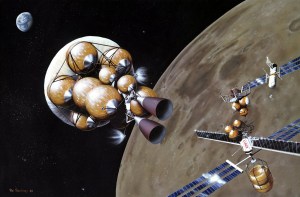
S83-28321 (14 March 1983) — In this artist’s concept of future lunar operations, a lunar ferry is about to burn out of lunar orbit for the trip back to facilities in low Earth orbit. The ferry vehicle carries tank modules filled with liquid oxygen, which has been produced from mining operations on the surface of the Moon. One possibility for such operations would be to have manned facilities in low lunar orbit, such as illustrated here. At the upper right side of the photo is a small orbiting manned station. At the lower right side of the photo is a liquid oxygen propellant dump, to which a lunar landing vehicle carrying liquid oxygen is about to dock. The lunar ferry vehicle itself is representative of one type of aerobraking system. The balloon-like torus around the center of the ferry-craft would inflate to several times its illustrated size and, once the vehicle has swooped down close to the Earth’s outer atmosphere on the return journey, would use atmospheric drag to slow the craft and place itself in low Earth orbit. The liquid oxygen would then be used in operations there for fueling various vehicles, including an orbital transfer vehicle for trips to geosynchronous Earth orbit. This concept is part of a study done for the Johnson Space Center by Eagle Engineering of Houston. The artist was Pat Rawlings.
Image credit: Eagle Engineering
Image source: Internet Archive
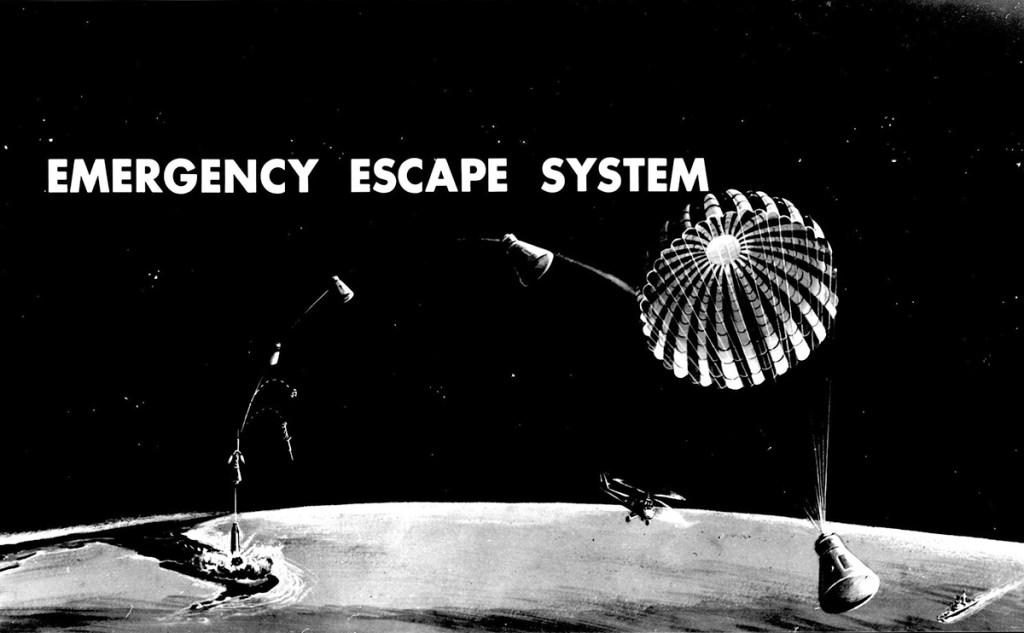
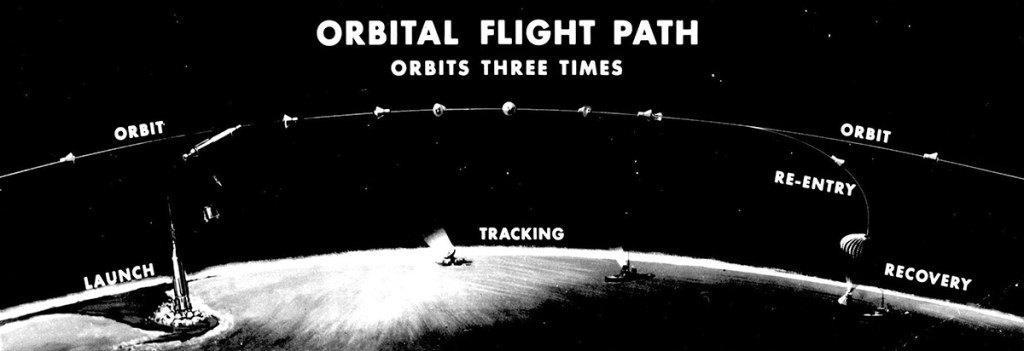
Top view – Artist conception of the Mercury-Atlas 5 emergency escape system. Bottom view – The orbital flight plan of the Mercury-Atlas 5, showing visually the sequence of events of launch and recovery of the spacecraft.
Image credit: NASA
Image source: National Archives
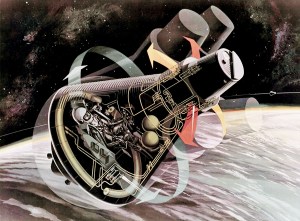
Image credit: NASA
Image source: NM Space Museum
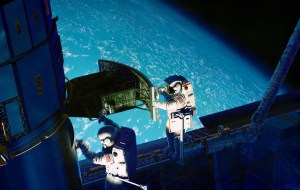
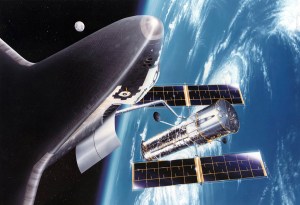
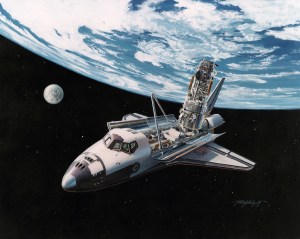
S93-48826 (November 1993) — This artist’s rendition of the 1993 Hubble Space Telescope (HST) servicing mission shows astronauts installing the new Wide Field/Planetary Camera (WF/PC 2). The instruments to replace the original camera and contains corrective optics that compensate for the telescope’s flawed primary mirror. During the 11-plus day mission, astronauts are also scheduled to install the Corrective Optics Space Telescope Axial Replacement (COSTAR) — an optics package that focuses and routes light to the other three instruments aboard the observatory — a new set of solar array panels, and other hardware and components. The artwork was done for JPL by Paul Hudson.
Image credit: NASA JSC
Image source: NASA Images
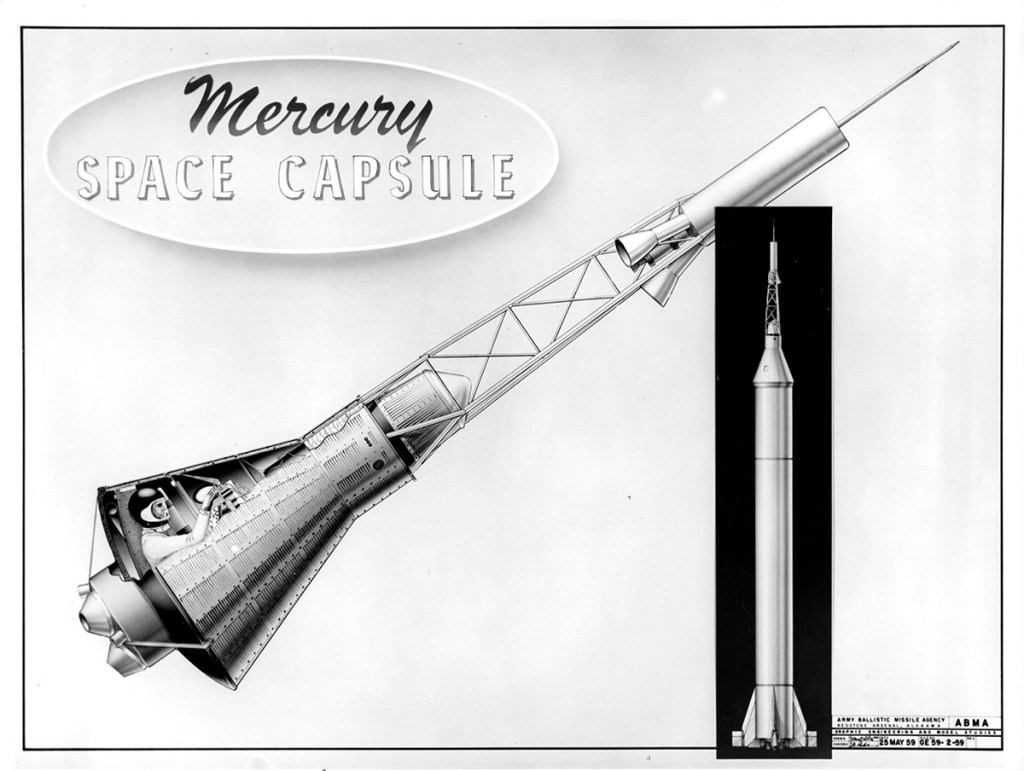
Image credit: ABMA
Image source: Numbers Station