EMPIRE Hunting: Part 3

Let’s go back to Solar Transportation for a minute, because it helps to explain some of the images in the Ehricke Papers. Ehricke’s team detailed a Mars lander that looked a lot like early Apollo concepts, but the some of the folders contain images of a landing using what looks like Gemini hardware. I think this image captioned in Solar Transportation is a clue.

From Solar Transportation:

In 1982, a 69 day Mars capture mission launches. The crew conducts intensive reconnaissance both from orbit, and using probes – including landers and returners – but no manned surface excursions are planned. A mission launched between 1984 is one-way, involving a 529 day stay on Mars. A follow-on mission in 1985 (via Venus) retrieves the crew.

Reading back through the General Dynamics and Douglas UMPIRE reports, I think there’s enough connective tissue to make the argument that the paintings below are at least vicinal to EMPIRE / UMPIRE if not directly related, like kissing cousins. It doesn’t really matter though, because I’m not a real historian, and this isn’t a thesis.

Above: Gemini, on Mars or wherever. Below: Yup, that’s a Mars Lander.

Artists’ concepts (Spacecraft) [1 of 6 folders]
Artists’ concepts (spacecraft) [4 of 6 folders]

1 / 2 / 3 / 4

Image credit: Krafft Ehricke Papers
Image source: NASM

Figure 2.

Space Habitats (artists’ concepts)

Unmanned probe approaching Pluto. Probe is powered by thermionic radioisotope power generator. The laser beams for surface illumination, with optical sensors slaved to the beams. Other equipment comprises radiation counters as well as field, plasma and particle sensors.

Image credit: Krafft Ehricke Papers
Image source: NASM

Figure 7.

Graphics [1] [2 of 3 folders]

Earth-moon based planetary space port in 1988. Spacecraft are nuclear propelled interplanetary vehicles, launched by solid propellant lift-off rockets side-mounted around center section which, like the cylinders at the spacecraft’s center section, contain nuclear pulse units. In background a large antenna, belonging to the lunar deep space network is visible.

Image credit: Krafft Ehricke Papers
Image source: NASM

0025-bx092-fd004_006

Mars Capture Mission in 1982. Orbit crew inspects the nuclear twin engine NERVA II system of the Earth Departure Module. Each engine delivers 250, 000 lbs. of thrust.

Image credit: Krafft Ehricke Papers
Image source: NASM

Vehicle Requirements

Artists’ concepts (spacecraft) [2 of 6 folders]

Vehicle Requirements

  • An appropriate Earth Launch Vehicle (ELV)
  • Space Taxis (ST) and associated auxiliary vehicles
  • Long duration ecological system
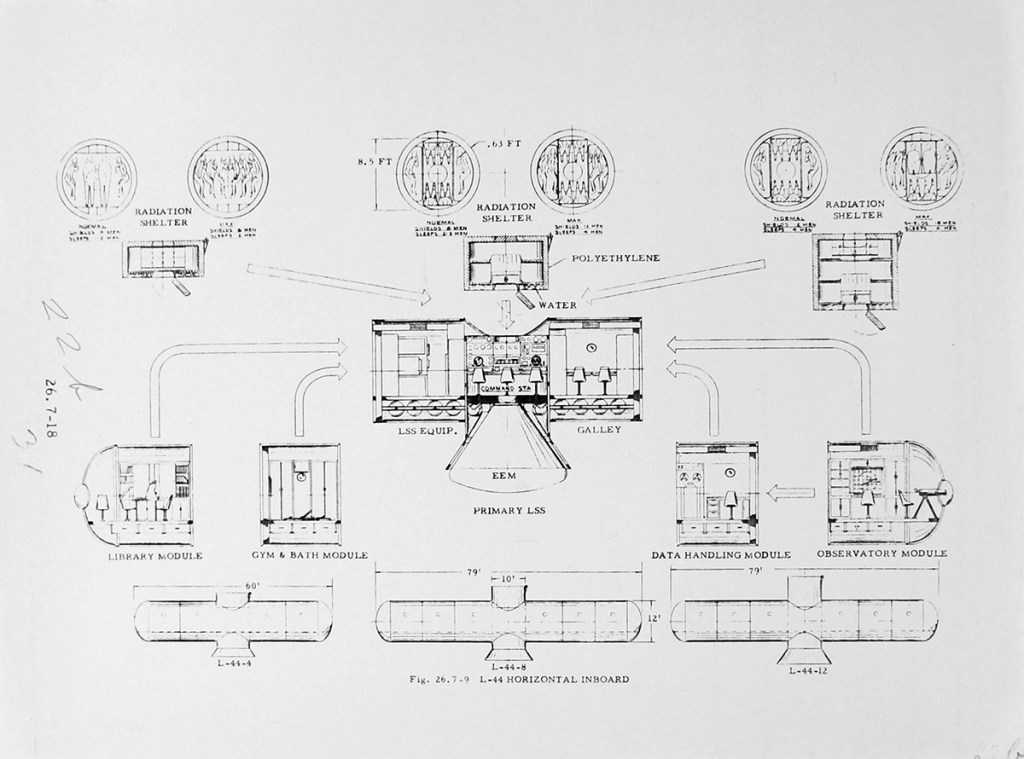
  • A set of mission modules referred to summarily as Life Support Section (LSS),including a radiation shelter, command module, ecology module, and others such as a workshop module, data transmission module and a more for electric power generation.
  • Orbit Launch Preparation Modules (OLPM) to support fueling and checkout activities.
  • An Earth Entry Module (EEM)
  • Propulsion Modules, for the Heliocentric Interorbital Space Vehicle
  • An Orbital Tanker Vehicle (OTV)
  • A Destination Space Vehicle (DSV) if secondary (excursions) missions are planned at the destination

Image credit: Krafft Ehricke Papers
Image source: NASM
Explorer Party Lands on Jupiter VII

Artists’ concepts (spacecraft) [6 of 6 folders]

Image credit: Krafft Ehricke Papers
Image source: NASM