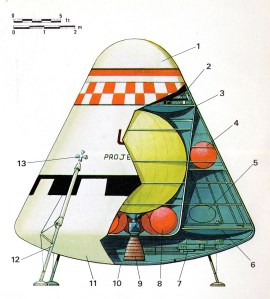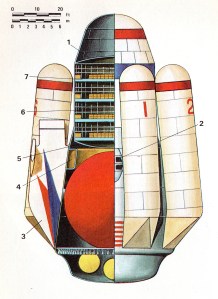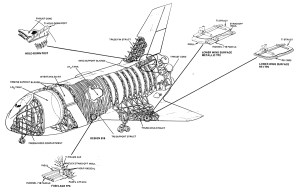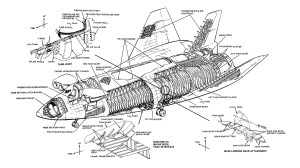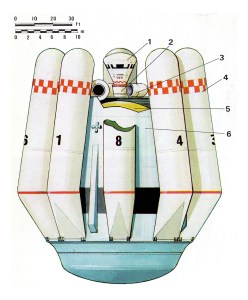
Pegasus Cutaway & Plan

Pegasus Intercontinental Passenger Rocket

  1. Forward pressure dome;
  2. Two-man crew compartment;
  3. Re-entry stabilization fines (2);
  4. Cargo compartment;
  5. Aft pressure dome;
  6. Pressurized cabin for passengers (170);
  7. Deck structure (4) with passenger couches (43 each).

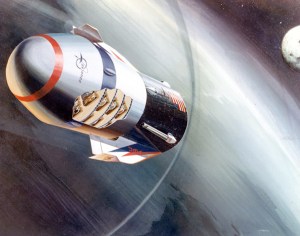
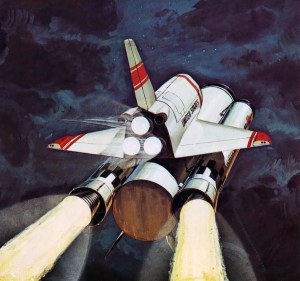
Pegasus during atmospheric re-entry uses the LH2-cooled plug nozzle as a heat shield. The ballistic transport would convey 172 passengers and freight 7,456 miles (12,000 km.) in 39 min. without exceeding an acceleration of 3g during ascent or re-entry. At the arrival spaceport it would hover on rocket thrust during a soft landing in the vertical attitude.

Pegasus Passenger Compartment

  1. Four-level passenger access doors (3);
  2. Stairways (2) connecting four passenger decks;
  3. Double-wall acoustic damping structure;
  4. Luggage racks (9);
  5. Re-entry stabilization fins (2).

Frontiers of Space
Philip Bono & Kenneth Gatland
Macmillan, 1969

Image credit: Douglas / Blandford Press
Images: Numbers Station, SDASM Archives

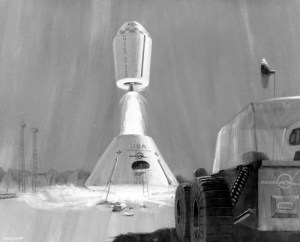
Selena Storyboard

How re-usable ROMBUS-type launch vehicles can be applied to construction of a temporary lunar base (Project Selena).

  1. Vehicle en route for the Moon is refuelled in Earth Orbit;
  2. Soft-lands on the Moon with lunar base components;
  3. Pressurized moon-tractor hauls hydrogen tanks adapted for human habitation to assembly site;
  4. The lunar base is ready for occupation.

Frontiers of Space is peppered with artwork from Douglas, including paintings by Don Charles and James Finnell. In the book, this section was illustrated with (pretty poor) knock-offs. Why? Who knows? These were the masters.

Image credit: Douglas
Image source: SDASM Archives

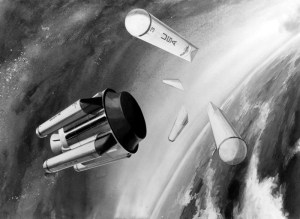
Deimos Storyboard

Mission to Mars (Project Deimos)

  1. Hydrogen tanks jettison as ROMBUS spaceship accelerates from Earth-orbit;
  2. Two hydrogen tanks jettison after retro-thrust into Mars orbit. Mars Landing Module separates from ROMBUS parent above the cratered deserts;
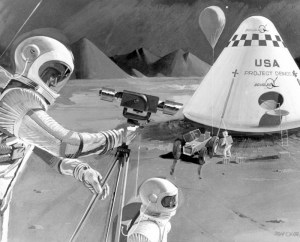
  3. After soft-landing, astronauts begin exploration setting out research equipment and taking meteorological soundings;
  4. Ascent stage of Mars Landing Module returns astronauts to ROMBUS parent in Martian orbit for return to Earth.

Frontiers of Space
Philip Bono & Kenneth Gatland
Macmillan, 1969

Image credit: Douglas
Image source: SDASM Archives

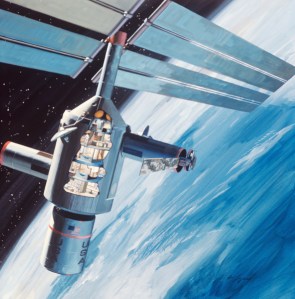
Concept by Henry Lozano Jr.

Image credit: North American Rockwell
Image source: Numbers Station
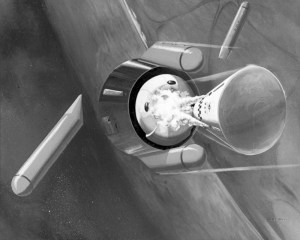
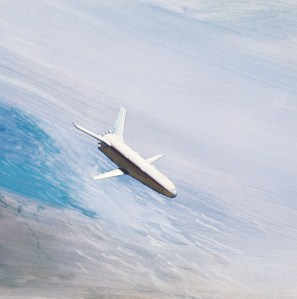
NAR Artist Concept

Image credit: North American Rockwell
Image source: Numbers Station
518 Flyback Booster

Image credit: Grumman
File source: NASA NTRS

619 by Craig Kavafes

Image credit: Grumman

Design 532

Image credit: Grumman
File source: NASA NTRS