Category: Apollo Missions
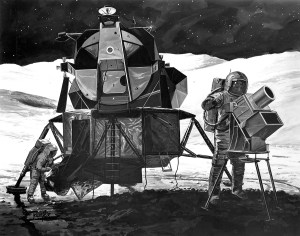
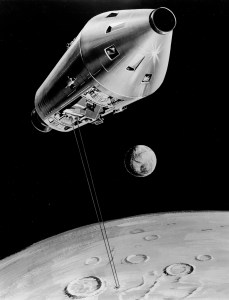
S72-53472
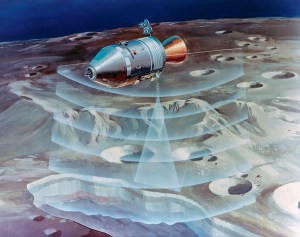
S72-53472 (November 1972) — An artist’s concept illustrating how radar beams of the Apollo 17 lunar sounder experiment will probe three-quarters of a mile below the moon’s surface from the orbiting spacecraft. The Lunar Sounder will be mounted in the SIM bay of the Apollo 17 Service Module. Electronic data recorded on film will be retrieved by the crew during trans-Earth EVA. Geologic information on the lunar interior obtained by the sounder will permit scientific investigation of underground rock layers, lava flow patterns, rille (canyon) structures, mascon properties, and any areas containing water. A prototype lunar sounder has been flight tested in aircraft over selected Earth sites to confirm the equipment design and develop scientific analysis techniques. The Lunar Sounder Experiment (S-209) was developed by North American Rockwell’s (NR) Space Division for NASA’s Manned Spacecraft Center to provide data for a scientific investigation team with representatives from the Jet Propulsion Laboratory, University of Utah, University of Michigan, U.S. Geological Survey, and NASA Ames Research Center.
Image credit: NASA JSC
Image source: NASA Images
Fra Mauro Highlands
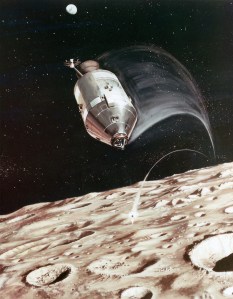
Image credit: NASA
Image source: Numbers Station
Rudy Baum
The Art of Apollo
S69-38662
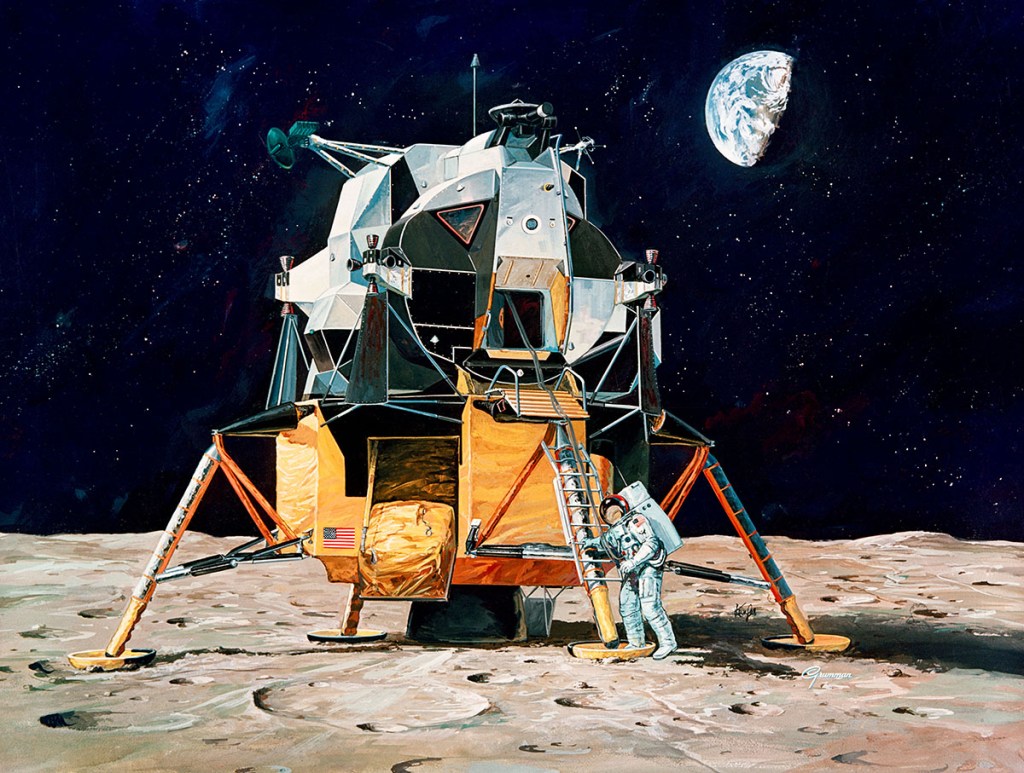
S69-38662 (July 1969) — A Grumman Aircraft Engineering Corporation’s artist concept depicting mankind’s first walk on another celestial body. Here astronaut Neil A. Armstrong, Apollo 11 commander, is making his first step onto the surface of the Moon. Armstrong has just egressed Lunar Module (LM) 5. Still inside the LM is astronaut Edwin E. Aldrin Jr., lunar module pilot. Astronaut Michael Collins, command module pilot, remains with the Command and Service Modules (CSM) in lunar orbit. In the background is the Earth, some 240,000 miles away.
Image credit: NASA Johnson
Image source: NASA Images
S69-39011
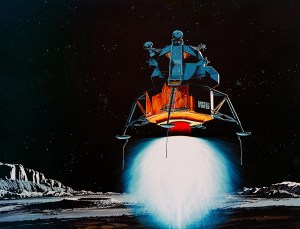
S69-39011 (July 1969) — TRW Incorporated’s artist concept depicting the Apollo 11 Lunar Module (LM) descending to the surface of the moon. Inside the LM will be astronauts Neil A. Armstrong, commander, and Edwin E. Aldrin Jr., lunar module pilot. Astronaut Michael Collins, command module pilot, will remain with the Command and Service Modules (CSM) in lunar orbit. TRW’s LM descent engine will brake Apollo 11’s descent to the lunar surface. The throttle-able rocket engine will be fired continuously the last 10 miles of the journey to the moon, slowing the LM to a speed of two miles per hour at touchdown. TRW Incorporated designed and built the unique engine at Redondo Beach, California under subcontract to the Grumman Aircraft Engineering Corporation, Bethpage, New York, the LM prime contractor.
Image credit: NASA JSC
Image source: NASA Images
S69-33765
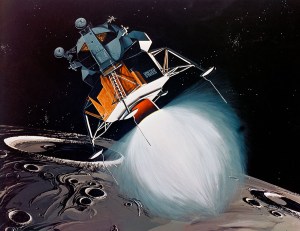
S69-33765 (12 May 1969) — Artist’s concept depicting the firing of the Apollo 10 Lunar Module descent engine for 42 seconds to propel “Snoopy” back into a higher lunar orbit for rendezvous and docking with the Command and Service Modules. Earlier, the LM descent engine will be fired for 27 seconds to take astronauts Thomas P. Stafford, Apollo 10 commander; and Eugene A. Cernan, lunar module pilot, to within 10 miles of the moon’s surface. Astronauts John W. Young, command module pilot, will remain in the Command Module, “Charlie Brown,” in lunar orbit. Developed by TRW’s Systems Group at Redondo Beach, California, under Grumman subcontract, the throttleable descent engine will be used to soft land the LM on the lunar surface during Apollo 11 and subsequent Apollo missions.
Image credit: NASA JSC
Image source: NASA Images
Apollo 8 Coming Home

Oil on panel by Robert McCall. The Apollo 8 spacecraft fires it’s engines to propel it out of lunar orbit and the return trip to Earth.
This is NASA, EP 22, 1971
Image credit: NASA
Image source: Numbers Station
Apollo 17 Experiments
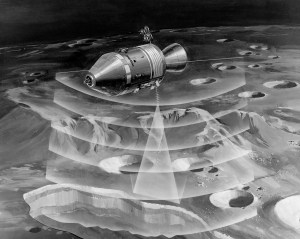
Image credit: NASA
Image source: Numbers Station
Deep Space EVA
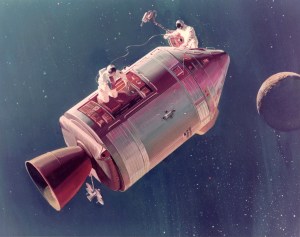
Image credit: NASA
Image source: Mike Acs
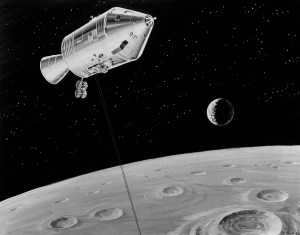
Worden’s EVA

see also:
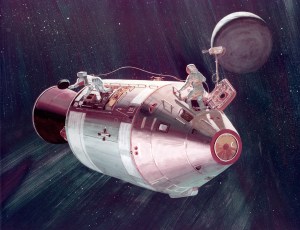
It took me a few, but the lower version is either an earlier or later version of the same painting. The figure representing James B. Irwin is a repaint. My guess is the image on NASA’s site is later, reworked to give the figure a slightly more dramatic pose. The painting is by a North American Rockwell artist.
Image credit: NASA JSC
Images: NASA Images, Numbers Station
