Orbital Workshop by Neil Jacobe

B&W (As seen in Roundup dated Nov. 24, 1967)
NOV. 67 S-67-51373

MANNED SPACE CENTER, HOUSTON, TEXAS

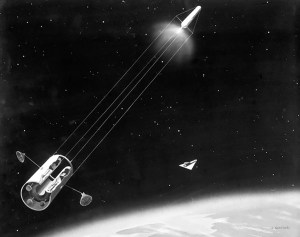
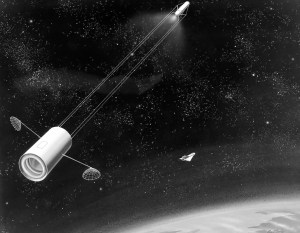
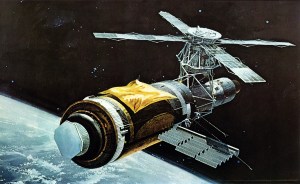
ORBITAL WORKSHOP — Artist’s concept showing how a Saturn S-IVB stage will appear when converted to the Apollo Applications Orbital Workshop. Launched fully fueled with airlock and docking adaptor attached, the S-IVB’s liquid hydrogen tank becomes a shirtsleeve environment workshop after the fuel has been depleted. At left is an Apollo Command and Service Module launched separately and docked into one of the docking adaptor’s ports. The Apollo Telescope Mount is shown docked into one of the side ports. The ATM will be joined to the cluster in a second phase of the program. Solar cell “wings” to provide power fold outward from the S-IVB after orbit is achieved. McDonnell Douglas Corporation’s Missile and Space Systems Division is making the S-IVB orbital workshop modifications under contract to NASA Marshall Space Flight Center and McDonnell Astronautics Company is developing the airlock under contract to MSC. (MCDONNELL DOUGLAS PHOTOGRAPH)
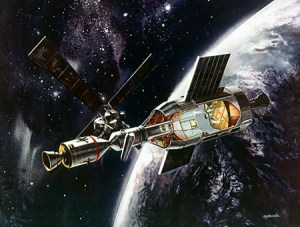
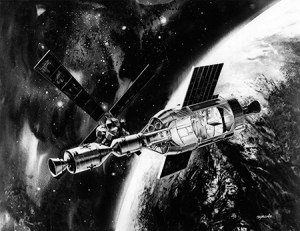
Look closely and you’ll notice subtle differences between this version of the painting and a colour rendering found in the SDASM Archives I’ve shared before.

If you’re interested in seeing more of Jacobe’s work, his artwork for the Douglas MOL can be found here. The images are small and plastered with watermarks, so it’s a bit of a tease but they are beautiful.

Image credit: NASA
Image source: Numbers Station
S-69-60223

Image credit: North American Rockwell
Images: NASA, Mike Acs

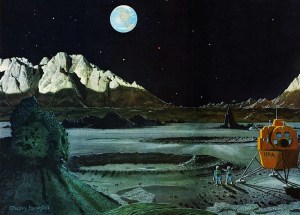
Surface Operations

Image credit: Convair
Image source: SDASM Archives

Exploratory Vehicle

A Boeing design for a manned orbital or interplanetary reconnaissance vehicle. The vehicle would be built in orbit around the earth around the Earth, inside a plastic bubble having controlled atmosphere and pressure, permitting technicians to work without space suits. Propelled by a nuclear-powered plasma jet, it could travel to planets within our solar-system , carrying shuttle vehicles to make the actual observations of planet surfaces. Nylon nets, rather than flooring, would divide the vehicle into seven levels.

Eagle Book of Rockets and Space
by John W.R. Taylor and Maurice Allward
Longacre Press, 1961

Image credit: Boeing Aircraft Company
Image source: Numbers Station

X-20 by George Mathis

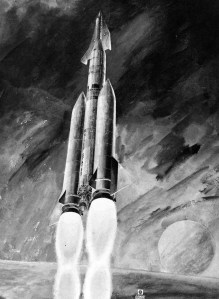
330-PSA-279-62 (USAF 167026): Artwork by George Mathis of how the Air Force Titan III Standard Launch Vehicle may look boosting the United States Air Force X-20 (Dyna-Soar) into orbit, August 1962.

Image credit: Boeing
Image source: National Museum of U.S. Navy

Outpost III

Image credit: Convair
Image source: SDASM Archives

Bonestell Moonscape

Image credit: NASA
Images: Mike Acs, Dan Beaumont Space Museum

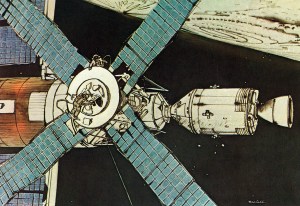
Skylab

Our World in Space
Robert McCall & Isaac Asimov
New York Graphic Society, 1974

Image credit: NASA
Image source: Numbers Station
Apollo 8 Coming Home

Oil on panel by Robert McCall. The Apollo 8 spacecraft fires it’s engines to propel it out of lunar orbit and the return trip to Earth.

This is NASA, EP 22, 1971

Image credit: NASA
Image source: Numbers Station
Skylab (McCall)

Our World in Space
Robert McCall & Isaac Asimov
New York Graphic Society, 1974

Image credit: NASA
Image source: Numbers Station
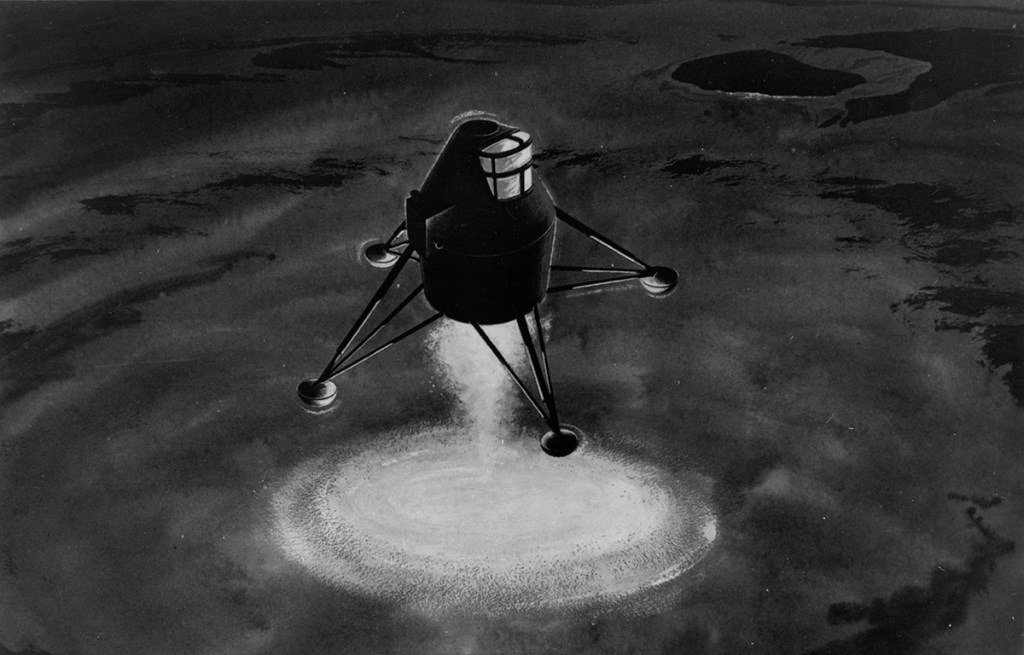
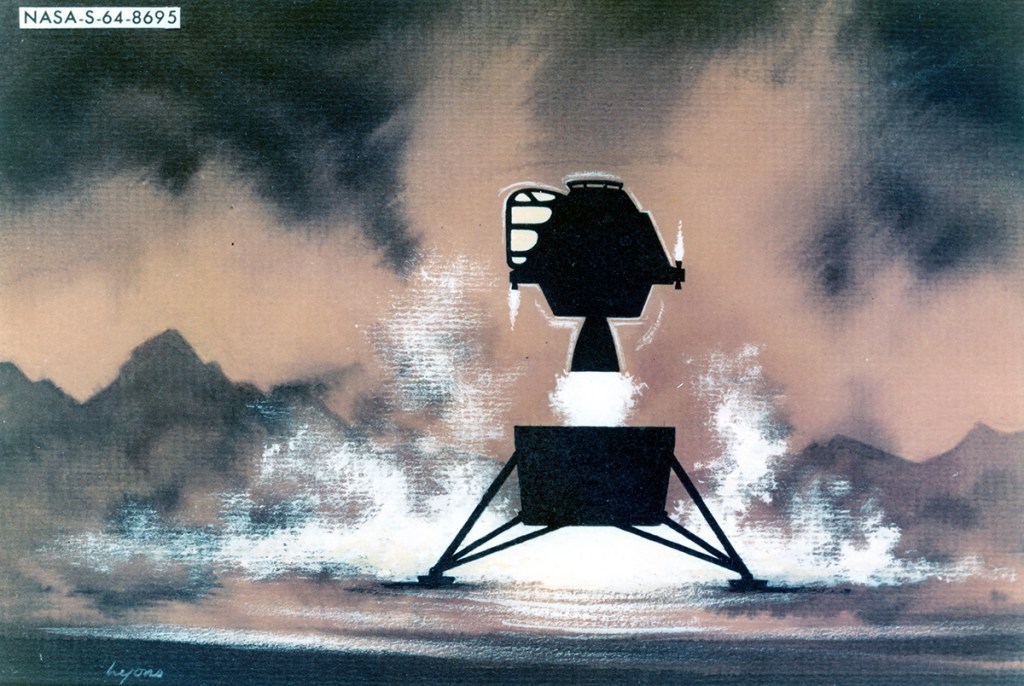
Early Lander Concept

Image credit: NASA
Images: Mike Acs, Drew Granston