Image credit: Convair
Image source: SDASM Archives
Image credit: Convair
Image source: SDASM Archives
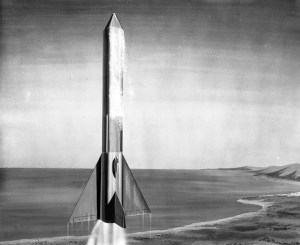

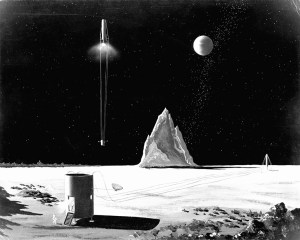
Image credit: Convair
Image source: SDASM Archives
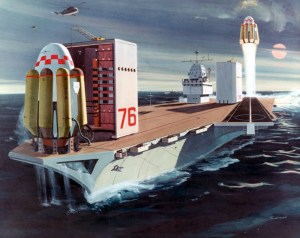
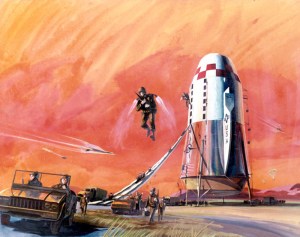
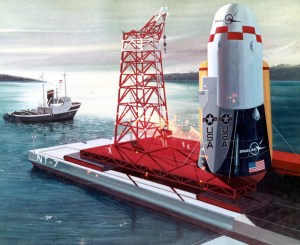
Image credit: Douglas
Image source: SDASM Archives
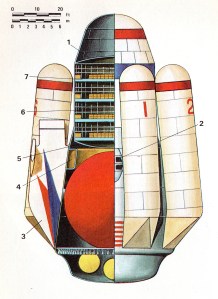
Pegasus Intercontinental Passenger Rocket
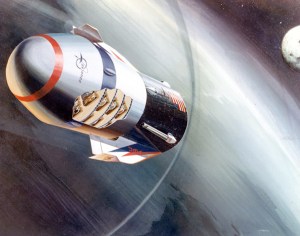
Pegasus during atmospheric re-entry uses the LH2-cooled plug nozzle as a heat shield. The ballistic transport would convey 172 passengers and freight 7,456 miles (12,000 km.) in 39 min. without exceeding an acceleration of 3g during ascent or re-entry. At the arrival spaceport it would hover on rocket thrust during a soft landing in the vertical attitude.

Pegasus Passenger Compartment
Frontiers of Space
Philip Bono & Kenneth Gatland
Macmillan, 1969
Image credit: Douglas / Blandford Press
Images: Numbers Station, SDASM Archives
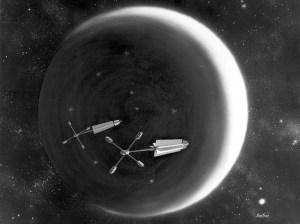
Image credit: Convair
Image source: SDASM Archives


How re-usable ROMBUS-type launch vehicles can be applied to construction of a temporary lunar base (Project Selena).
Frontiers of Space is peppered with artwork from Douglas, including paintings by Don Charles and James Finnell. In the book, this section was illustrated with (pretty poor) knock-offs. Why? Who knows? These were the masters.
Image credit: Douglas
Image source: SDASM Archives
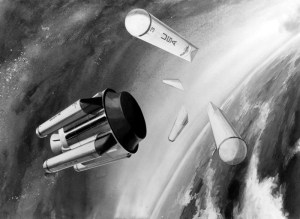
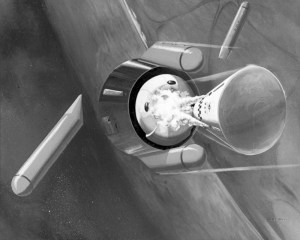
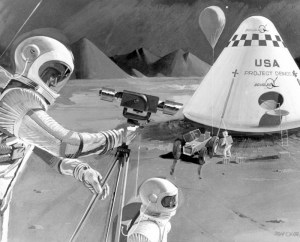
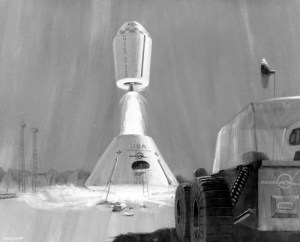
Mission to Mars (Project Deimos)
Frontiers of Space
Philip Bono & Kenneth Gatland
Macmillan, 1969
Image credit: Douglas
Image source: SDASM Archives
Image credit: NASA
Image source: SDASM Archives
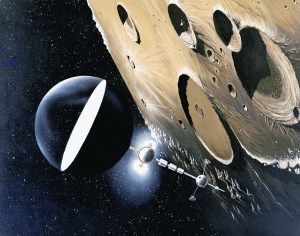
This glorious painting by John Sentovic depicts a solar-powered ship in lunar orbit, as envisioned by Krafft A. Ehricke.
Image credit: Convair
Image source: SDASM Archives

Image credit: NASA
Image source: SDASM Archives