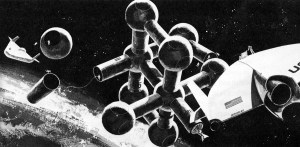
Huge space ferries are used by astronauts to perform the final assembly of the huge Spaceball orbiting station.
Orbiting Stations: Stopovers to Space Travel
Irwin Stambler
G.P. Putnam’s Sons, 1965
Image credit: Douglas
Image source: Numbers Station
Huge space ferries are used by astronauts to perform the final assembly of the huge Spaceball orbiting station.
Orbiting Stations: Stopovers to Space Travel
Irwin Stambler
G.P. Putnam’s Sons, 1965
Image credit: Douglas
Image source: Numbers Station
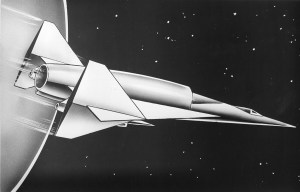
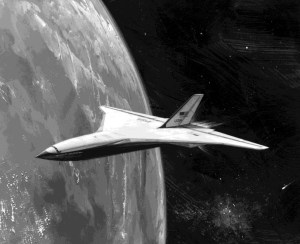
This drawing from the magazine Air Force and Space Digest shows a proposed NASA “ONE-STAGE-TO-ORBIT” aerospace plane. The craft would be able to take off from a regular airport using turbojet engines, then switch to ramjet propulsion at supersonic speed. To reach orbital speed in space, the aerospace plane would use a third set of engines using rocket propulsion.
In the drawing (above) the combination turbo-ramjet engines are housed in pods, just inside the vertical tailfins (on either side). The huge scoop atop the rear half of the fuselage contains the rocket engines and a novel collection and compression unit for gathering oxygen to burn in the rockets. The other propellant would be liquid oxygen carried in the craft’s tanks.
After it’s orbital mission, the aerospace plane would be able to reenter the atmosphere and land as a conventional aircraft at an airfield. The craft would be about 90 feet long and weigh some 100,000 pounds.
CREDIT LINE (UPI PHOTO) 7-21-62 (ML)
UNITED PRESS INTERNATIONAL ROTO SERVICE
Image credit: USAF
Image source: Numbers Station
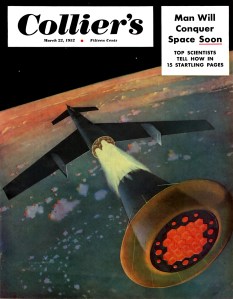


Man will Conquer Space Soon
Collier’s, March 22, 1953
Image credit: Collier’s
Image source: AIAA Houston

Von Braun’s rocket ship design. Tall as a 24-story building, it will weight 7,000 tons and have a 65-foot base.
Man will Conquer Space Soon
Collier’s, March 22, 1953
Image credit: Collier’s
Image source: AIAA Houston
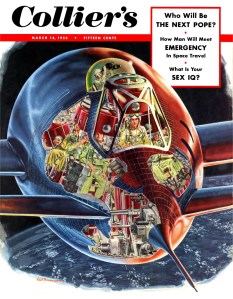
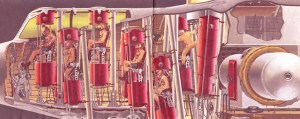
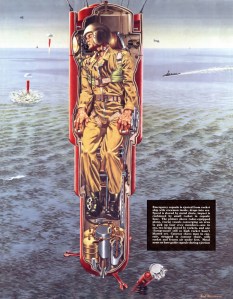
How Man will Meet Emergency in Space Travel
Collier’s, March 14, 1953
Image credit: Collier’s
Image source: AIAA Houston
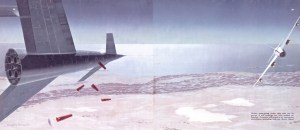
Before space-going rocket tries out its power, it will undergo tow tests behind jet bomber. Crew will board it, try emergency procedures–including bail-out, shown above.
How Man will Meet Emergency in Space Travel
Collier’s, March 14, 1953
Image credit: Collier’s
Image source: AIAA Houston
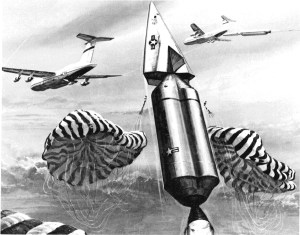
A Lockheed artist’s impression of a novel method of taking a unique and untried method of orbital delivery and making it even more unique and more untried. As my wife said to me in the giftshop of the Palm Springs Aerial Tramway, “Baby, I’ll take the car and see you up there!”
Image credit: Lockheed
Image source: AFMC
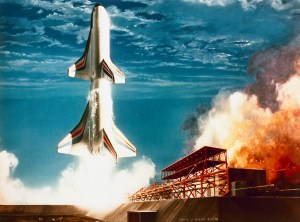
Image credit: Boeing
Image source: National Archives
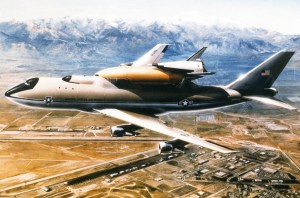
Image credit: Boeing
Image source: National Archives
Image credit: Boeing
Image source: National Archives