Image credit: NASA JSC
Image source: NASA Images
Image credit: NASA JSC
Image source: NASA Images
Image credit: NAR / NASA MSFC
Image source: Numbers Station

The solid-rocket boosters (SRB’s) are separated during ascent when Space Shuttle is about 28 miles (45 km) above the earth. Landing in the ocean, the SRB’s are recovered, refurbished and reused. Propelled by it’s three own engines, Shuttle continues its climb with increasing velocity.
Rockwell International
Space Systems Group
Image credit: NASA
Image source: Numbers Station
Image credit: NASA
Image source: Numbers Station
Image credit: North American Aviation
Image source: Numbers Station
Image credit: NASA
Image source: Numbers Station
Image credit: North American Aviation
Image source: Numbers Station
Image credit: North American Aviation
Image source: Numbers Station
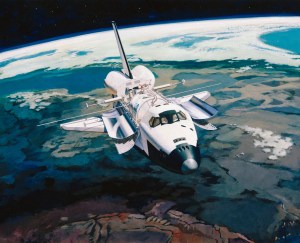
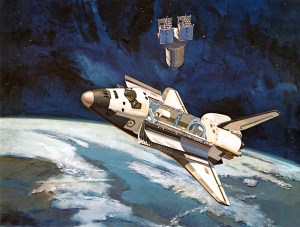
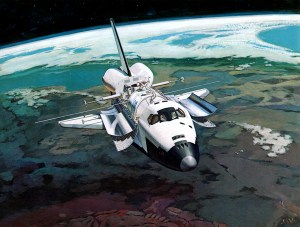
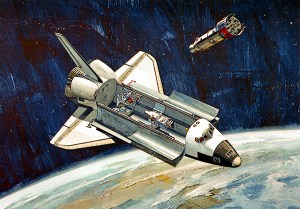
Artist Concept of Shuttle in-orbit flight with Earth limb in the background.
Image credit: NASA JSC
Image source: NASA Images
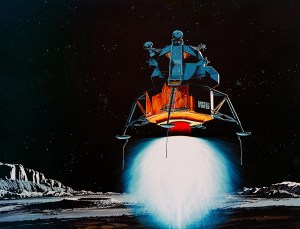
S69-39011 (July 1969) — TRW Incorporated’s artist concept depicting the Apollo 11 Lunar Module (LM) descending to the surface of the moon. Inside the LM will be astronauts Neil A. Armstrong, commander, and Edwin E. Aldrin Jr., lunar module pilot. Astronaut Michael Collins, command module pilot, will remain with the Command and Service Modules (CSM) in lunar orbit. TRW’s LM descent engine will brake Apollo 11’s descent to the lunar surface. The throttle-able rocket engine will be fired continuously the last 10 miles of the journey to the moon, slowing the LM to a speed of two miles per hour at touchdown. TRW Incorporated designed and built the unique engine at Redondo Beach, California under subcontract to the Grumman Aircraft Engineering Corporation, Bethpage, New York, the LM prime contractor.
Image credit: NASA JSC
Image source: NASA Images