Emphasis for the 1970’s

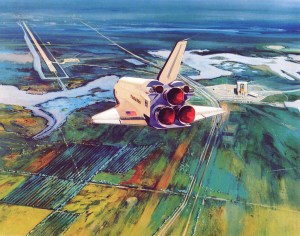
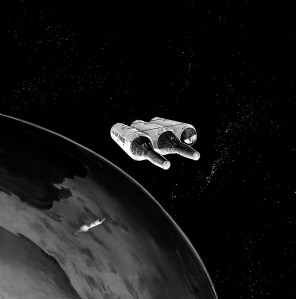
The Space Shuttle will take off vertically with a pilot and a c0-pilot at the helm and two other crew members. In early operations, the Shuttle port will be at Kennedy Space Center, Florida, for east-west orbits. Later a port will be added at Vandenberg Air For Base, California for north-south orbits.

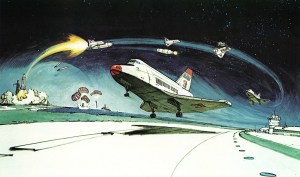
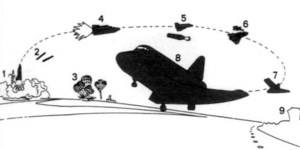
Two solid-propellant booster rockets will supply most of the power (1). About 40 kilometers (25 miles) high, the boosters will separate (2) and descend by parachute to the ocean surface (3). There they will be recovered and returned to the launch site for reuse.The main section of the Shuttle, called the Orbiter, will continue flying (4) on the power of its liquid-propellant engines, supplied by a large external tank. After these two sections reach orbit, the tank will separate (5) and land in a remote ocean area. The Orbiter will be able to carry out space missions lasting at least seven days (6). Special materials covering its entire surface will protect the interior from the searing heat of re-entry. The Orbiter will fly horizontally like an airplane during the latter phase of descent (7) and it will land on a runway (8) near the launch site (9). As ground crews gain experience in readying it for subsequent flights, the turnaround time will be reduced to two weeks.

Our World in Space
Robert McCall & Isaac Asimov
New York Graphic Society, 1974

Image credit: NASA
Images: Numbers Station

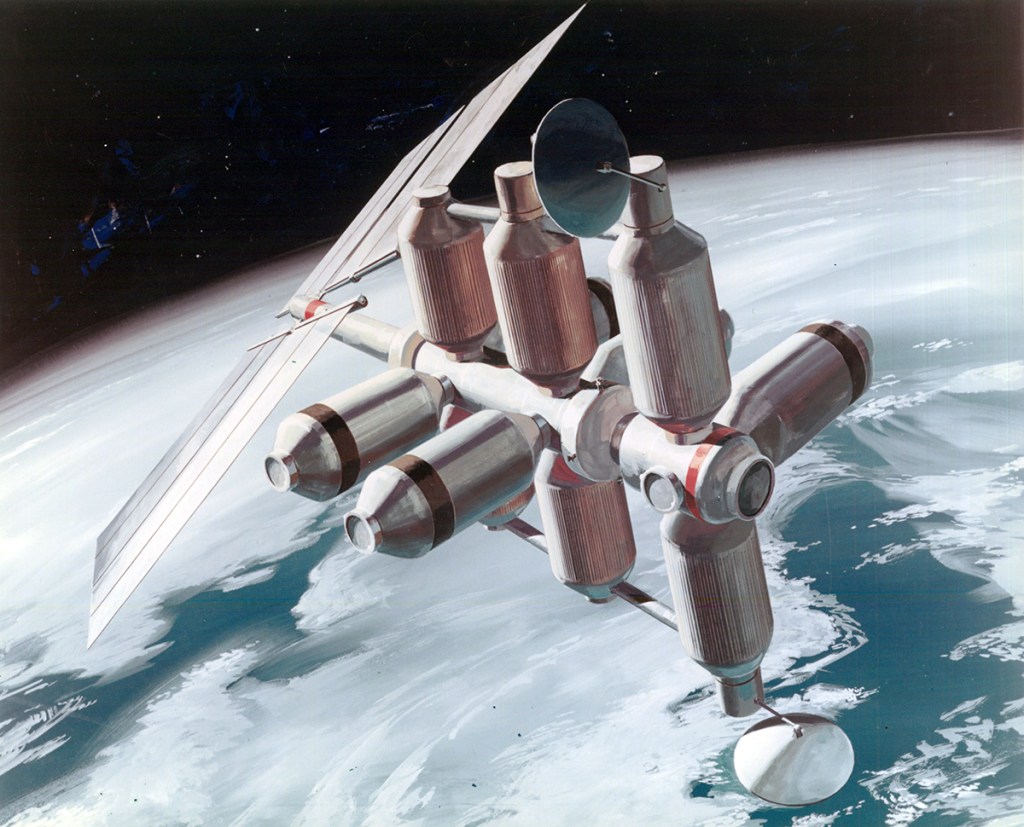
Modularized Space Station

Image credit: NAR / NASA MSFC
Image source: Numbers Station

S66-17592

Image credit: NASA
Image source: Internet Archive

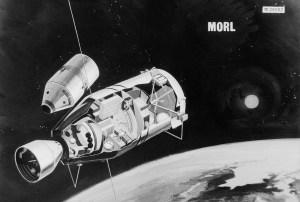
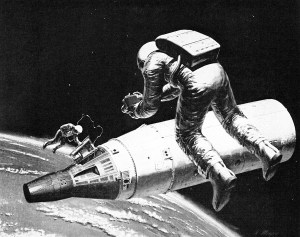
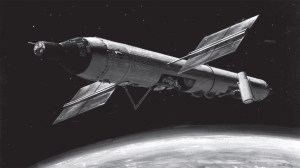
Gemini B / MOL

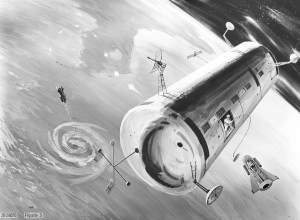
A 1960 concept image of the United States Air Force’s proposed Manned Orbiting Laboratory (MOL) that was intended to test the military usefulness of having humans in orbit. The station’s baseline configuration was that of a two-person Gemini B spacecraft that could be attached to a laboratory vehicle. The structure was planned to launch onboard a Titan IIIC rocket. The station would be used for a month and then the astronauts could return to the Gemini capsule for transport back to Earth. The first launch of the MOL was scheduled for December 15, 1969, but was then pushed back to the fall of 1971. The program was cancelled by Defense Secretary Melvin R. Laird in 1969 after the estimated cost of the program had risen in excess of $3 billion, and had already spent $1.3 billion. Some of the military astronauts selected for the program then transferred to NASA and became some of the first people to fly the Space Shuttle, including Richard Truly, who later became the NASA Administrator. 

Image # : 2B24070-Fig3

Date: Circa 1960

Image credit: McDonnell
Image source: NASA on The Commons

Manned Orbiting Laboratory

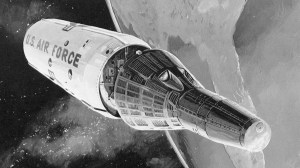
Manned Orbiting Laboratory (MOL), an evolution of the earlier “Blue Gemini” program, which was conceived to be an all-Air Force parallel of NASA’s Gemini efforts. (U.S. Air Force photo)

Image credit: USAF
Image source: USAF Museum

Garrett/AiResearch

Image credit: McDonnell
Images: Mike Acs, Drew Granston

The Dorian Files Revealed

Image credit: USAF
Image source: National Reconnaissance Office