Landing Sequence

Image credit: North American
Image source: Mike Acs

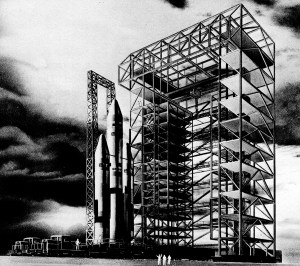
Titan III C

The huge Titan III C vehicle, towering over 150 feet into the air, moves into place on the launch pad. Missile is carried on same railroad car on which its parts were assembled.

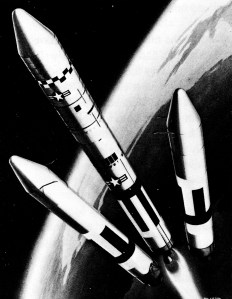
Once the solid rockets have lifted Titan III C and it’s payload off the ground, their role is finished. As this sketch shows, when the solids burn out, they separate from the core section. Just before solid burnout, the first-stage liquid propellant engines are ignited to push the spacecraft farther towards space.

Course of the Titan III and it’s payload is monitored from a launch center such as this.

Orbiting Stations: Stopovers to Space Travel
Irwin Stambler
G.P. Putnam’s Sons, 1965

Image credit: USAF
Image source: National Archives

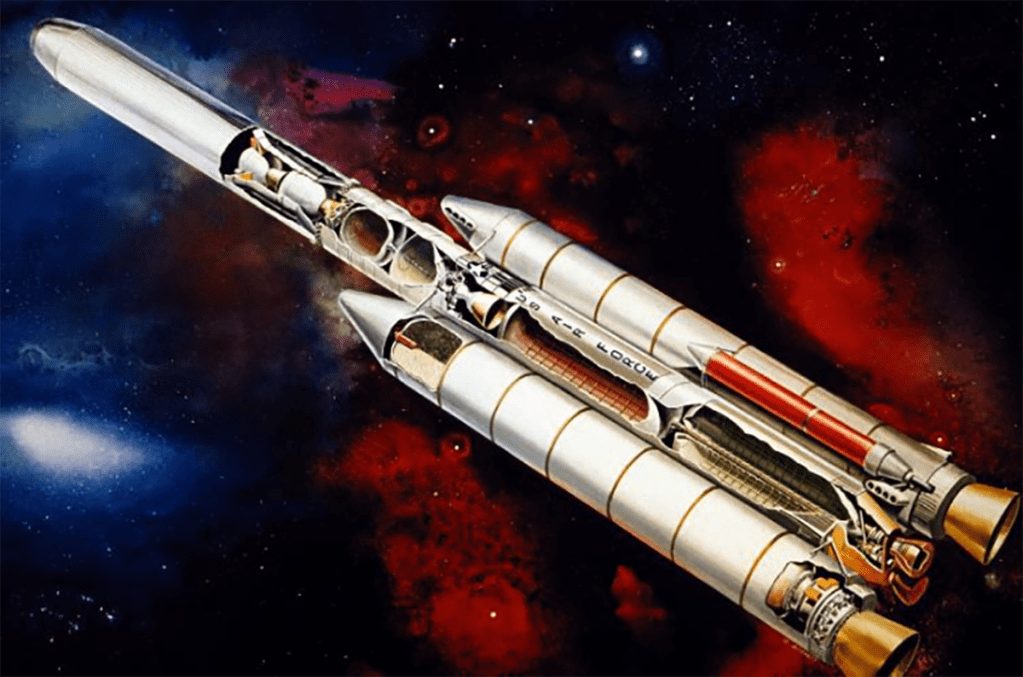
TITAN

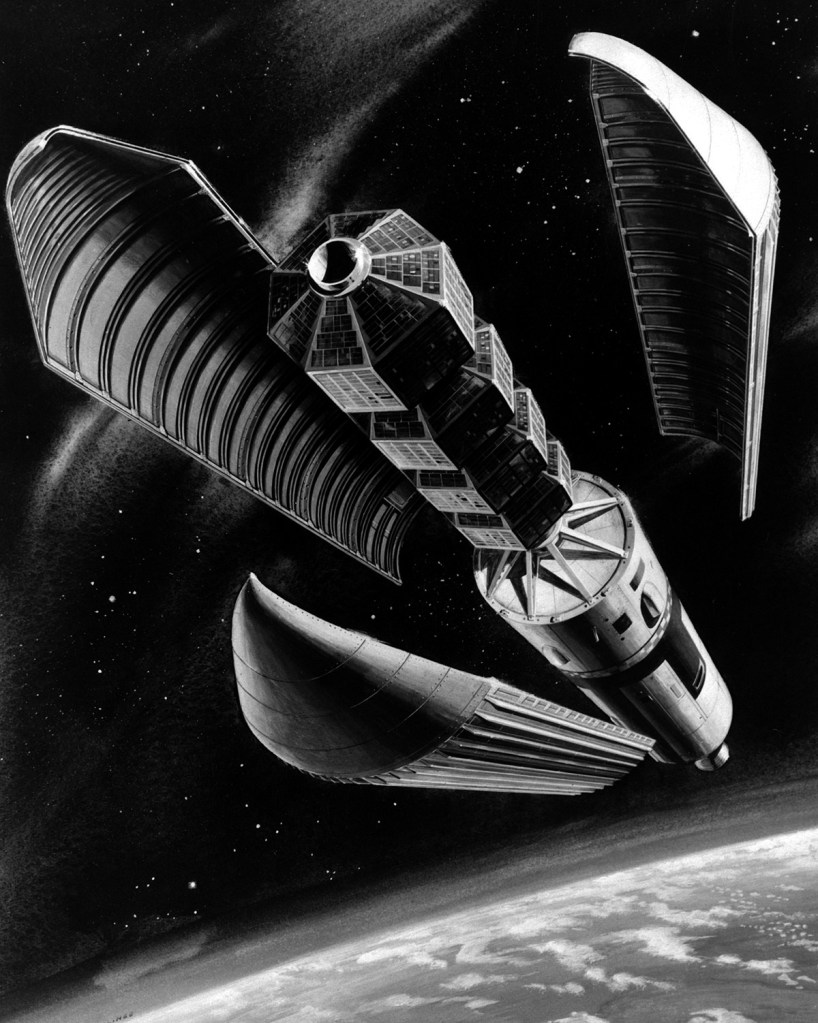
Artist’s concept of the Titan standard launch vehicle 34-D entering the space.

An artist’s concept of the new modular three-section fairing for the Air Force’s Titan III-C space launch vehicle.

Image credit: USAF
Image source: National Archives

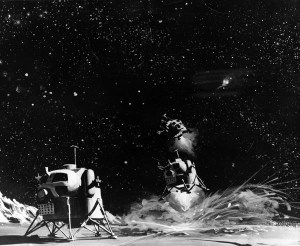
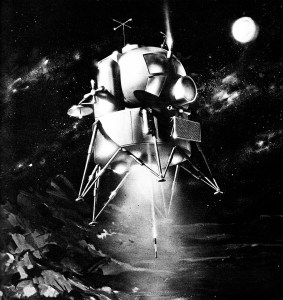
Lunar Liftoff

  1. Mariner IV determined that Mars’ atmosphere is only 1 to 2 percent of the Earth’s in density. This may mean that future manned spacecraft to Mars must employ the same landing technique – retro rockets – as the ones which will be used by the Apollo lunar ship.
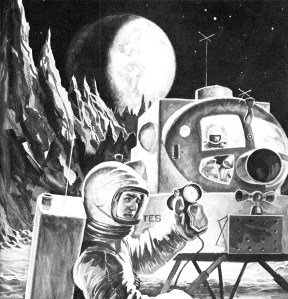
  2. Artist’s drawing of interplanetary explorers maintaining contact through the use of small radio equipment. This particular transmitter is also designed to transmit data concerning the condition of the astronaut and the functioning of his suit.

Mars: Planet for Conquest
by Erik Bergaust
G.P Putnam’s Sons, 1967

Image source: Numbers Station
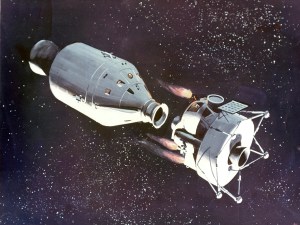
Over Phobos

Electrostatic ion-powered five-man spacecraft passing over Mars’ moon Phobos on the way to Mars. One of two “scout cars” will land on the tiny moon and rendezvous with the ship later.

Mars: Planet for Conquest
by Erik Bergaust
G.P Putnam’s Sons, 1967

Rocketdyne
Image source: Numbers Station

LEM by Gary Meyer

Image credit: NASA
Image source: Mike Acs

Ascent Stage

Image credit: NASA
Image source: Mike Acs

Źiemba and Collopy

Image credit: NASA
Image source: Mike Acs

Lunar Liftoff

Space World, November 1964

Image credit: Bell Aerosystems
Image source: Numbers Station
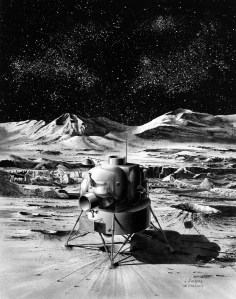
Northrop Lander

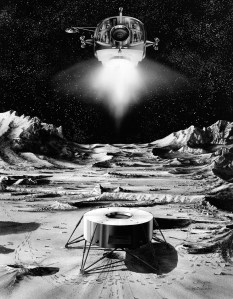
First manned landing on Mars! This Northrop sketch shows how a soft landing on the red planet might look from ground level. A steerable gliding cloverleaf parachute slows the craft down as the retrorockets start to fire. The parachute is then jettisoned, and the retrorockets perform the final maneuver for touchdown. Retrorocket braking was perfected in the 1960’s to provide the soft landings for the Surveyor moon probe.

Project Viking: Space Conquest Beyond the Moon
by Irwin Stambler
G.P. Putnam’s Sons, 1970

Image credit: NASA
Image source: Numbers Station