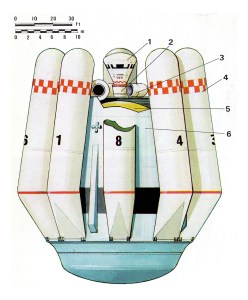
Selena Storyboard

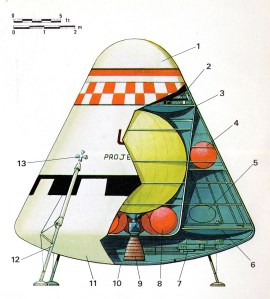
How re-usable ROMBUS-type launch vehicles can be applied to construction of a temporary lunar base (Project Selena).

  1. Vehicle en route for the Moon is refuelled in Earth Orbit;
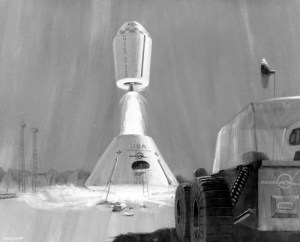
  2. Soft-lands on the Moon with lunar base components;
  3. Pressurized moon-tractor hauls hydrogen tanks adapted for human habitation to assembly site;
  4. The lunar base is ready for occupation.

Frontiers of Space is peppered with artwork from Douglas, including paintings by Don Charles and James Finnell. In the book, this section was illustrated with (pretty poor) knock-offs. Why? Who knows? These were the masters.

Image credit: Douglas
Image source: SDASM Archives

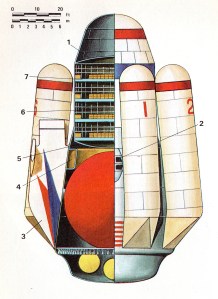
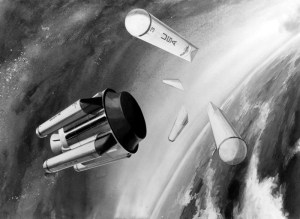
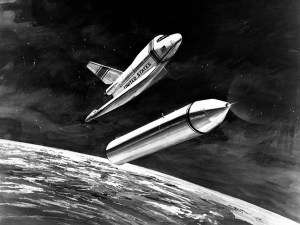
Deimos Storyboard

Mission to Mars (Project Deimos)

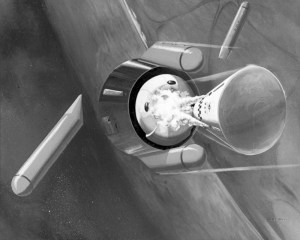
  1. Hydrogen tanks jettison as ROMBUS spaceship accelerates from Earth-orbit;
  2. Two hydrogen tanks jettison after retro-thrust into Mars orbit. Mars Landing Module separates from ROMBUS parent above the cratered deserts;
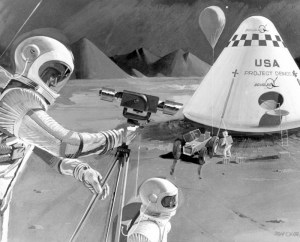
  3. After soft-landing, astronauts begin exploration setting out research equipment and taking meteorological soundings;
  4. Ascent stage of Mars Landing Module returns astronauts to ROMBUS parent in Martian orbit for return to Earth.

Frontiers of Space
Philip Bono & Kenneth Gatland
Macmillan, 1969

Image credit: Douglas
Image source: SDASM Archives

Concept by Henry Lozano Jr.

Image credit: North American Rockwell
Image source: Numbers Station
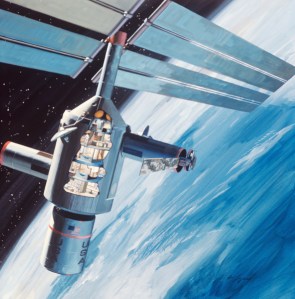
NAR Artist Concept

Image credit: North American Rockwell
Image source: Numbers Station
619 by Craig Kavafes

Image credit: Grumman

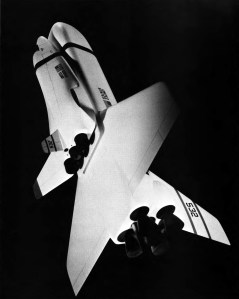
Design 532

Image credit: Grumman
File source: NASA NTRS

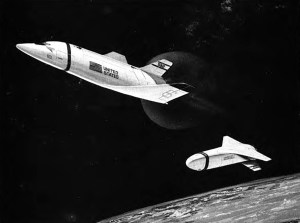
X-20 by Warren McCallister

FOR RELEASE AT 9:00 A.M., PDT, SEPTEMBER 22, 1960

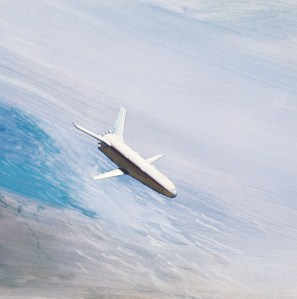
DYNA SOAR GLIDER RE-ENTERING EARTH’S ATMOSPHERE

This is a Boeing artist’s impression of how the Dyna Soar manned space glider will look when it re-enters the earth’s atmosphere after a flight into space. Leading edges of the craft will glow from the heat created by the friction of the vehicle passing into the atmosphere. Dyna Soar will be boosted into space by a modified Titan intercontinental ballistic missile. After being separated from its booster, the glider will be left in a piloted, near orbital flight. Its pilot later could glide to a conventional landing at an Air Force base. The Boeing Company, under supervision of the Air Force, is prime contractor for the system and the glider. The Martin Company is prime contractor for the Titan booster.

— Boeing Airplane Company Photo

FROM:

News Bureau
Boeing Airplane Company
Seattle 24, Washington

Image credit: Boeing
Image source: Numbers Station
Design 619

Image credit: Grumman
Image source: Numbers Station
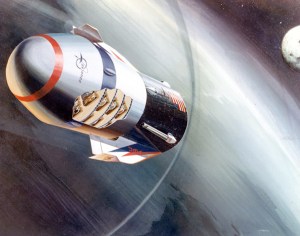
Solar-powered Ship

This glorious painting by John Sentovic depicts a solar-powered ship in lunar orbit, as envisioned by Krafft A. Ehricke.

Image credit: Convair
Image source: SDASM Archives

Design 518

Image credit: Grumman
File source: NASA NTRS