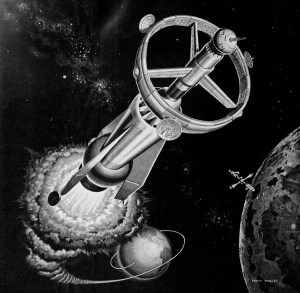
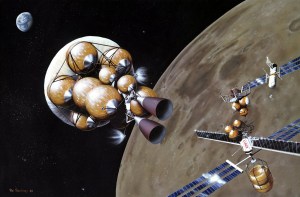
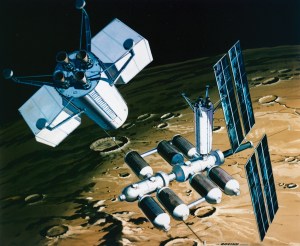
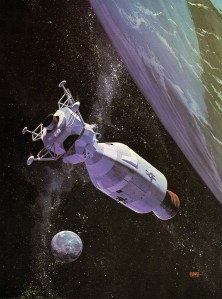
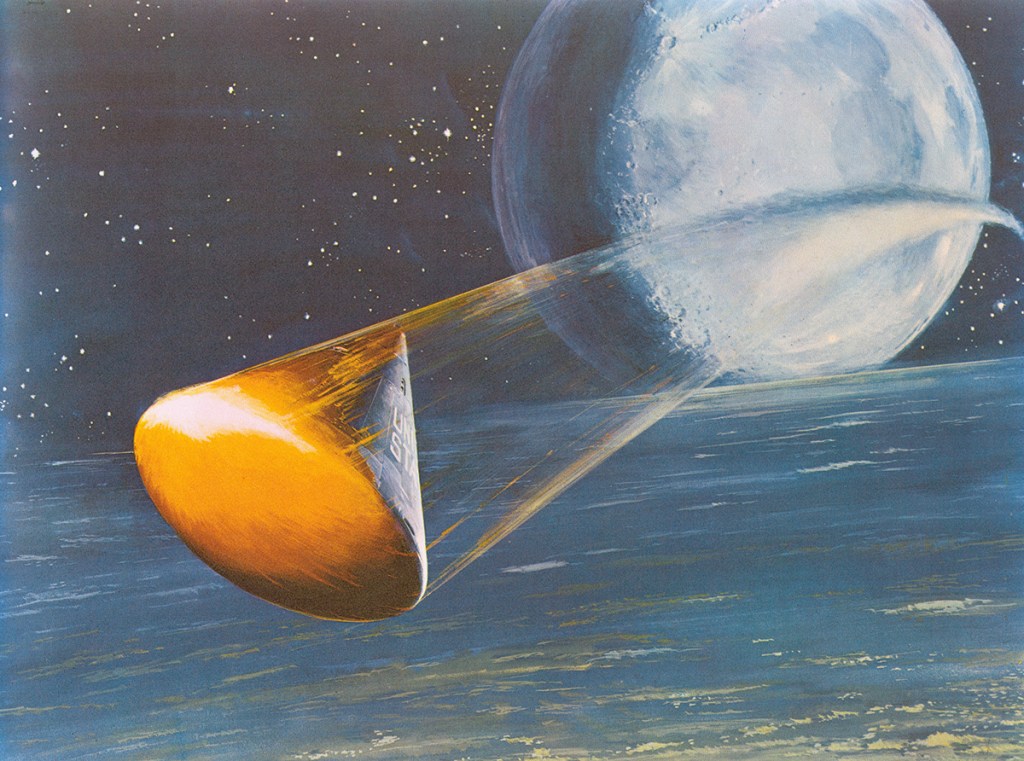
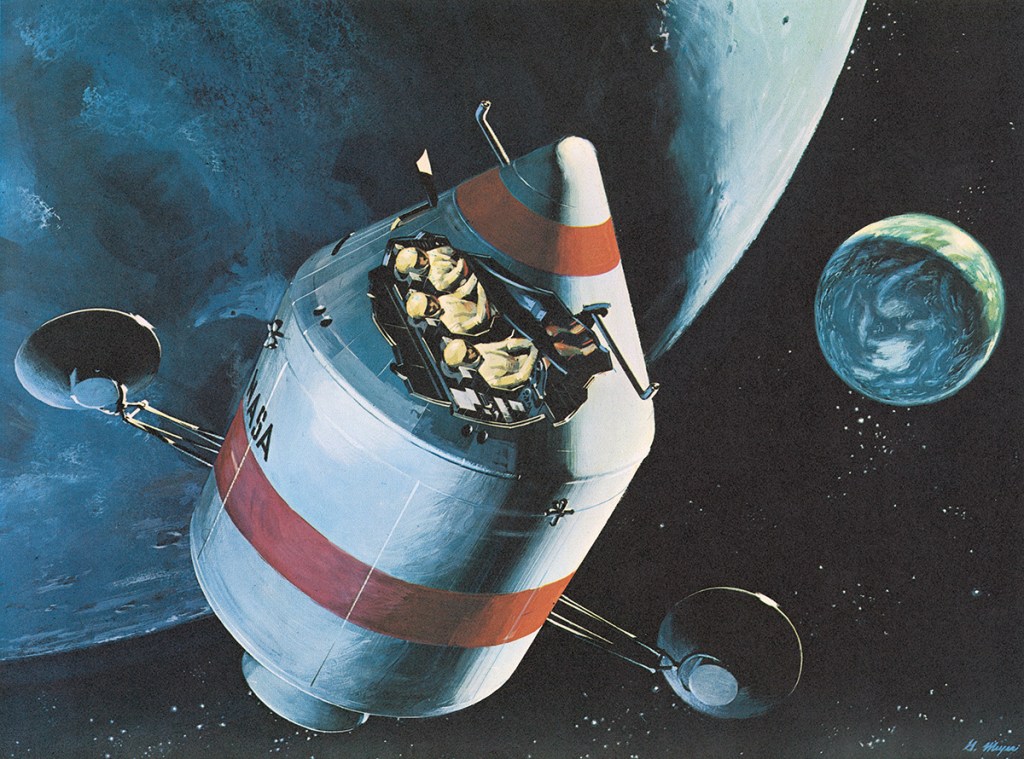
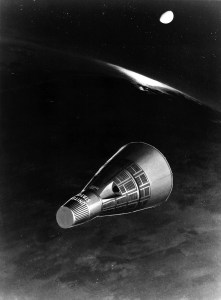
S83-28321 (14 March 1983) — In this artist’s concept of future lunar operations, a lunar ferry is about to burn out of lunar orbit for the trip back to facilities in low Earth orbit. The ferry vehicle carries tank modules filled with liquid oxygen, which has been produced from mining operations on the surface of the Moon. One possibility for such operations would be to have manned facilities in low lunar orbit, such as illustrated here. At the upper right side of the photo is a small orbiting manned station. At the lower right side of the photo is a liquid oxygen propellant dump, to which a lunar landing vehicle carrying liquid oxygen is about to dock. The lunar ferry vehicle itself is representative of one type of aerobraking system. The balloon-like torus around the center of the ferry-craft would inflate to several times its illustrated size and, once the vehicle has swooped down close to the Earth’s outer atmosphere on the return journey, would use atmospheric drag to slow the craft and place itself in low Earth orbit. The liquid oxygen would then be used in operations there for fueling various vehicles, including an orbital transfer vehicle for trips to geosynchronous Earth orbit. This concept is part of a study done for the Johnson Space Center by Eagle Engineering of Houston. The artist was Pat Rawlings.
Image credit: Eagle Engineering Image source: Internet Archive
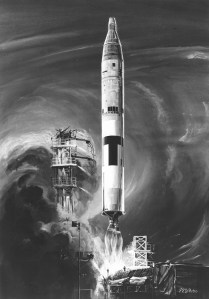
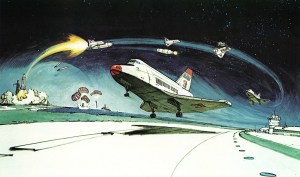
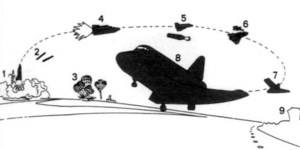
The Space Shuttle will take off vertically with a pilot and a c0-pilot at the helm and two other crew members. In early operations, the Shuttle port will be at Kennedy Space Center, Florida, for east-west orbits. Later a port will be added at Vandenberg Air For Base, California for north-south orbits.
Two solid-propellant booster rockets will supply most of the power (1). About 40 kilometers (25 miles) high, the boosters will separate (2) and descend by parachute to the ocean surface (3). There they will be recovered and returned to the launch site for reuse.The main section of the Shuttle, called the Orbiter, will continue flying (4) on the power of its liquid-propellant engines, supplied by a large external tank. After these two sections reach orbit, the tank will separate (5) and land in a remote ocean area. The Orbiter will be able to carry out space missions lasting at least seven days (6). Special materials covering its entire surface will protect the interior from the searing heat of re-entry. The Orbiter will fly horizontally like an airplane during the latter phase of descent (7) and it will land on a runway (8) near the launch site (9). As ground crews gain experience in readying it for subsequent flights, the turnaround time will be reduced to two weeks.
Our World in Space Robert McCall & Isaac Asimov New York Graphic Society, 1974