Gemini B / MOL

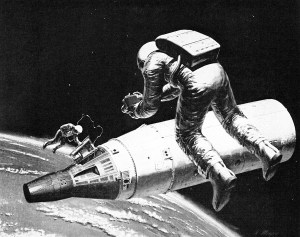
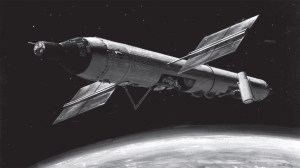
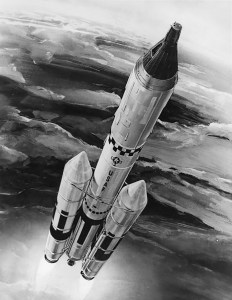
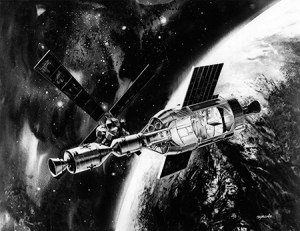
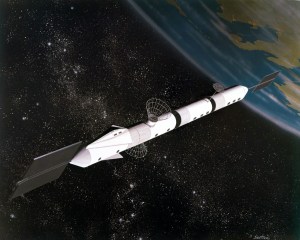
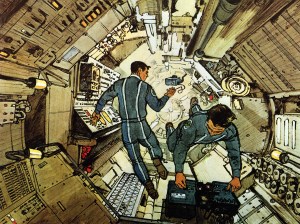
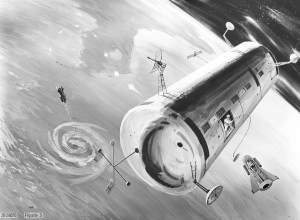
A 1960 concept image of the United States Air Force’s proposed Manned Orbiting Laboratory (MOL) that was intended to test the military usefulness of having humans in orbit. The station’s baseline configuration was that of a two-person Gemini B spacecraft that could be attached to a laboratory vehicle. The structure was planned to launch onboard a Titan IIIC rocket. The station would be used for a month and then the astronauts could return to the Gemini capsule for transport back to Earth. The first launch of the MOL was scheduled for December 15, 1969, but was then pushed back to the fall of 1971. The program was cancelled by Defense Secretary Melvin R. Laird in 1969 after the estimated cost of the program had risen in excess of $3 billion, and had already spent $1.3 billion. Some of the military astronauts selected for the program then transferred to NASA and became some of the first people to fly the Space Shuttle, including Richard Truly, who later became the NASA Administrator. 

Image # : 2B24070-Fig3

Date: Circa 1960

Image credit: McDonnell
Image source: NASA on The Commons
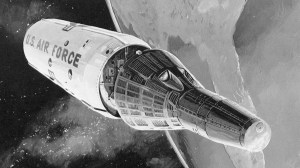
Manned Orbiting Laboratory

Manned Orbiting Laboratory (MOL), an evolution of the earlier “Blue Gemini” program, which was conceived to be an all-Air Force parallel of NASA’s Gemini efforts. (U.S. Air Force photo)

Image credit: USAF
Image source: USAF Museum

Garrett/AiResearch

Image credit: McDonnell
Images: Mike Acs, Drew Granston

The Dorian Files Revealed

Image credit: USAF
Image source: National Reconnaissance Office

’68 MOL by Ted Brown

Image credit: McDonnell
Image source: SDASM Archives

MOL

(WX3) WASHINGTON, AUG. 25 — ARTIST’S CONCEPTION OF MANNED ORBITING LABORATORY (MOL) REVEALED BY PRESIDENT JOHNSON TODAY AT HIS WASHINGTON NEW CONFERENCE. (U.S. AIIR ORCE PHOTO VIA AP WIRE PHOTO) (rbe41015ho) 1965.

Image credit: USAF
Image source: Numbers Station

Orbital Workshop by Neil Jacobe

B&W (As seen in Roundup dated Nov. 24, 1967)
NOV. 67 S-67-51373

MANNED SPACE CENTER, HOUSTON, TEXAS

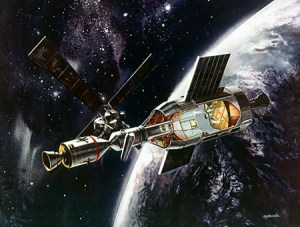
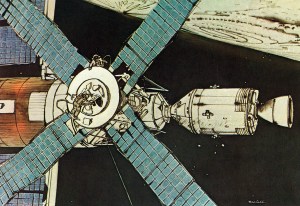
ORBITAL WORKSHOP — Artist’s concept showing how a Saturn S-IVB stage will appear when converted to the Apollo Applications Orbital Workshop. Launched fully fueled with airlock and docking adaptor attached, the S-IVB’s liquid hydrogen tank becomes a shirtsleeve environment workshop after the fuel has been depleted. At left is an Apollo Command and Service Module launched separately and docked into one of the docking adaptor’s ports. The Apollo Telescope Mount is shown docked into one of the side ports. The ATM will be joined to the cluster in a second phase of the program. Solar cell “wings” to provide power fold outward from the S-IVB after orbit is achieved. McDonnell Douglas Corporation’s Missile and Space Systems Division is making the S-IVB orbital workshop modifications under contract to NASA Marshall Space Flight Center and McDonnell Astronautics Company is developing the airlock under contract to MSC. (MCDONNELL DOUGLAS PHOTOGRAPH)

Look closely and you’ll notice subtle differences between this version of the painting and a colour rendering found in the SDASM Archives I’ve shared before.

If you’re interested in seeing more of Jacobe’s work, his artwork for the Douglas MOL can be found here. The images are small and plastered with watermarks, so it’s a bit of a tease but they are beautiful.

Image credit: NASA
Image source: Numbers Station

Outpost III

Image credit: Convair
Image source: SDASM Archives

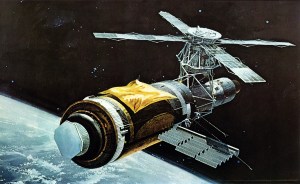
Skylab

Our World in Space
Robert McCall & Isaac Asimov
New York Graphic Society, 1974

Image credit: NASA
Image source: Numbers Station

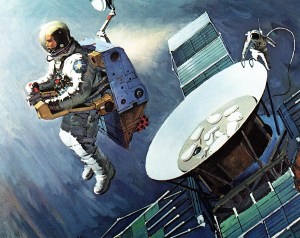
Skylab (McCall)

Our World in Space
Robert McCall & Isaac Asimov
New York Graphic Society, 1974

Image credit: NASA
Image source: Numbers Station

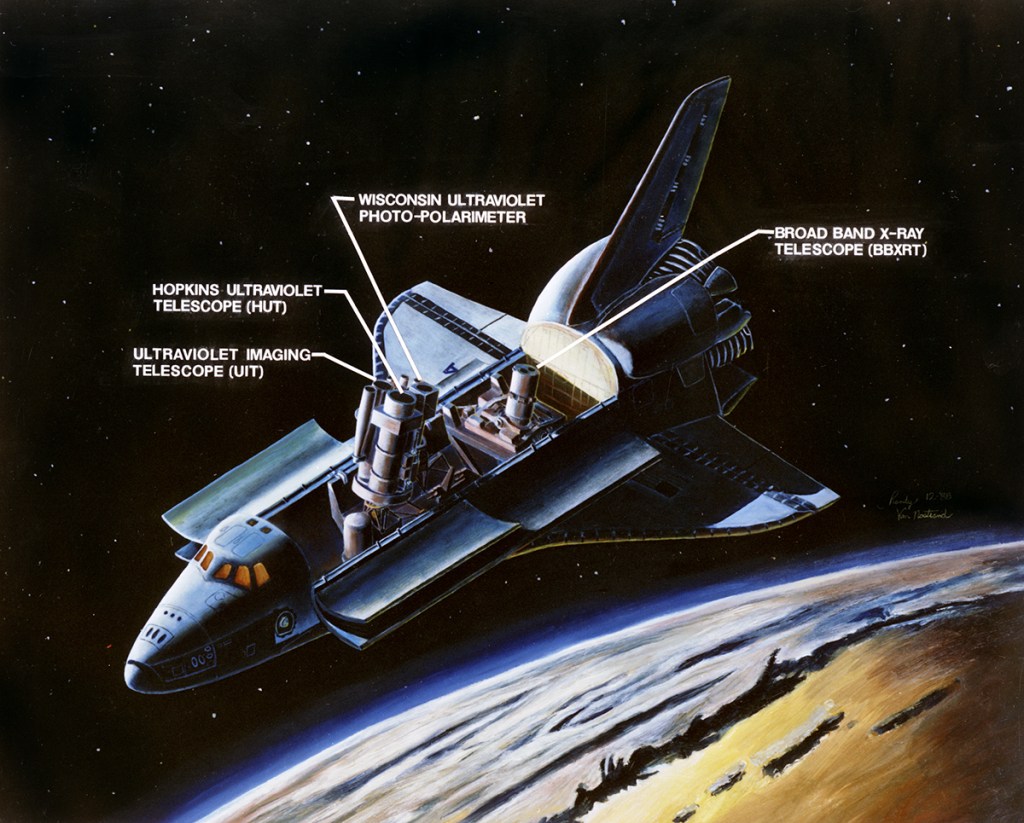
Astro 1

Image credit: NASA

Image source: NASA ARC