S69-18546

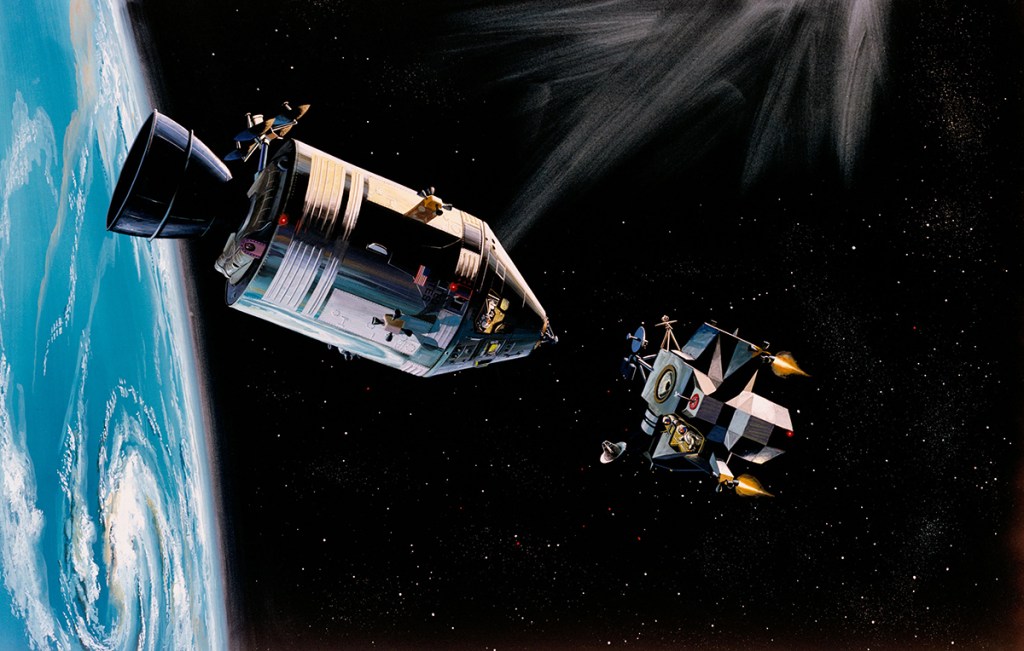
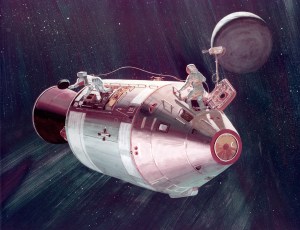
S69-18546 (February 1969) — North American Rockwell artist’s concept illustrating the docking of the Lunar Module ascent stage with the Command and Service Modules during the Apollo 9 mission. The two figures in the Lunar Module represent astronauts James A. McDivitt, Apollo 9 commander; and Russell L. Schweickart, lunar module pilot. The figure in the Command Module represents astronaut David R. Scott, command module pilot. The Apollo 9 mission will evaluate spacecraft lunar module systems performance during manned Earth-orbital flight.

Image credit: NASA JSC
Image source: NASA Images

Do The Astro!

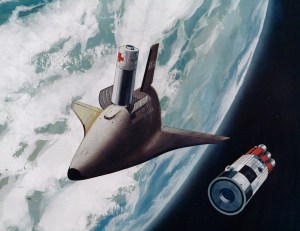
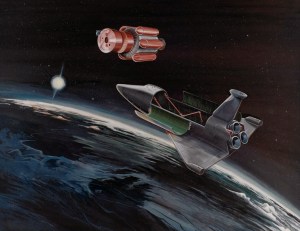
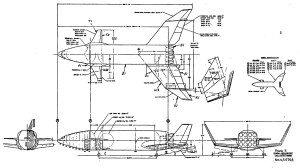
ASTRO — a manned reusable spacecraft concept developed by Douglas Aircraft.

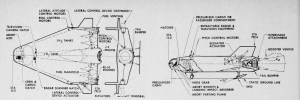
PLAN AND ELEVATION views of ASTRO A2 vehicle. Note booster vehicle attachment at aft end.

Missiles and Rockets, September 3, 1962

Image credit: Douglas
Image source: Internet Archive

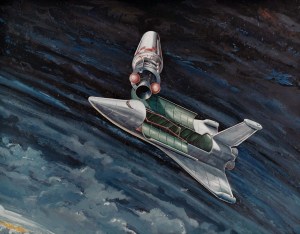
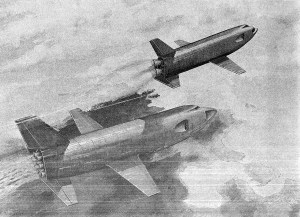
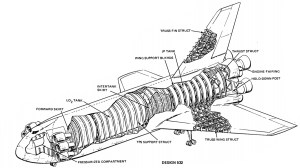
532 Flyback Booster

Image credit: Grumman
File source: NASA NTRS

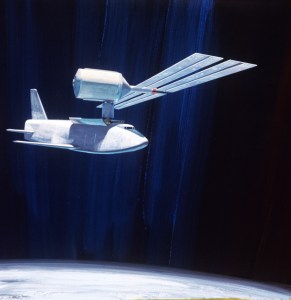
Canard Booster

Imaged credit: NASA
File source: NASA NTRS

By Jove!

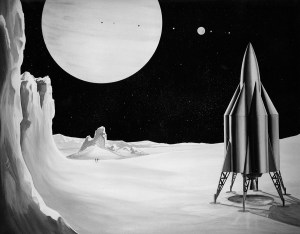
Jupiter Lunar Landing

From one of Jupiter’s 12 moons, earth astronauts gaze on this impressive, but bleak, view of the 86,900 mile-diameter planet. More than 316 times the mass of the Earth, Jupiter is seven times further from the sun than Earth; would require voyage of one to two months to reach at velocity of one million feet per second. Max Hunter, Douglas Aircraft Company engineer predicts economically feasible trips to Jupiter will be made through development of nuclear thrust spaceship engines. 

Douglas Aircraft Company, Inc. General Offices, Santa Monica, Calif.

Image credit: Douglas Aircraft Company
Image source: Numbers Station

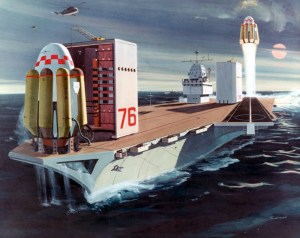
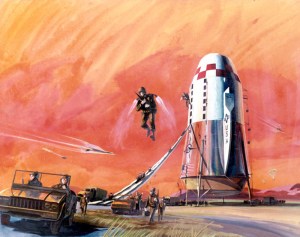
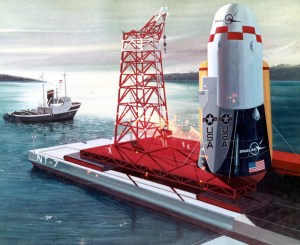
Ithacus Explained

  1. Ithacus troop transport launched from a nuclear carrier;
  2. Troops disembark from Ithacus rocket at their destination halfway across the world;
  3. After transfer from the interior, empty vehicle is taken by barge to a convenient coastal spaceport for reconditioning and relaunch.

Image credit: Douglas
Image source: SDASM Archives

Inside Deimos

ROMBUS

Configuration for a manned Mars mission (Project Deimos).

  1. Six man Mars landing capsule;
  2. Pressurized tunnel;
  3. Toroidal living compartment;
  4. Liquid hydrogen tanks (8);
  5. Spherical liquid oxygen tank
  6. Booster centerbody.

Project Deimos – Mars Landing Module

  1. Earth-return capsule;
  2. Command centre and pressurized tunnel;
  3. Separation joint, for return to Mars orbit;
  4. Mars landing propellant tanks(6);
  5. Ground access hatch;
  6. Mars-launch platform;
  7. Payload and power supply equipment compartment;
  8. Mars-launch propellant tank;
  9. Landing and take-off rocket motor;
  10. Jettisonable closure panel;
  11. Mars-entry heat shield;
  12. Extensible landing gear(4);
  13. Altitude-control system quads (4).

Frontiers of Space
Philip Bono & Kenneth Gatland
Macmillan, 1969

Image credit: Douglas
Image source: Numbers Station