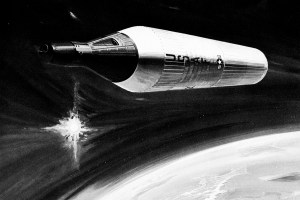
Into The Unknown
by Don Dwiggins
Golden Gate Books, 1971
Image credit: McDonnell
Image source: Numbers Station
Into The Unknown
by Don Dwiggins
Golden Gate Books, 1971
Image credit: McDonnell
Image source: Numbers Station
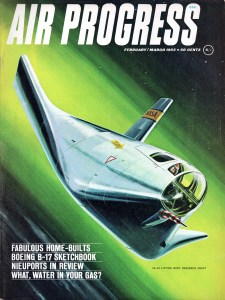
Image credit: Northrop
Image source: Numbers Station
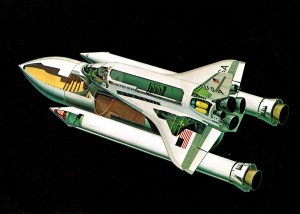
Image credit: Rockwell International
Image source: Numbers Station
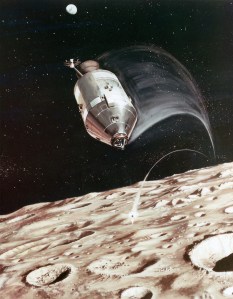
Image credit: NASA
Image source: Numbers Station
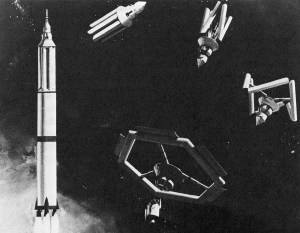
Three-armed LORL is shown in this artist’s sketch. Center hub, which contains parking area for several space ferries, does not rotate and thus remains weightless. Under the parking area is a laboratory for study of weightlessness. The three arms rotate around the hub to create artificial gravity. Cutaway of one arm shows it to contain a series of rooms for other laboratory requirements and studies.
Orbiting Stations: Stopovers to Space Travel
Irwin Stambler
G.P. Putnam’s Sons, 1965
Image credit: North American Aviation
Image source: Numbers Station
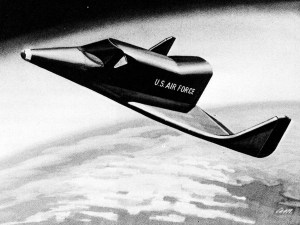
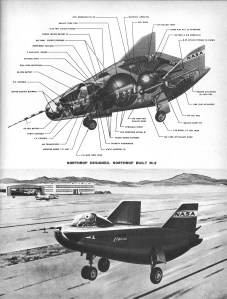
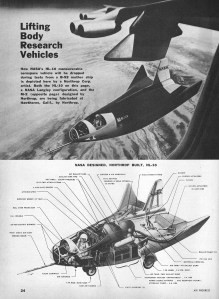
Dyna-Soar in space was never to be, for the program was canceled in December 1963. One of reasons was the development of a new type of aerospace plane, the lifting body.
Orbiting Stations: Stopovers to Space Travel
Irwin Stambler
G.P. Putnam’s Sons, 1965
Image credit: Boeing
Image source: Numbers Station
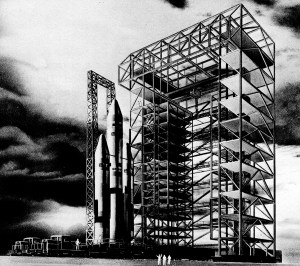
The huge Titan III C vehicle, towering over 150 feet into the air, moves into place on the launch pad. Missile is carried on same railroad car on which its parts were assembled.
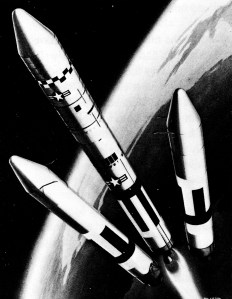
Once the solid rockets have lifted Titan III C and it’s payload off the ground, their role is finished. As this sketch shows, when the solids burn out, they separate from the core section. Just before solid burnout, the first-stage liquid propellant engines are ignited to push the spacecraft farther towards space.

Course of the Titan III and it’s payload is monitored from a launch center such as this.
Orbiting Stations: Stopovers to Space Travel
Irwin Stambler
G.P. Putnam’s Sons, 1965
Image credit: USAF
Image source: National Archives
Mars: Planet for Conquest
by Erik Bergaust
G.P Putnam’s Sons, 1967
Image source: Numbers Station

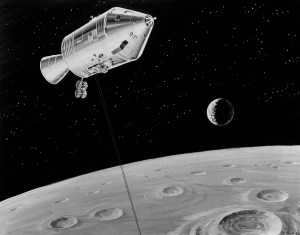
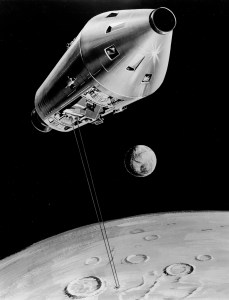
Electrostatic ion-powered five-man spacecraft passing over Mars’ moon Phobos on the way to Mars. One of two “scout cars” will land on the tiny moon and rendezvous with the ship later.
Mars: Planet for Conquest
by Erik Bergaust
G.P Putnam’s Sons, 1967
Rocketdyne
Image source: Numbers Station