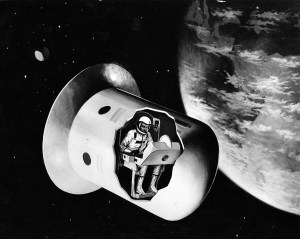
Over Phobos

Electrostatic ion-powered five-man spacecraft passing over Mars’ moon Phobos on the way to Mars. One of two “scout cars” will land on the tiny moon and rendezvous with the ship later.

Mars: Planet for Conquest
by Erik Bergaust
G.P Putnam’s Sons, 1967

Rocketdyne
Image source: Numbers Station

Lunar Liftoff

Space World, November 1964

Image credit: Bell Aerosystems
Image source: Numbers Station

“Complex” Space Vehicle

Complex space vehicles from Earth in orbit around Mars some time in the late 70’s, as visualized by today’s engineers.

The Next Fifty Years in Space
by Erik Bergaust
Macmillan, 1964

Image credit: Rocketdyne
Image source: Numbers Station
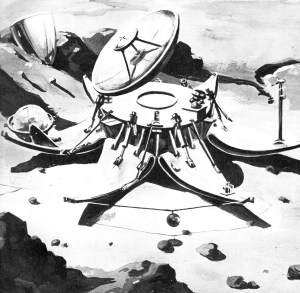
A Laboratory on Mars

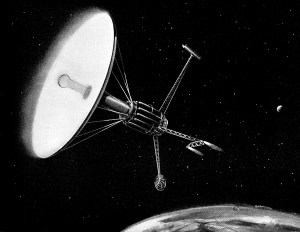
Prime goal of Project Viking is this National Aeronautics and Space Administration sketch, to land a biological laboratory on the surface of Mars. The picture shows a design in which the protective housing around the experiments unfolds in petal fashion once the laboratory is safely on the Martian surface.

Project Viking: Space Conquest Beyond the Moon

by Irwin Stambler
G.P. Putnam’s Sons, 1970

Image credit: NASA
Image source: Numbers Station

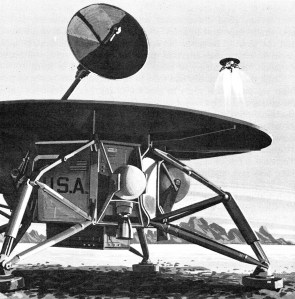
Boeing Viking

Project Viking: Space Conquest Beyond the Moon
by Irwin Stambler
G.P. Putnam’s Sons, 1970

Image credit: NASA
Image source: Numbers Station
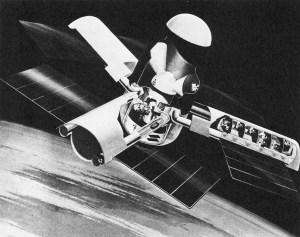
LORL (Lockheed)

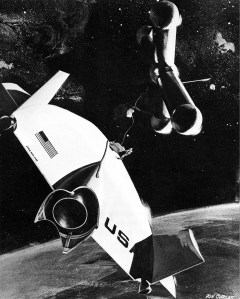
Three-armed LORL is shown in this artist’s sketch. Center hub, which contains parking area for several space ferries, does not rotate and thus remains weightless. Under the parking area is a laboratory for study of weightlessness. The three arms rotate around the hub to create artificial gravity. Cutaway of one arm shows it to contain a series of rooms for other laboratory requirements and studies.

Orbiting Stations: Stopovers to Space Travel
Irwin Stambler
G.P. Putnam’s Sons, 1965

Image credit: Lockheed
Image source: Numbers Station
All-Purpose Space Vehicle

  1. All-purpose space vehicle proposed by Douglas Missile & Space Systems Division engineer Phil Bono, is pictured in artist’s concept during refueling in earth orbit prior to flight to the moon.
  2. Refueling tankers, on either side will return to earth. Vehicle carries up to eight “strap-on” liquid hydrogen tanks, which can be ejected after they are emptied or retained for use on moon. Retro engines are fire as spacecraft nears lunar surface to allow a direct landing without an orbital maneuver. All-purpose space vehicle proposed by Douglas Missile & Space Systems Division engineer Phil Bono, is pictured in artist’s concept during refueling in earth orbit prior to flight to the moon.
  3. Empty strap-on tanks are lowered to lunar surface before each return flight.
  4. These liquid hydrogen tanks could be used as shelter for pioneering lunar colony.

Space World
December 1964, VOL. A-14

Image credit: Douglas
Image source: Numbers Station
Space Delivery

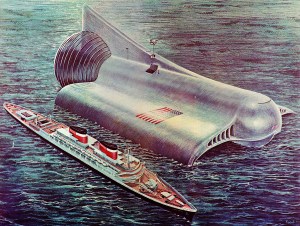
Space delivery – The partnership of the space ferry and the manned laboratory is demonstrated in this sketch. Here astronauts in a Douglas Astro ferry approach a huge space station with fresh supplies of food and test equipment. Eventually, experimental orbiting stations may give way to orbiting terminals for space travelers of the future.

Orbiting Stations: Stopovers to Space Travel
Irwin Stambler
G.P. Putnam’s Sons, 1965

Image credit: Douglas
Image source: Numbers Station
Space-Age Station

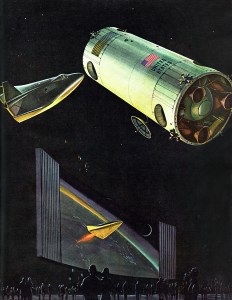
A spaceport and supply rocket designed by the Martin Marietta Corporation in mid-air in this scene from the Hall of Science space show. In such a port, astronauts may orbit for half a year.

New York World’s Fair 1964/1965
Official Souvenir Book
Time Life, 1964

Image credit: Martin Marietta
Image source: Numbers Station
Aldebaran

Space World
April 1965, VOL. B-4.18

Image credit: Space World
Image source: Numbers Station
Roy Scarfo Album

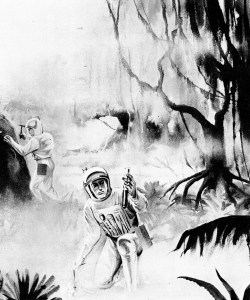
  1. Extraterrestrial explorers, in space suits, gather samples from strange planet, to determine its adaptability to supporting human life.
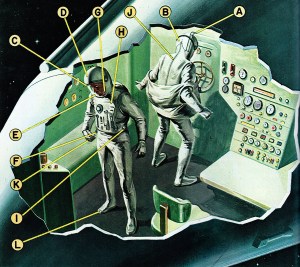
  2. SPACE SUIT SYSTEMS – While space suits are unnecessary within the spaceship, they are vital for activities outside the vessel, or on asteroids or planets. (A) direct audio communications aerial; (B)(J) receiving aerial (also serves as suit zipper); (C) unbreakable glass visor; (D) helmet visor to be lowered against strong light or radiation; (E) voice diaphragm; (F) electric systems; (G) microphone; (H) tools and suit controls (heat, etc.) (I) nitrogen inflation nozzle; (K) flexible metal gloves; (L) magnetic and heated shoes.
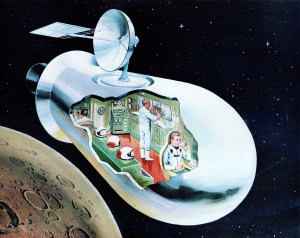
  3. DIRECT RADITATION SYSTEM – Useful for relatively longer mission durations such as one or two months. This could be a lunar observation or space laboratory type mission. Because of the weight penalty resulting in the need to store a large quantity of expendable liquid such a system can no longer be considered for mission durations exceeding one or two weeks. Where the storage of relatively larger food quantities is required, a satisfactory system would be one in which heat is conducted away from the food to a fin providing a large surface area for direct radiation of the heat to space. Such a system would operate best if the radiating surfaces were to face away from the sun. The fin is therefore shown attached to a solar collector (part of another system) which is maintained in an orientation always facing the sun. The large radiator surfaces will then face away from the sun. The food stored by such a system would again be provided in special containers to permit eating in the absence of gravity. Special provisions such as suction cups on the food containers permit the astronaut to stand the food containers on table or shelf. Magnetic shoes permit him to walk about the cabin in the usual manner.
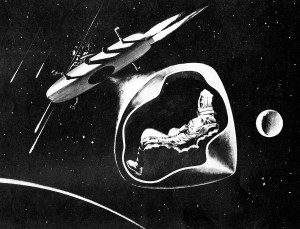
  4. Space escape capsule. After escape from damaged ship, rescue is possible from this “lifeboat’ of space.
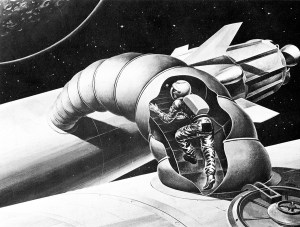
  5. Transferring from shuttle ship to space ship in orbit. Larger ships need not land on moon or planet.
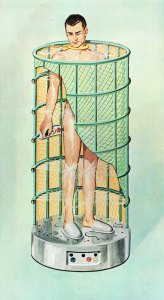
  6. NEEDLE SPRAY BATH SYSTEM – Water on long missions must be closed-system, used over and over for all purposes. Waste water collected from all sources, redistilled and purified is shown here being used for a full bath. Heat is procured from the solar collector, is removed via the distillation process, and in turn converted into electricity to run the motors controlling the needle sprays on circulating system. Degradable detergents are used instead of soap, and recovered for reuse in the distillation process.
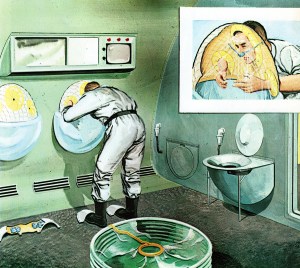
  7. WASHROOM AND TOILET SYSTEMS – Hand and face are miniature needle spray systems, used for ablutions and for face rinse after shaving. Toilet facilities operate on air-suction principle, and all water is removed from wastes and purified for re-use in the entire bathroom system.
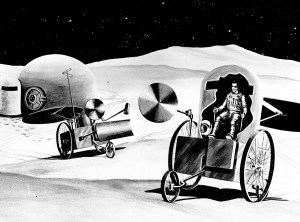
  8. Manned lunar roving vehicle, capable of maneuvering about the airless desert landscape.

Space World
December 1964, VOL. A-14

Image credit: Space World
Image source: Numbers Station