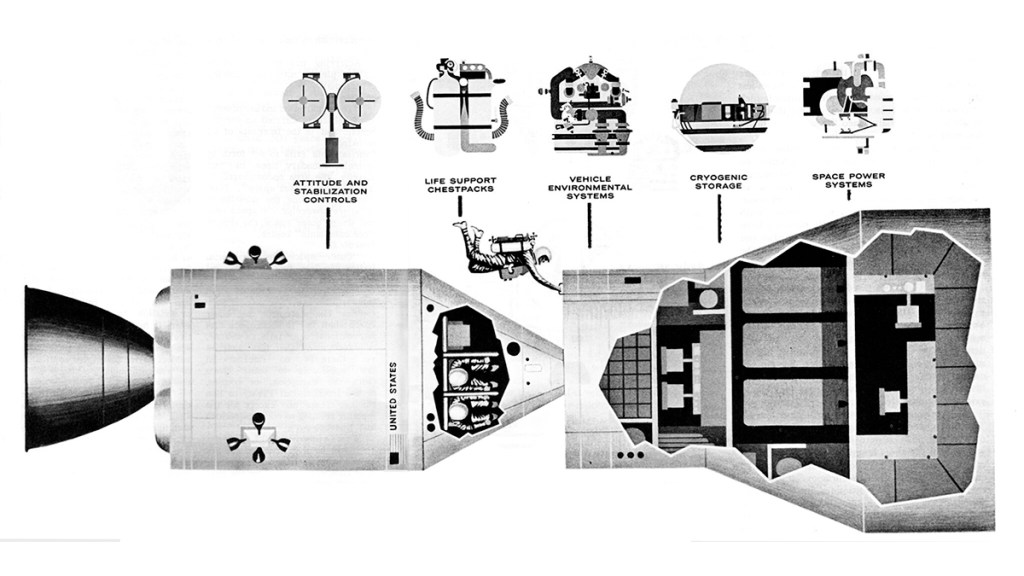
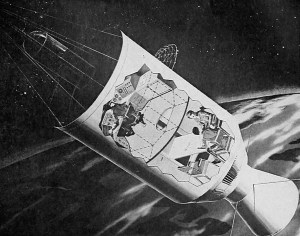
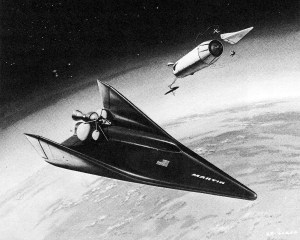
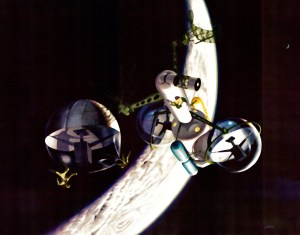
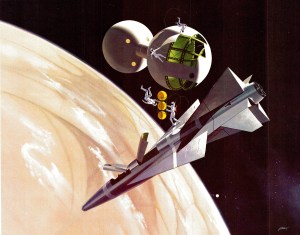
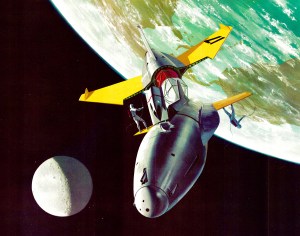
An “extended” Apollo would be able to travel for several months in space. Garrett concepts of environmental system, cryogenic storage, life-support and attitude control can be adapted to this vehicle.
Space World December 1964, VOL. A-14
Image credit: Marquardt Corporation Image source: Numbers Station
The Marquardt Corporation is conducting studies under contract to North American’s Space and Information Systems Division on advanced rocket reaction control systems for Apollo X. The Extended Apollo Mission is depicted above in conjunction with a space laboratory system, one of several concepts to determine additional applications of the Apollo spacecraft by NASA. Marquardt’s four-engine reaction control system cluster is illustrated above on the surface of the Apollo X service module. Similar systems are being developed by Marquardt for the current Project Apollo lunar mission on both the service and lunar excursion module.
Space World April 1965, VOL. B-4.18
Image credit: Marquardt Corporation Image source: Numbers Station
GENERAL DYNAMICS / ASTRONAUTICS artist’s conception of a three-man Manned Astronautical Research Station (MARS) in operation 200 miles above earth. The station in orbit would be linked to a spent Centaur vehicle. The two bodies would rotate about each other, the resulting centrifugal force providing the necessary artificial gravity.
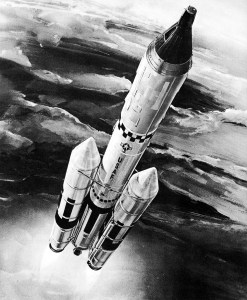
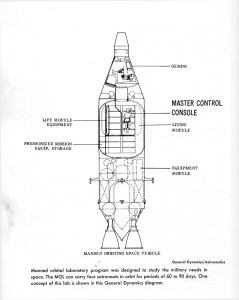
The MOL – Manned Orbiting Laboratory – is shown, in this artist’s view, being lifted into space by the Titan III C. On top of the cylindrical canister, the crew sit in a modified Gemini capsule.
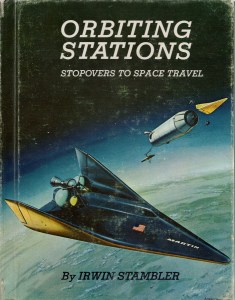
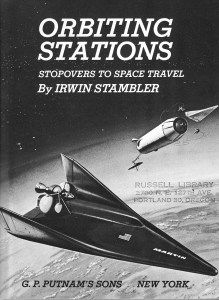
Orbiting Stations: Stopovers to Space Travel Irwin Stambler G.P. Putnam’s Sons, 1965