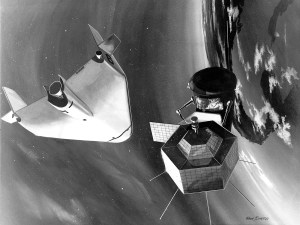
Image credit: McDonnell
Image source: SDASM Archives
Image credit: McDonnell
Image source: SDASM Archives
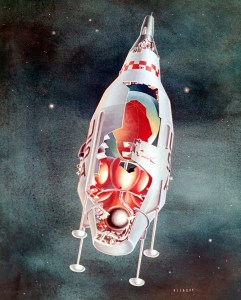
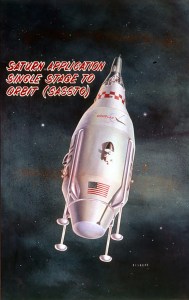
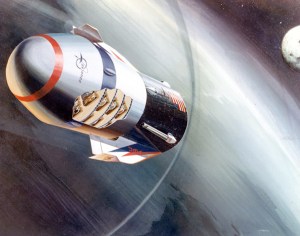
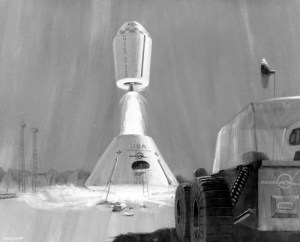
SASSTO (Saturn Application Single-Stage-to-Orbit) combined launch vehicle and spacecraft. Only 62.3 ft (19m.) tall, a single plug-nozzle engine would serve both as launch vehicle and for soft-landing back on Earth after an orbital mission. The craft – seen here with a Gemini two-man capsule – would be recovered intact and could be used repeatedly. It would be a particularly appropriate for ferry missions into Earth-orbit including the emergency rescue of astronauts.
Image credit: Douglas
Images: SDASM Archives
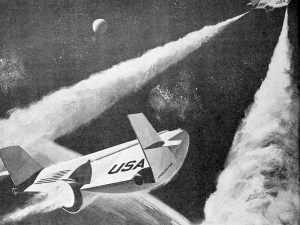
ASTRO — a manned reusable spacecraft concept developed by Douglas Aircraft.
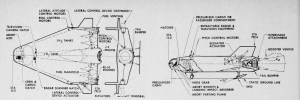
PLAN AND ELEVATION views of ASTRO A2 vehicle. Note booster vehicle attachment at aft end.
Missiles and Rockets, September 3, 1962
Image credit: Douglas
Image source: Internet Archive
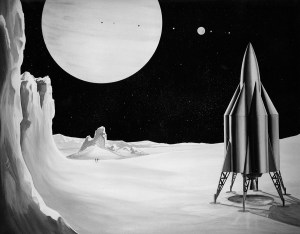
Jupiter Lunar Landing
From one of Jupiter’s 12 moons, earth astronauts gaze on this impressive, but bleak, view of the 86,900 mile-diameter planet. More than 316 times the mass of the Earth, Jupiter is seven times further from the sun than Earth; would require voyage of one to two months to reach at velocity of one million feet per second. Max Hunter, Douglas Aircraft Company engineer predicts economically feasible trips to Jupiter will be made through development of nuclear thrust spaceship engines.
Douglas Aircraft Company, Inc. General Offices, Santa Monica, Calif.
Image credit: Douglas Aircraft Company
Image source: Numbers Station
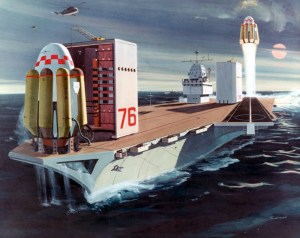
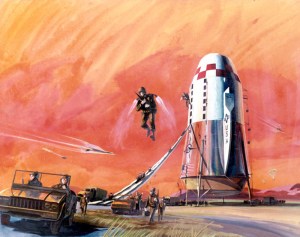
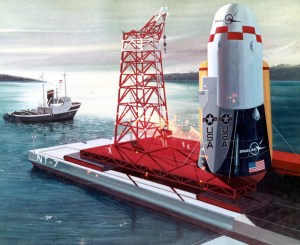
Image credit: Douglas
Image source: SDASM Archives
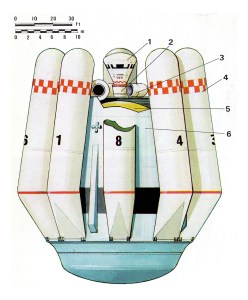
ROMBUS
Configuration for a manned Mars mission (Project Deimos).
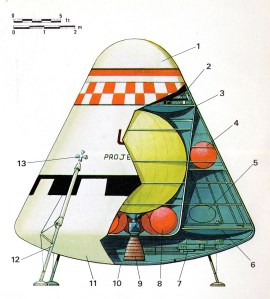
Project Deimos – Mars Landing Module
Frontiers of Space
Philip Bono & Kenneth Gatland
Macmillan, 1969
Image credit: Douglas
Image source: Numbers Station
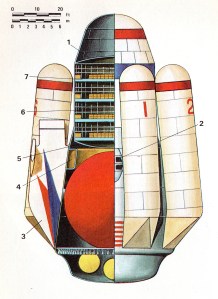
Pegasus Intercontinental Passenger Rocket
Pegasus during atmospheric re-entry uses the LH2-cooled plug nozzle as a heat shield. The ballistic transport would convey 172 passengers and freight 7,456 miles (12,000 km.) in 39 min. without exceeding an acceleration of 3g during ascent or re-entry. At the arrival spaceport it would hover on rocket thrust during a soft landing in the vertical attitude.

Pegasus Passenger Compartment
Frontiers of Space
Philip Bono & Kenneth Gatland
Macmillan, 1969
Image credit: Douglas / Blandford Press
Images: Numbers Station, SDASM Archives


How re-usable ROMBUS-type launch vehicles can be applied to construction of a temporary lunar base (Project Selena).
Frontiers of Space is peppered with artwork from Douglas, including paintings by Don Charles and James Finnell. In the book, this section was illustrated with (pretty poor) knock-offs. Why? Who knows? These were the masters.
Image credit: Douglas
Image source: SDASM Archives
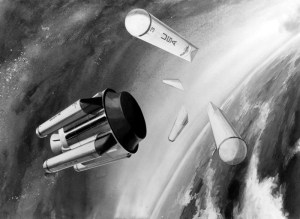
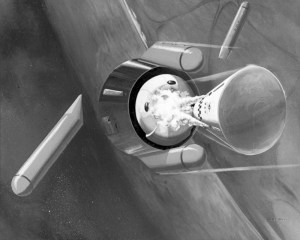
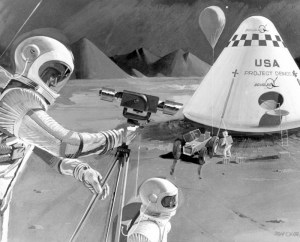
Mission to Mars (Project Deimos)
Frontiers of Space
Philip Bono & Kenneth Gatland
Macmillan, 1969
Image credit: Douglas
Image source: SDASM Archives
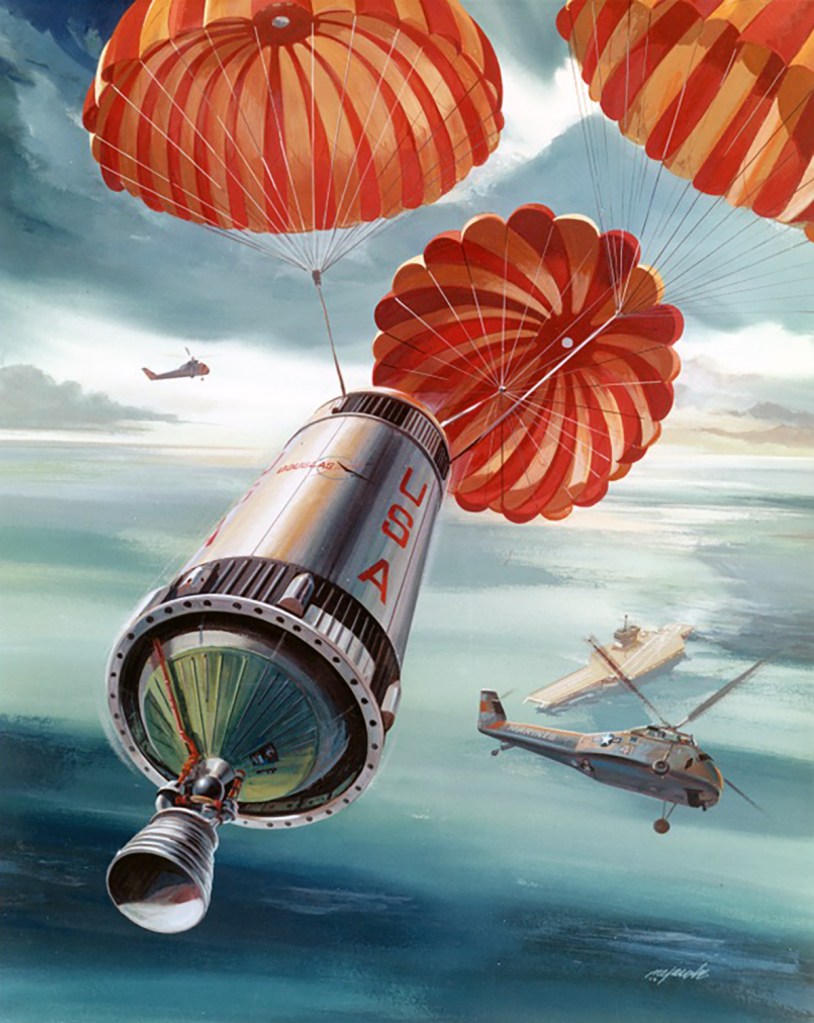
Image credit: Douglas
Image source: SDASM Archives