Image credit: NASA JSC
Image source: NASA Images
Image credit: NASA JSC
Image source: NASA Images
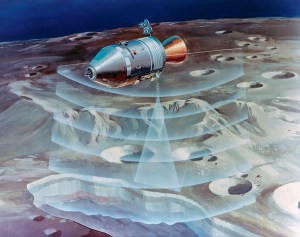
S72-53472 (November 1972) — An artist’s concept illustrating how radar beams of the Apollo 17 lunar sounder experiment will probe three-quarters of a mile below the moon’s surface from the orbiting spacecraft. The Lunar Sounder will be mounted in the SIM bay of the Apollo 17 Service Module. Electronic data recorded on film will be retrieved by the crew during trans-Earth EVA. Geologic information on the lunar interior obtained by the sounder will permit scientific investigation of underground rock layers, lava flow patterns, rille (canyon) structures, mascon properties, and any areas containing water. A prototype lunar sounder has been flight tested in aircraft over selected Earth sites to confirm the equipment design and develop scientific analysis techniques. The Lunar Sounder Experiment (S-209) was developed by North American Rockwell’s (NR) Space Division for NASA’s Manned Spacecraft Center to provide data for a scientific investigation team with representatives from the Jet Propulsion Laboratory, University of Utah, University of Michigan, U.S. Geological Survey, and NASA Ames Research Center.
Image credit: NASA JSC
Image source: NASA Images
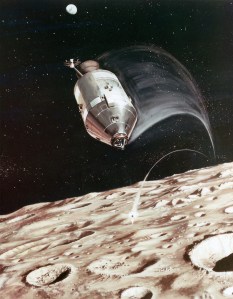
Image credit: NASA
Image source: Numbers Station
Image credit: NASA Johnson
Image source: NASA Images
Image credit: NASA Johnson
Image source: NASA Images
Image credit: Ryan Aeronautical
Image source: SDASM Archives
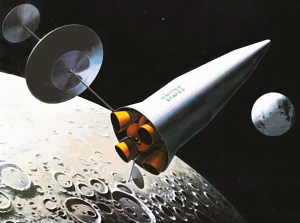
Image credit: General Electric
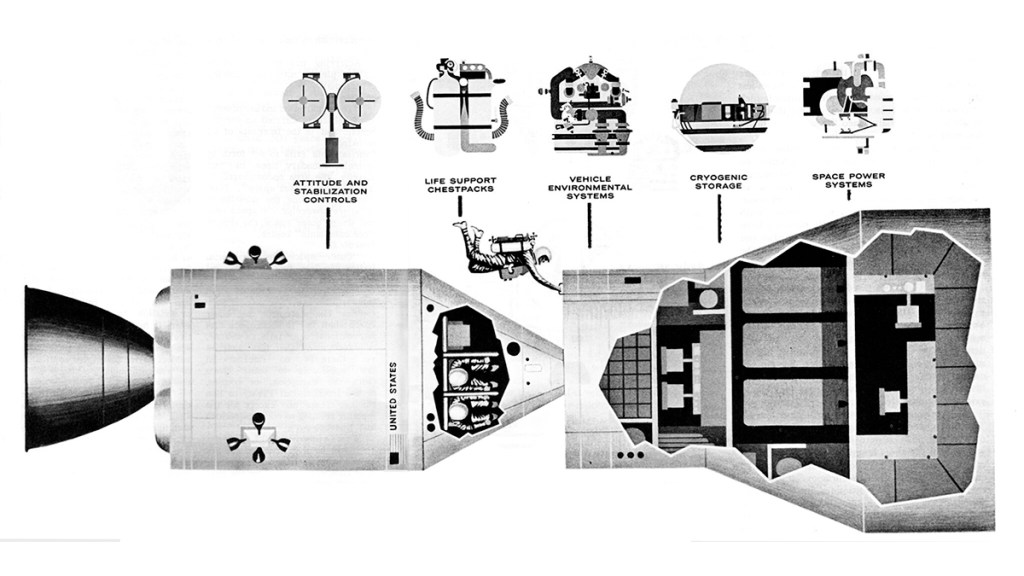
An “extended” Apollo would be able to travel for several months in space. Garrett concepts of environmental system, cryogenic storage, life-support and attitude control can be adapted to this vehicle.
Space World
December 1964, VOL. A-14
Image credit: Marquardt Corporation
Image source: Numbers Station

The Marquardt Corporation is conducting studies under contract to North American’s Space and Information Systems Division on advanced rocket reaction control systems for Apollo X. The Extended Apollo Mission is depicted above in conjunction with a space laboratory system, one of several concepts to determine additional applications of the Apollo spacecraft by NASA. Marquardt’s four-engine reaction control system cluster is illustrated above on the surface of the Apollo X service module. Similar systems are being developed by Marquardt for the current Project Apollo lunar mission on both the service and lunar excursion module.
Space World
April 1965, VOL. B-4.18
Image credit: Marquardt Corporation
Image source: Numbers Station
see also:
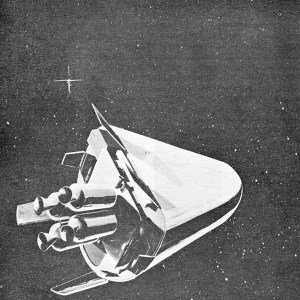
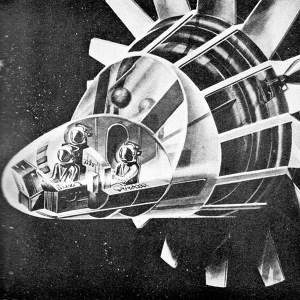
L. Apollo is pictured here by an artist of The Martin Co., one of three leading Space Age manufacturers awarded study contracts on project by NASA. Apollo was a god of Ancient Greece, son of Clymene and Titan. This is nicely appropriate, since Martin produces the mighty Titan intercontinental ballistic missile.
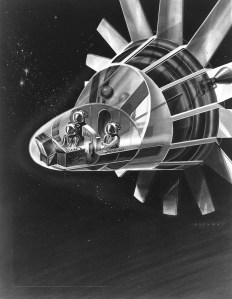
R. The Apollo lunar spacecraft planned to carry 3 crewmen on round trip between earth and the moon is shown above here enroute among the stars. Protruding fan-shapes are solar arrays to gather energy from sun for use aboard. Apollo was said to have been the triumphant participant in Olympic games. Homer called him the “god of prophecy.”
America’s Mightiest Missile
by Larry Eisinger
Arco Publishing, 1961
Image credit: NASA
Image source(s): Mike Acs, Numbers Station
Image credit: NASA
Image source: Drew Granston