Single-Stage-to-Orbit

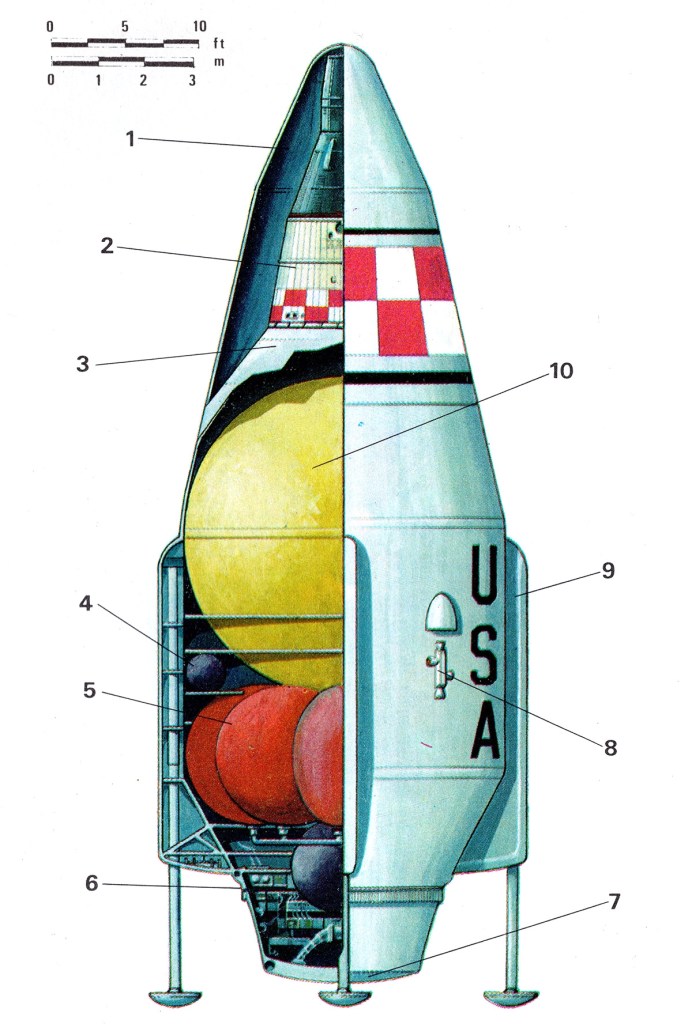
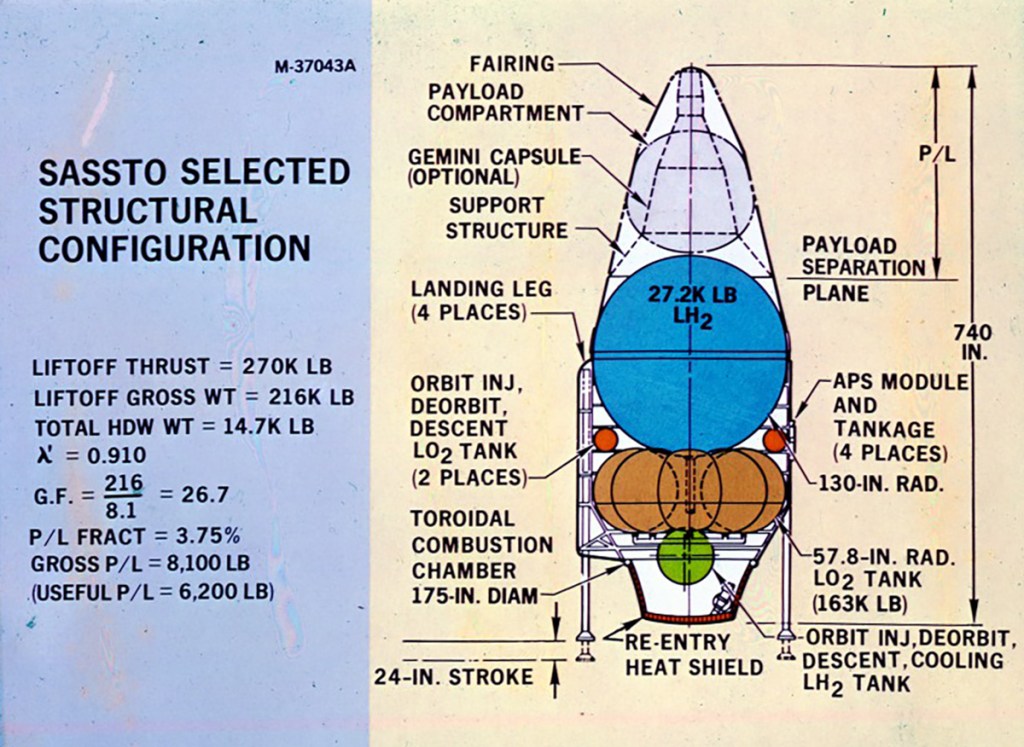
  1. Optional fairing around the two-man Gemini Capsule;
  2. Gemini adapter section;
  3. Transition support structure;
  4. Orbit injection / retro and control propellant tanks (6);
  5. Toroidal liquid-oxygen tank;
  6. Annular combustion chamber;
  7. Truncated plug nozzle and re-entry heat shield;
  8. Attitude-control system (4);
  9. Retractable landing legs (4);
  10. Spherical liquid-hydrogen propellant tank.

Frontiers of Space
Philip Bono & Kenneth Gatland
Macmillan, 1969

Image credit: Douglas
Images: Numbers Station
Phil Santos

Image credit: Douglas
Image source: SDASM Archives

All-Purpose Space Vehicle

  1. All-purpose space vehicle proposed by Douglas Missile & Space Systems Division engineer Phil Bono, is pictured in artist’s concept during refueling in earth orbit prior to flight to the moon.
  2. Refueling tankers, on either side will return to earth. Vehicle carries up to eight “strap-on” liquid hydrogen tanks, which can be ejected after they are emptied or retained for use on moon. Retro engines are fire as spacecraft nears lunar surface to allow a direct landing without an orbital maneuver. All-purpose space vehicle proposed by Douglas Missile & Space Systems Division engineer Phil Bono, is pictured in artist’s concept during refueling in earth orbit prior to flight to the moon.
  3. Empty strap-on tanks are lowered to lunar surface before each return flight.
  4. These liquid hydrogen tanks could be used as shelter for pioneering lunar colony.

Space World
December 1964, VOL. A-14

Image credit: Douglas
Image source: Numbers Station

SASSTO

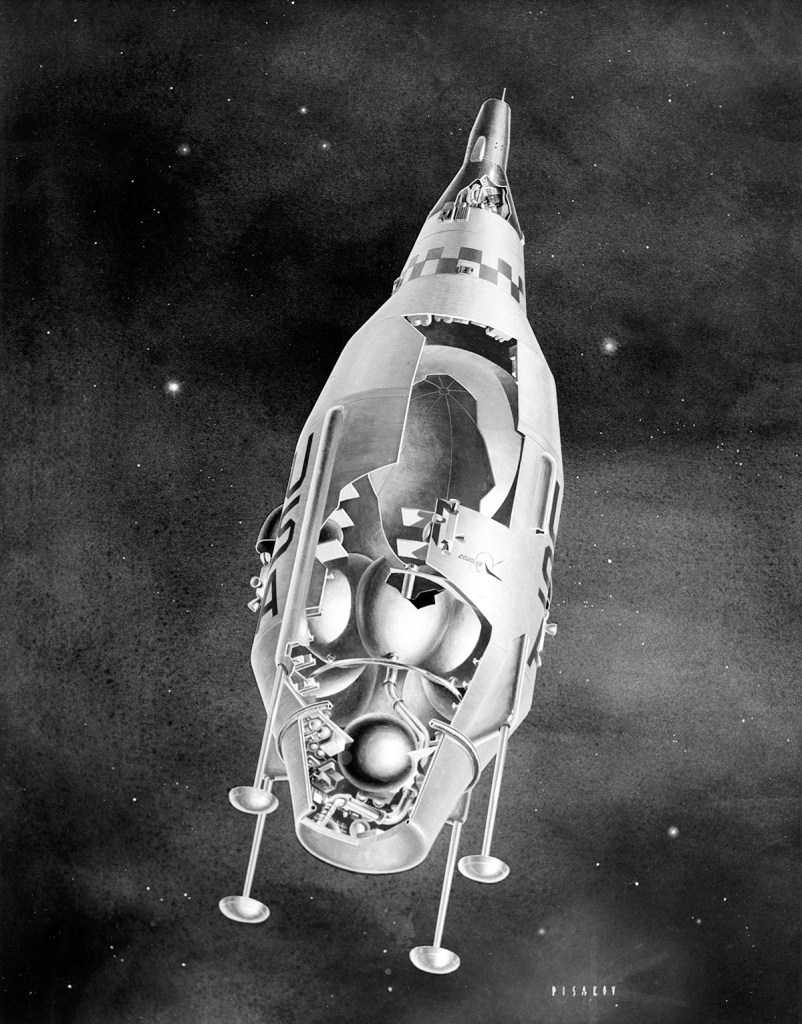
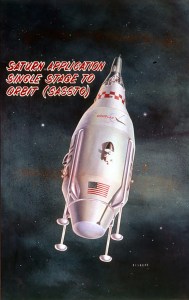
SASSTO (Saturn Application Single-Stage-to-Orbit) combined launch vehicle and spacecraft. Only 62.3 ft (19m.) tall, a single plug-nozzle engine would serve both as launch vehicle and for soft-landing back on Earth after an orbital mission. The craft – seen here with a Gemini two-man capsule – would be recovered intact and could be used repeatedly. It would be a particularly appropriate for ferry missions into Earth-orbit including the emergency rescue of astronauts.

Image credit: Douglas
Images: SDASM Archives