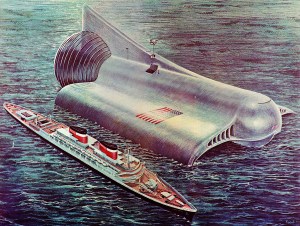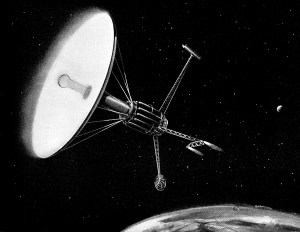
Complex space vehicles from Earth in orbit around Mars some time in the late 70’s, as visualized by today’s engineers.
The Next Fifty Years in Space
by Erik Bergaust
Macmillan, 1964
Image credit: Rocketdyne
Image source: Numbers Station
Complex space vehicles from Earth in orbit around Mars some time in the late 70’s, as visualized by today’s engineers.
The Next Fifty Years in Space
by Erik Bergaust
Macmillan, 1964
Image credit: Rocketdyne
Image source: Numbers Station
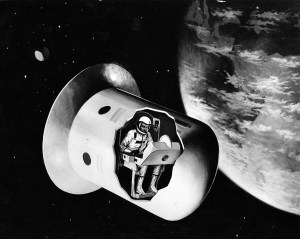
Image credit: General Electric
Image source: Numbers Station
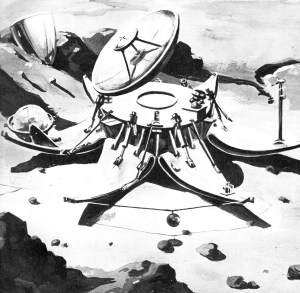
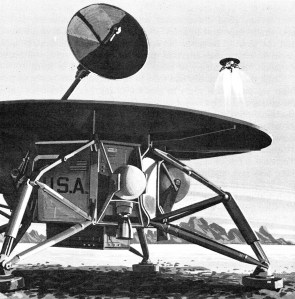
Prime goal of Project Viking is this National Aeronautics and Space Administration sketch, to land a biological laboratory on the surface of Mars. The picture shows a design in which the protective housing around the experiments unfolds in petal fashion once the laboratory is safely on the Martian surface.
Project Viking: Space Conquest Beyond the Moon
by Irwin Stambler
G.P. Putnam’s Sons, 1970
Image credit: NASA
Image source: Numbers Station
Project Viking: Space Conquest Beyond the Moon
by Irwin Stambler
G.P. Putnam’s Sons, 1970
Image credit: NASA
Image source: Numbers Station
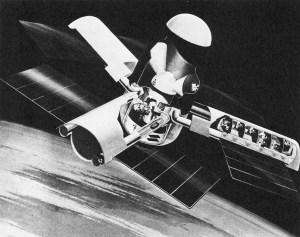
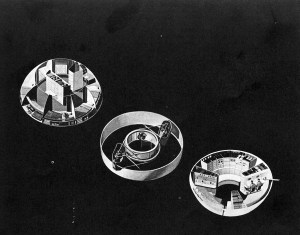
Three-armed LORL is shown in this artist’s sketch. Center hub, which contains parking area for several space ferries, does not rotate and thus remains weightless. Under the parking area is a laboratory for study of weightlessness. The three arms rotate around the hub to create artificial gravity. Cutaway of one arm shows it to contain a series of rooms for other laboratory requirements and studies.
Orbiting Stations: Stopovers to Space Travel
Irwin Stambler
G.P. Putnam’s Sons, 1965
Image credit: Lockheed
Image source: Numbers Station


Space World
December 1964, VOL. A-14
Image credit: Douglas
Image source: Numbers Station
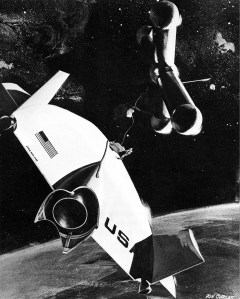
Space delivery – The partnership of the space ferry and the manned laboratory is demonstrated in this sketch. Here astronauts in a Douglas Astro ferry approach a huge space station with fresh supplies of food and test equipment. Eventually, experimental orbiting stations may give way to orbiting terminals for space travelers of the future.
Orbiting Stations: Stopovers to Space Travel
Irwin Stambler
G.P. Putnam’s Sons, 1965
Image credit: Douglas
Image source: Numbers Station
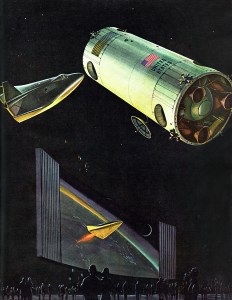
A spaceport and supply rocket designed by the Martin Marietta Corporation in mid-air in this scene from the Hall of Science space show. In such a port, astronauts may orbit for half a year.
New York World’s Fair 1964/1965
Official Souvenir Book
Time Life, 1964
Image credit: Martin Marietta
Image source: Numbers Station

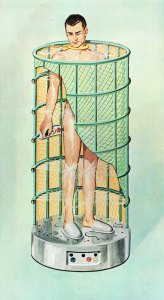
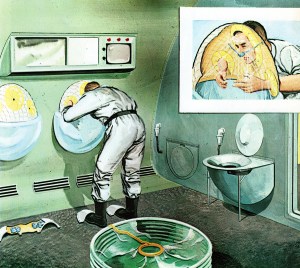
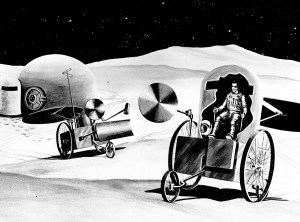
Space World
December 1964, VOL. A-14
Image credit: Space World
Image source: Numbers Station
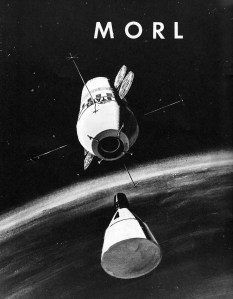
Space World
November 1964, VOL. A-13
Image credit: Douglas
Image source: SDASM Archives

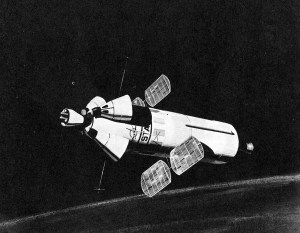
A manned orbital space space laboratory would be able to operate for several months without resupply. Basic Garrett-AiResearch systems could be slightly modified to meet requirements for environmental control, life support, cryogenic storage, power and attitude control for both the command module and laboratory.
Space World
December 1964, VOL. A-14
Image credit: Garrett-AiResearch
Image source: Numbers Station