Get To Da Choppa!

Project Viking: Space Conquest Beyond the Moon
by Irwin Stambler
G.P. Putnam’s Sons, 1970

Image credit: NASA
Image source: Numbers Station

Viking by Russ Arasmith

Image credit: NASA
Image source: Mike Acs
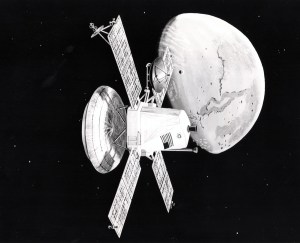
Viking

Image credit: NASA
Image source: Mike Acs

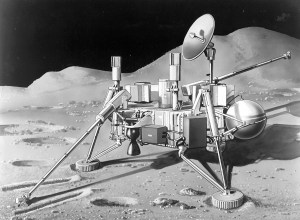
A Laboratory on Mars

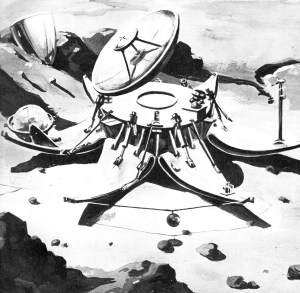
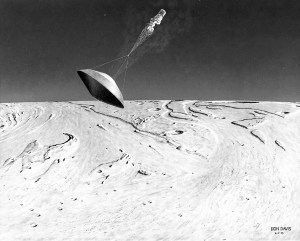
Prime goal of Project Viking is this National Aeronautics and Space Administration sketch, to land a biological laboratory on the surface of Mars. The picture shows a design in which the protective housing around the experiments unfolds in petal fashion once the laboratory is safely on the Martian surface.

Project Viking: Space Conquest Beyond the Moon

by Irwin Stambler
G.P. Putnam’s Sons, 1970

Image credit: NASA
Image source: Numbers Station
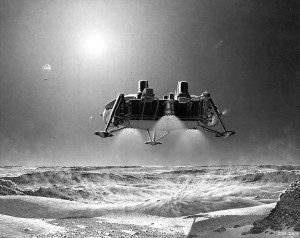
Boeing Viking

Project Viking: Space Conquest Beyond the Moon
by Irwin Stambler
G.P. Putnam’s Sons, 1970

Image credit: NASA
Image source: Numbers Station
LORL (Lockheed)

Three-armed LORL is shown in this artist’s sketch. Center hub, which contains parking area for several space ferries, does not rotate and thus remains weightless. Under the parking area is a laboratory for study of weightlessness. The three arms rotate around the hub to create artificial gravity. Cutaway of one arm shows it to contain a series of rooms for other laboratory requirements and studies.

Orbiting Stations: Stopovers to Space Travel
Irwin Stambler
G.P. Putnam’s Sons, 1965

Image credit: Lockheed
Image source: Numbers Station

All-Purpose Space Vehicle

  1. All-purpose space vehicle proposed by Douglas Missile & Space Systems Division engineer Phil Bono, is pictured in artist’s concept during refueling in earth orbit prior to flight to the moon.
  2. Refueling tankers, on either side will return to earth. Vehicle carries up to eight “strap-on” liquid hydrogen tanks, which can be ejected after they are emptied or retained for use on moon. Retro engines are fire as spacecraft nears lunar surface to allow a direct landing without an orbital maneuver. All-purpose space vehicle proposed by Douglas Missile & Space Systems Division engineer Phil Bono, is pictured in artist’s concept during refueling in earth orbit prior to flight to the moon.
  3. Empty strap-on tanks are lowered to lunar surface before each return flight.
  4. These liquid hydrogen tanks could be used as shelter for pioneering lunar colony.

Space World
December 1964, VOL. A-14

Image credit: Douglas
Image source: Numbers Station
Space-Age Station

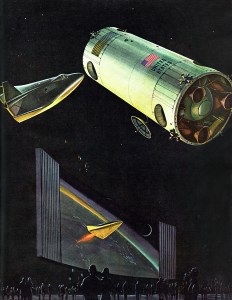
A spaceport and supply rocket designed by the Martin Marietta Corporation in mid-air in this scene from the Hall of Science space show. In such a port, astronauts may orbit for half a year.

New York World’s Fair 1964/1965
Official Souvenir Book
Time Life, 1964

Image credit: Martin Marietta
Image source: Numbers Station
Preliminary Conception

Missiles and Rockets, Feb 10, 1964

Image credit: USAF
Image source: Internet Archive
MORL

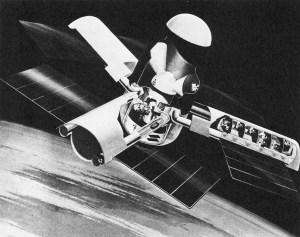
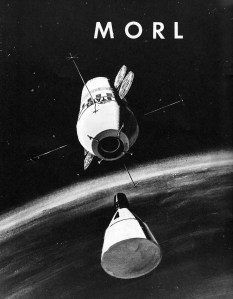
  1. CONCEPT OF A MANNED ORBITING RESEARCH LABORATORY, which has been under research study by the National Aeronautics and Space Administration, is illustrated in this artist’s rendering. The concept evolved from by the Douglas Missile & Space Administration under contract to the NASA Langley Research Center. Douglas engineers believe the concept could be operational within a five-year period. A Gemini-type ferry-craft approaches the orbiting laboratory, which is designed to remain in a 200 nautical-mile earth orbit for a period of a year or more.
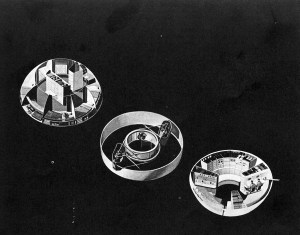
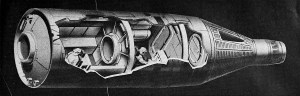
  2. One concept of a Manned Orbiting Research Laboratory (MORL), which has been under research study for the National Aeronautics and Space Administration, would occupy a cylinder 260 inches in diameter. Inside the cylinder, a spherical vessel might house living and work spaces and an on-board centrifuge for maintaining crew fitness. In this artist’s concept, evolved by Douglas Aircraft Company’s Missile & Space Systems Division under NASA contract, living quarters are shown on the upper left, a centrifuge in the center, and working area at the right. The Douglas concept is based on the Saturn IB launch vehicle.
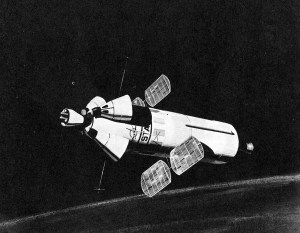
  3. MANNED ORBITING RESEARCH LABORATORY (MORL) concept, which has been under research study by National Aeronautical and Space Administration, is pictured in a 200 nautical-mile earth orbit in this artist’s rendering. The concept evolved from studies made by Douglas Aircraft Company’s Missile & Space Division under contract to the NASA Langley Research Center. A Gemini-type ferry craft which might transport crew and supplies from Earth is docked in a hangar in the laboratory’s nose cone. Once rendezvous and docking are complete, the hangar can be sealed and pressurized and the astronauts can enter the MORL. Paddle-like devices attached to the orbiting laboratory are solar cell arrays to convert energy from the sun. They would be unfolded after MORL was in orbit.

Space World
November 1964, VOL. A-13

Image credit: Douglas
Image source: SDASM Archives