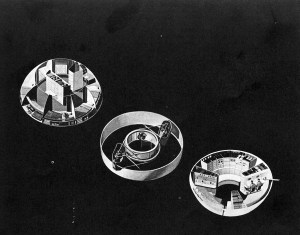
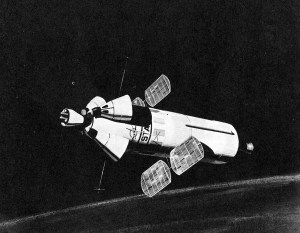
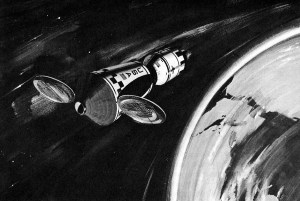
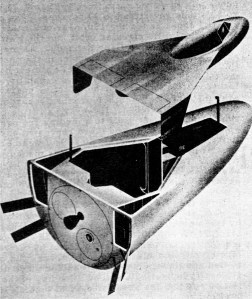
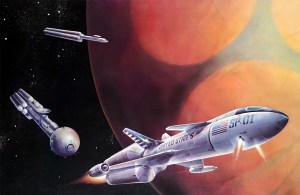
- All-purpose space vehicle proposed by Douglas Missile & Space Systems Division engineer Phil Bono, is pictured in artist’s concept during refueling in earth orbit prior to flight to the moon.
- Refueling tankers, on either side will return to earth. Vehicle carries up to eight “strap-on” liquid hydrogen tanks, which can be ejected after they are emptied or retained for use on moon. Retro engines are fire as spacecraft nears lunar surface to allow a direct landing without an orbital maneuver. All-purpose space vehicle proposed by Douglas Missile & Space Systems Division engineer Phil Bono, is pictured in artist’s concept during refueling in earth orbit prior to flight to the moon.
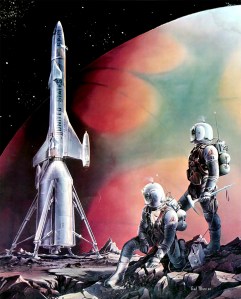
- Empty strap-on tanks are lowered to lunar surface before each return flight.
- These liquid hydrogen tanks could be used as shelter for pioneering lunar colony.
Space World
December 1964, VOL. A-14
Image credit: Douglas
Image source: Numbers Station