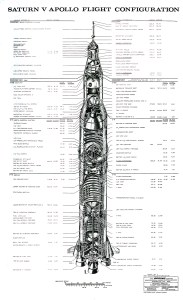
Apollo Flight Configuration

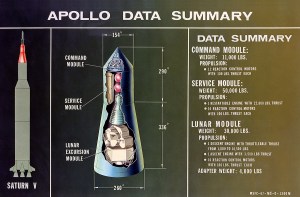
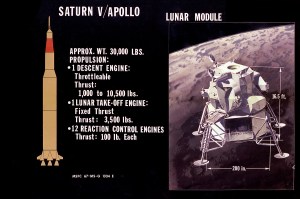
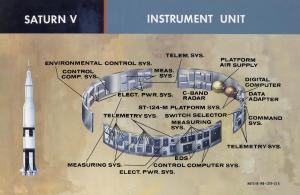
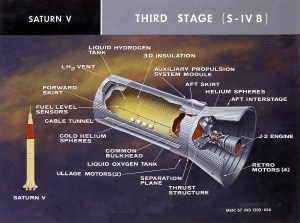
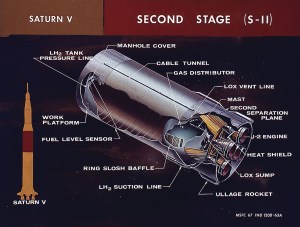
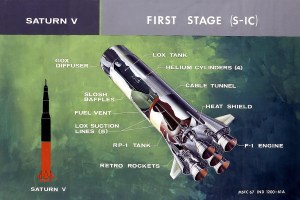
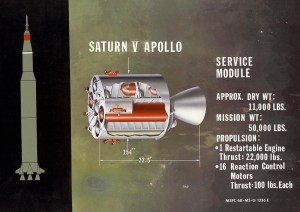
The Saturn V configuration is shown in inches and meters as illustrated by the Boeing Company. The Saturn V vehicle consisted of three stages: the S-IC (first) stage powered by five F-1 engines, the S-II (second) stage powered by five J-2 engines, the S-IVB (third) stage powered by one J-2 engine. A top for the first three stages was designed to contain the instrument unit, the guidance system, the Apollo spacecraft, and the escape system. The Apollo spacecraft consisted of the lunar module, the service module, and the command module. The Saturn V was designed perform lunar and planetary missions and it was capable of placing 280,000 pounds into Earth orbit.

Image credit: NASA MSFC
Image source: NASA Images
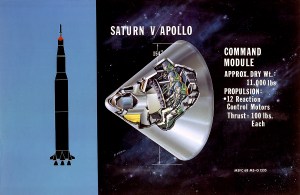
Saturn V Apollo

Image credit: NASA MSFC
Image source: NASA Images
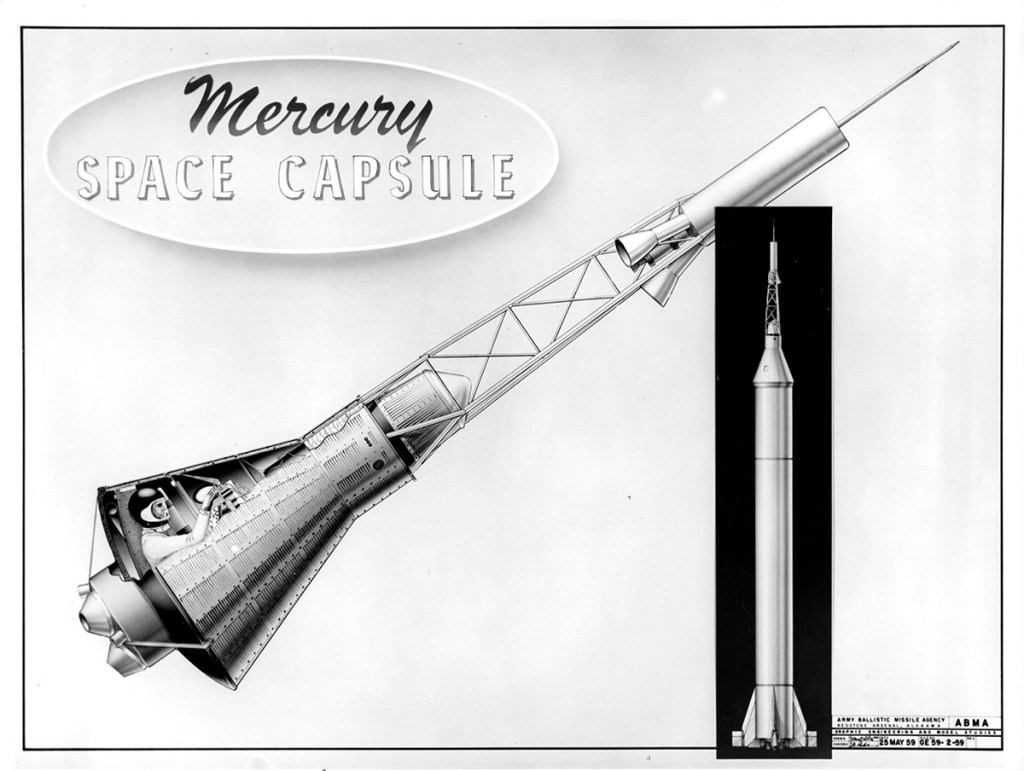
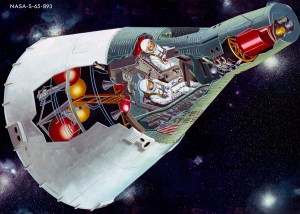
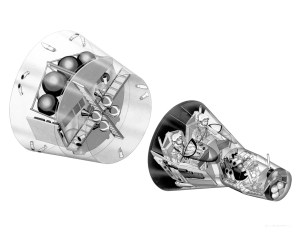
Mercury Space Capsule

Image credit: ABMA
Image source: Numbers Station

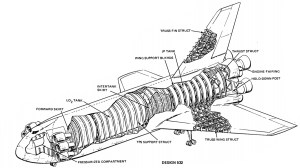
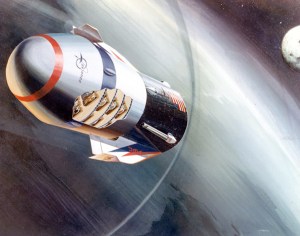
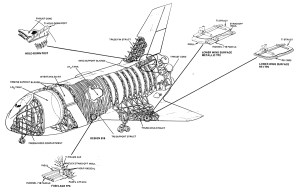
532 Flyback Booster

Image credit: Grumman
File source: NASA NTRS

Inside Deimos

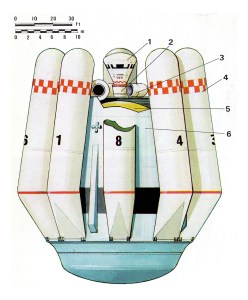
ROMBUS

Configuration for a manned Mars mission (Project Deimos).

  1. Six man Mars landing capsule;
  2. Pressurized tunnel;
  3. Toroidal living compartment;
  4. Liquid hydrogen tanks (8);
  5. Spherical liquid oxygen tank
  6. Booster centerbody.

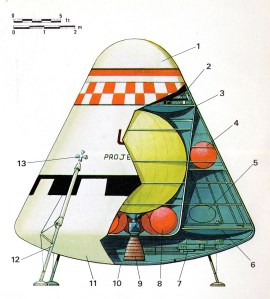
Project Deimos – Mars Landing Module

  1. Earth-return capsule;
  2. Command centre and pressurized tunnel;
  3. Separation joint, for return to Mars orbit;
  4. Mars landing propellant tanks(6);
  5. Ground access hatch;
  6. Mars-launch platform;
  7. Payload and power supply equipment compartment;
  8. Mars-launch propellant tank;
  9. Landing and take-off rocket motor;
  10. Jettisonable closure panel;
  11. Mars-entry heat shield;
  12. Extensible landing gear(4);
  13. Altitude-control system quads (4).

Frontiers of Space
Philip Bono & Kenneth Gatland
Macmillan, 1969

Image credit: Douglas
Image source: Numbers Station

Pegasus Cutaway & Plan

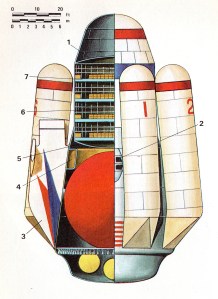
Pegasus Intercontinental Passenger Rocket

  1. Forward pressure dome;
  2. Two-man crew compartment;
  3. Re-entry stabilization fines (2);
  4. Cargo compartment;
  5. Aft pressure dome;
  6. Pressurized cabin for passengers (170);
  7. Deck structure (4) with passenger couches (43 each).

Pegasus during atmospheric re-entry uses the LH2-cooled plug nozzle as a heat shield. The ballistic transport would convey 172 passengers and freight 7,456 miles (12,000 km.) in 39 min. without exceeding an acceleration of 3g during ascent or re-entry. At the arrival spaceport it would hover on rocket thrust during a soft landing in the vertical attitude.

Pegasus Passenger Compartment

  1. Four-level passenger access doors (3);
  2. Stairways (2) connecting four passenger decks;
  3. Double-wall acoustic damping structure;
  4. Luggage racks (9);
  5. Re-entry stabilization fins (2).

Frontiers of Space
Philip Bono & Kenneth Gatland
Macmillan, 1969

Image credit: Douglas / Blandford Press
Images: Numbers Station, SDASM Archives

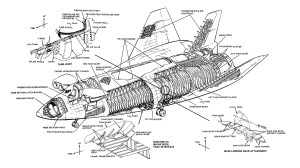
518 Flyback Booster

Image credit: Grumman
File source: NASA NTRS