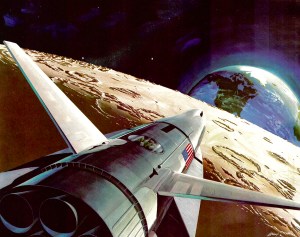
Image credit: Northrop
Image source: Numbers Station
Image credit: Northrop
Image source: Numbers Station


Space World
December 1964, VOL. A-14
Image credit: Douglas
Image source: Numbers Station
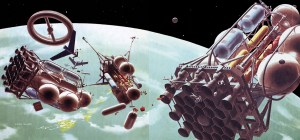
Weightless in orbit 1,075 miles above earth, workers in space assemble three moon ships. Hawaiian Islands lie below. Winged transports unload near wheel-shaped space station top left. Engineers and equipment cluster around cargo ship lower left, passenger ship center and right.
Man on the Moon
Collier’s, October 18,1952
Image credit: Colliers
Image source: AIAA Houston
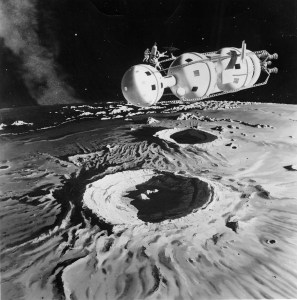
The first trip to our moon will be without landing, in a ship designed to travel in space only, taking off near the Space Station and returning to it. Here the round-the-moon ship is some 240,000 miles from earth, 50 miles above the lunar surface. The large crater is Aristillus (diameter 35 miles); the other crater is Autolycus; the distant mountains are the lunar Apennines.
Man will Conquer Space Soon
Collier’s, March 22, 1953
Image credit: Collier’s
Image source: Mike Acs
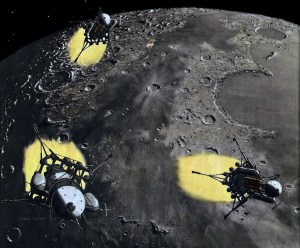
Landing on the moon. Ten minutes before touchdown, rocket motors are switched on to slow down ships’ high-speed fall caused by the moon’s gravity. Vehicles are maneuvering 550 miles above landing area known as Sinus Roris (Dewy Bay), dark plain above cargo ship in lower left.
Man on the Moon
Collier’s, October 18,1952
Image credit: Colliers
Image source: AIAA Houston
see also:
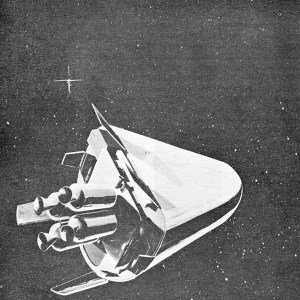
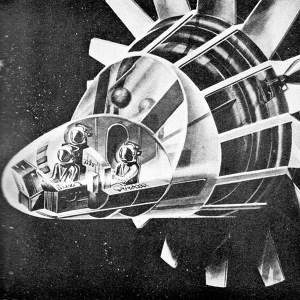
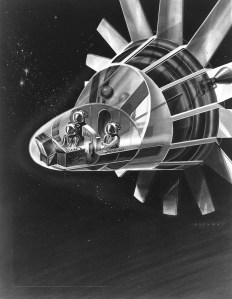
L. Apollo is pictured here by an artist of The Martin Co., one of three leading Space Age manufacturers awarded study contracts on project by NASA. Apollo was a god of Ancient Greece, son of Clymene and Titan. This is nicely appropriate, since Martin produces the mighty Titan intercontinental ballistic missile.
R. The Apollo lunar spacecraft planned to carry 3 crewmen on round trip between earth and the moon is shown above here enroute among the stars. Protruding fan-shapes are solar arrays to gather energy from sun for use aboard. Apollo was said to have been the triumphant participant in Olympic games. Homer called him the “god of prophecy.”
America’s Mightiest Missile
by Larry Eisinger
Arco Publishing, 1961
Image credit: NASA
Image source(s): Mike Acs, Numbers Station
